

Walkers for Older Adults: Standard, Rollator or Reciprocal, Which One Is Right for Your Parent's Stability?
Article Category: General Wellness
Article by: Ridhi
Jul 24, 2026
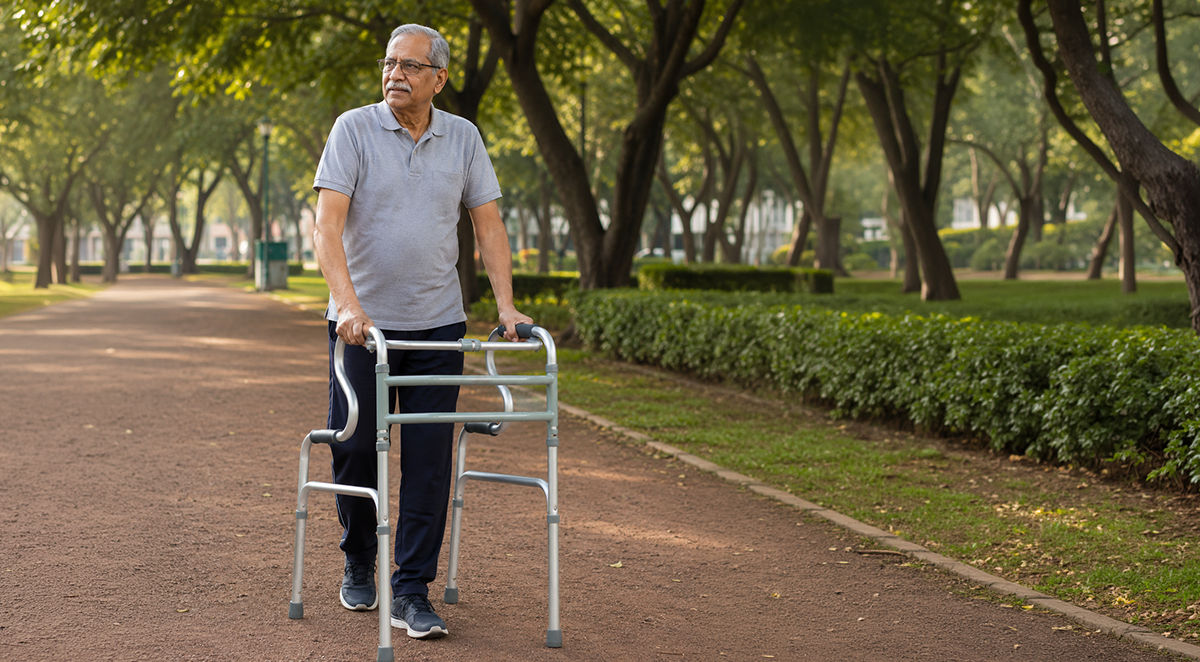
Not every walker provides safety for older adults. The wrong walker can make walking more difficult, and most families find this out when the walker is sitting in the closet and their parent still feels unsteady while walking.
Purchasing a walker seems easy, but it is quite the opposite. If you were to walk to the nearest store, you would find 3 types of walkers: standard, rollator, and reciprocal. All of them claim to improve walking and mobility challenges, yet none of them clearly describes which one is meant for what kind of mobility challenge.
The most technologically advanced walker isn't always the best option. Choosing a walker based on the number of wheels, folding frames, color, etc is the recipe for making a poor choice.
The better question to ask is what type of support does your parent need?
Still unsure yet? Then break down the question even further.
- Do they need stability with every step?
- Do they get tired easily on walks?
- Are their hands and arms strong enough to control the wheeled walker before it rolls away?
- Is the primary problem balance, strength, or coordination?
Walkers are designed to solve specific mobility challenges. Your selection should focus on the specific challenge that your parent is facing.
Selecting the wrong walker for your parent will make them feel more unsteady and insecure. Making the right choice will ensure that they walk with more confidence, stay active for a longer period of time, and their risk of falling would reduce.
This article helps you understand the difference in standard walkers, rollators, and reciprocal walkers. It covers the needs of different types of users to help you choose the right walker based on your parent's strength, balance, and mobility requirements.
How Walkers Differ From Each Other
The 3 types of walkers are positioned on a continuum.
On one end, you have the most stability with the greatest slowness. On the other, you have speed and endurance but with less inherent stability.
Determining where your parent belongs on that continuum depends on their strength, balance, and how far they walk each day.
Standard Walker
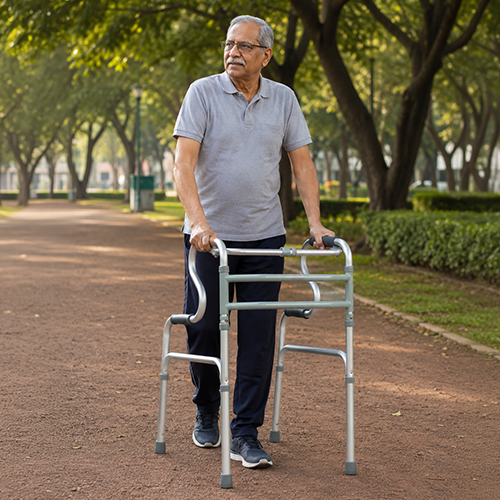
A standard walker has no wheels, and four rubber-tipped legs. The parent must lift the entire frame, place it in front of them, and step into it. Because of this, nothing rolls and nothing moves until they do.
This design gives your parent the most stability of any walker. While your parent moves their center of mass forward, all four legs are kept on the ground. This fixed support is very important for those that are recovering from a hip or knee replacement or for someone that has a significant loss of balance.
The trade-off here is a lot of effort. For each step/frame lift, it takes upper body strength and disrupts one's natural walking pattern. For older adults suffering from shoulder pain, hand arthritis, or those that tend to have low stamina, this is also very draining. It is also not practical for use on uneven outdoor surfaces.
Choose a standard walker if your parent primarily walks indoors, arm strength for lifting the frame multiple times is a must, walks only short distances, and most importantly, needs to weight bear through their arms.
Reciprocal or Two-Step Walker
A reciprocal walker is like a standard walker but has hinged sides. Your parent moves one side forward, takes a step, and then moves the other side. During this process, one half of the frame stays on the ground.
This is appropriate for older adults who find the lift-and-place movement of standard walkers either awkward or tiring. As the movement is alternating, it encourages a more natural walking rhythm. This reduces the jolting weight shifts that can be distressing for individuals with balance problems.
An example is the AGEasy Step Walker for Elders, which incorporates this design. It features a step-by-step mechanism that is designed to promote a natural walking rhythm, an adjustable height feature for optimal ergonomic positioning, and handle grips that reduce hand fatigue during prolonged use. This design is preferred by family members of customers with arthritis. Since this style can be used with significantly less strain on the joints, it is better than conventional walkers that are more demanding to use.
However, reciprocal walkers necessitate a certain level of coordination. Your parent will have to do a side alternating movement with the left and right sides. For individuals with cognitive decline or difficulty executing tasks that include several steps, this may pose additional challenges and may create confusion instead of offering assistance.
Rollator
A rollator has 3 or 4 wheels, hand brakes, and often has a padded seat. Nothing gets lifted. Your parent pushes it and walks.
This is the right choice for someone whose main issue is endurance, rather than balance. If your parent walks steadily, but tires after 10 minutes, or gets breathless on the way back from the market, a rollator allows them to rest without looking for a bench. The AGEasy Rollator with Seat is built around this understanding, providing a stable rolling frame with a seat.
The requirement is control. Your parent must squeeze and hold the brakes, which is especially crucial on slopes or before sitting. Weak grip, poor hand coordination, or slow reaction time is what makes a rollator dangerous. A rollator will not stop someone from falling if they lean on it too much. It rolls away, and they go down.
Never choose a rollator for someone who needs to put real weight through their arms. It is a walking aid, not a support frame.
Matching the Walker to the Real Problem
Work backwards from what your parent struggles with.
If it's balance, they need contact with the ground. A standard or reciprocal walker provides that. A rollator does not.
If it is bilateral weakness after a stroke, a physiotherapist should see them before you buy anything. Asymmetric weakness alters which side takes the load, and the wrong frame will reinforce a poor gait pattern.
In the case where stamina is the issue, it can be directly solved with a rollator that comes with a seat.
As for the issue where the individual lacks the confidence to use a walker, a walking stick is often a sufficient alternative. If a walker is prescribed at this point in time, it will be increasing reliance for those independent. AGEasy sells pivot walking sticks and stick-with-seat options for those that are looking for a compromise.
Pain in the joints whilst walking can be bothersome, however, pain relief and an aid for mobility should be used in conjunction with one another. AGEasy knee supports for pain relief are intended to be used with a walker and should not be relied upon for a solution.
Getting the Fit Right
Choosing the right walker can come undone, if it isn't fitted properly.
When the arms are by the side, the handle height should be at the wrist crease. The elbows should be bent between 15 to 20 degrees. If the position of the handles is too low, that is going to cause them to stoop and this is going to put a lot of weight on the front and encourage them to fall. If the handles are too high this is going to tire the shoulders greatly as they will have to elevate them to these positions.
If the rubber tips are worn out, they will slip - replace them often. You will also need to adjust the brakes on your rollator to guarantee that they work freely and engage firmly.
They should walk behind the frame of the walker and not step back from the front. Walking behind the walker is a common habit and this will often lead to them falling.
Safety Around the House
There are limitations to where the walker can assist. For Indian homes with narrow bathrooms, ensure you measure your doorways and spaces before purchasing the walker. Repeatedly clearing the path of loose rugs, extension cords, and clutter is essential as this is where the walker will assist them the most.
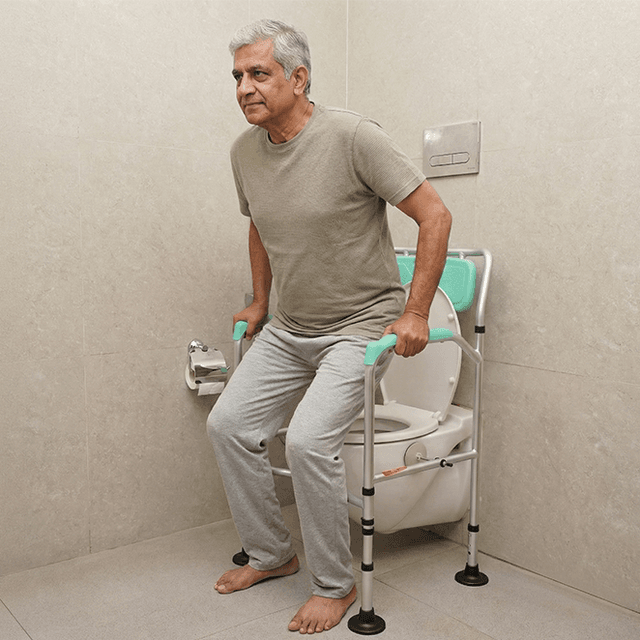
The restrooms require special consideration. Most walkers cannot be used on wet floors, therefore grab bars on the toilet and inside the shower are as important as the walker. Raised toilet seats alleviate the strain of sitting and standing for individuals that experience knee problems.
When to Involve a Professional
If your parent has had a fall in the last six months, has Parkinson's or another neurological condition, has had a stroke, is post-op (surgery), has a history of dizziness or fainting, or has vision issues, do not choose a walker before consulting a physician or physiotherapist.
If your parent has experienced a rapid decline in walking ability over a period of days or weeks, has new weakness in the legs, has new pain that alters their gait, or has fallen repeatedly, book an assessment without delay. Rapid changes in mobility are indicators of an underlying medical issue that a walker will not address.
Most families end up making costly mismatches when purchasing a walker, but just one appointment with a physiotherapist to assess your parent can eliminate that. Additional physiotherapy will be needed to address the issues of strength, balance, or coordination in order to recommend a specific type of walker.
Disclaimer: This article is not a substitute for medical advice. Before choosing a mobility aid, speak with a qualified health care professional or a physiotherapist.