

Home-Based Senior Care Is Becoming the Norm
Jun 12, 2026
Whenever I visit my home these days, it feels a little different.
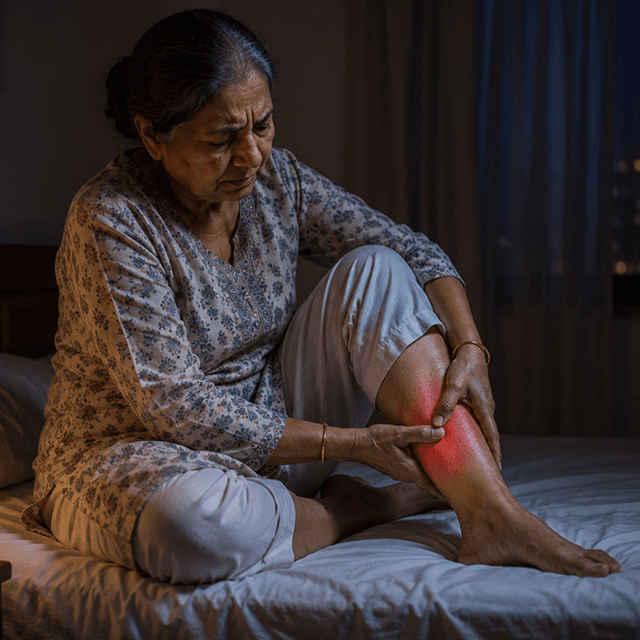
The stairs felt a little harder for my father to climb. My mother took a little longer to get up from the chair. I noticed unfinished chores, dishes in the sink - things that took care of themselves a while ago.
Although my parents didn't mention this to me. But on the flight back, I kept thinking about it - "Are they really doing okay on their own?"
The truth is that our parents are aging faster than we thought they would.
Due to work, I've been living further way, and the gaps between my visits are growing longer. While I want my parents to remain independent, comfortable and safe - I can understand that occasional phone calls are no longer enough.
That's why I have decided to opt for home-based senior care. If you have aging parents like me, you'd appreciate that instead of waiting for a medical emergency to arrive, we should choose professional assistance for home based senior care.
In fact, senior care is already becoming the new normal in many metro cities in India. The reasons? Well, there are demographic, economic and emotional changes that are leading this shift. Let’s dive in.
India is aging rapidly
According to the UNFPA India Ageing Report 2021, the number of Indians over 60 hovers between 139 and 158 million. This is already a greater number than the total population of most of the countries in the world.
By 2050, this will be approximately 319 million, nearly double the numbers of today in one generation.
By then, senior citizens will be nearly 20% of India's total population, up from 10% currently. By 2046, for the first time in India's history, there will be more Indians over the age of 60 than those under the age of 15. This is hard to imagine today.
Not only is the number of senior citizens increasing, but so is life span. The average life expectancy is around 70 years as of 2021. The population of the 80-plus age group, who require the most support, is the fastest growing group and senior women now outnumber senior men.
This has turned from a concept to a reality for Indian families. The conversation about "elder care" that was for so long an abstract thought has taken center stage in the everyday life of Indian families, including yours, and possibly tens of millions more.
When a market grows this fast, there is something going on
When a sector in healthcare starts growing at 18% to 19% a year, that does not happen due to an innovative marketing campaign. The market doesn’t work that way. This means that millions of families are making the same decisions, independently, at the same time.
India's home healthcare market is, without a doubt, one of the fastest developing healthcare segments, if not the fastest in the entire country.
According to Mordor Intelligence, it is approximately 11.9 billion US dollars in 2025, and will reach 27.38 billion by 2030, growing at 18.13 percent annually. Grand View Research expects it to be nearly 36.1 billion by 2030, growing at 19.29 percent annually. An estimate that has been gaining a lot of popularity recently from ET Healthworld, placed it at around 21 billion dollars by 2028.
Different companies are taking different approaches and estimating with different methods, with different parameters that they are considering. However, it is clear that all are supporting that it is growing tremendously, and will continue to do that for years to come, in one of the largest countries around the globe.
This isn't supply looking for demand. This demand is so strong that it's pulling supply into existence.
Families are not purchasing home care solutions. They are continually seeing the best choices for them. What matters is the timing, so what has changed?
What happened to the joint family concept?
Caring for aging parents wasn't really a formal system for most of India's history.
Parents usually aged in the house. The house was run by a daughter-in-law. Sons were close. Grandchildren were close. If your father needed to be taken to a doctor, there was someone to do it. If your mother needed something at 3 am, there was someone who could help.
Distance and time made caring for family members a service, but families already provided the care. Even more quietly, the Indian family structure has changed in the past 2 decades.
A son who moved to Pune from Patna at age 22 can no longer take his father to have a cardiology appointment in Patna when his father is in his sixties. A daughter who now works 12-hour days in Bengaluru can no longer take care of her mother in Patna and can no longer check her mother's blood pressure. The love is still there, but so is the distance, and no good will can bridge the distance when communication is done by phone.
The NSSO and the India Aging Report of 2021 show what families have been seeing in India: the number of older adults living alone is rising, as are the adults who live with only a spouse and no children. Currently, about 20 percent of India's older, urban adults want to live alone, and the percentage continues to grow.
The joint family didn't disappear. It got redistributed across cities, time zones, and work calendars. The care it once provided had to come from somewhere else.
Home-based professional care is the answer that fills the gap left by the care once provided in formal family structures. Home-based professional care does not replace the family. It carries the family to areas where it cannot be.
What your parents actuall want? It matter more than you think!What your parents actuall want? It matter more than you think!
Many people think that moving their old parents with them will solve the issue. But the truth is that elderly people don’t like moving. They don’t want to move to a new place where they don’t know people and where they haven’t lived before.
There is a great deal of cross-cultural research that shows that people of all cultures prefer to age in place and therefore, prefer to remain in the homes where they have spent their lives rather than moving to some institutional care facility, and India, of course, is no exception.
Elderly people have a great deal of difficulty coping both physically and psychologically with change. The more immediate and personal the change is to their environment, the more difficult it is for them to cope.
UNFPA has suggested that the Indian government should start formulating policies that will encourage older adults to remain in their homes and support them in remaining in their communities, as opposed to developing policies that encourage institutional models. The answer cannot be purely emotional. In fact, care outcomes are improved when older people remain in their community and family structures.
What older people want and what people ought to be doing to answer their needs, coincide in this case. In most health-related cases, this is not the case.
Families and care providers who appreciate the previous 2 statements, recognize that they are constructing a creative solution to a real need rather than simply accommodating a preference.
What the pandemic taught us
COVID-19 taught us stuff that we should have figured out before. Families that presumed the only place for medical treatment was the hospital learned that, during a global pandemic, a lot of things could happen in the home.
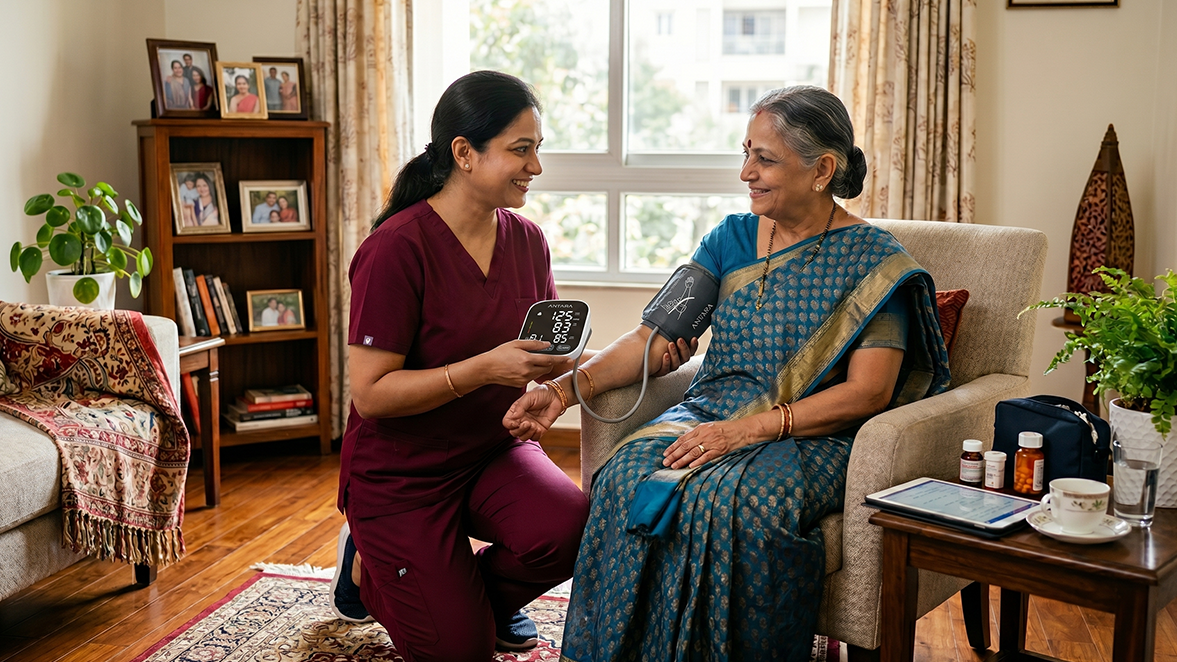
Doctors and physiotherapists could make home visits. Nursing care could be set up at home and not require a hospital admission. Even blood work could be done at home without the need for an overcrowded waiting room.
All of a sudden, hospitals became very unsafe.
For the elderly with many health issues, the risks of being in a hospital and the infections, confusion, disruption of the usual routine of a hospital, and the loss of a familiar setting were no longer abstract. Home care became a very reasonable option for a variety of health care needs.
That shift has remained.
Subsequent to the pandemic, there was a sustained period of home care growth, with home nursing, home physiotherapy, home palliative care, and home companionship services, among others, experiencing post-pandemic double-digit growth. It's also worth knowing that this is not the industry of hiring companions.
According to the Grand View Research 2022 report, skilled home care, or home health care with trained home care services, represents the bulk (approximately 87.7 percent) of the home health care industry. A medical services industry moved to the patients’ homes.
The technology that made all of this work.The technology that made all of this work.
10 years ago, what we’re describing would be very difficult to arrange. But today, the supporting systems have emerged.
A doctor in Delhi can see the oxygen and heart rate of a patient who has a monitoring system in his bedroom in Jaipur. Systems which remind patients about their medication can help with the challenges faced by a parent who takes 5 disparate medications at 5 different times.
Even at 2 am in the morning, fall detection devices can notify a family member about the occurrence of an incident, despite the fact that no one was awake to witness the occurrence.
Thanks to AI surveillance, new systems can detect changes in movements and patterns that can indicate a health crisis. For NRIs who seek home-based care for their aging parents in India, the invention of AI monitoring systems has made it possible to offer professional care without being physically present.
Increased incomes have made it possible for parents over 50 to access services offered to what researchers call the silver economy. These services include home-based care.
Before the invention of these systems, families living in the cities in India were unable to access professional home nursing or physiotherapy. Now, these systems make it possible to hire these services.
The part that most families miss.
Home-based care has become the ethos for many families. A nurse, perhaps a physiotherapist, even a companion, can all be hired. Many families feel it’s the equivalent of getting the job done.
However, there are seriously unsafe factors in the home that professional care cannot address.
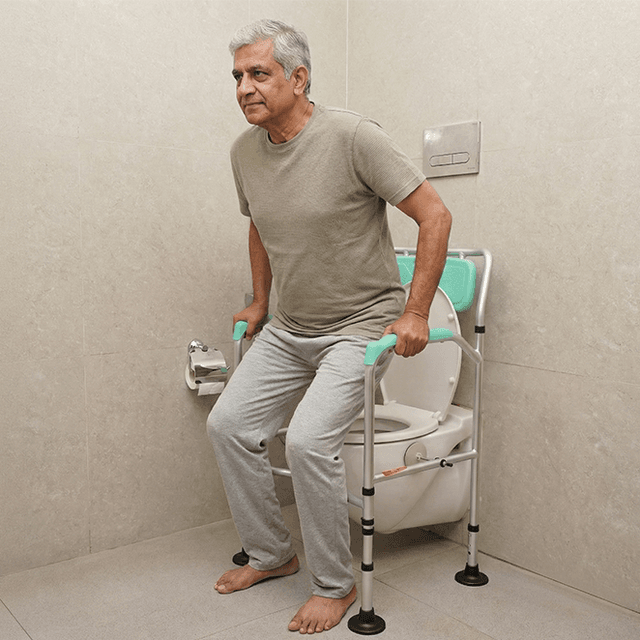
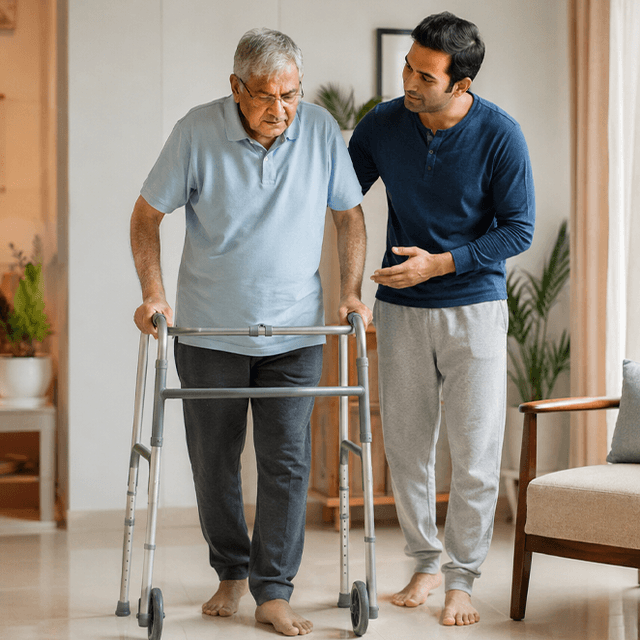
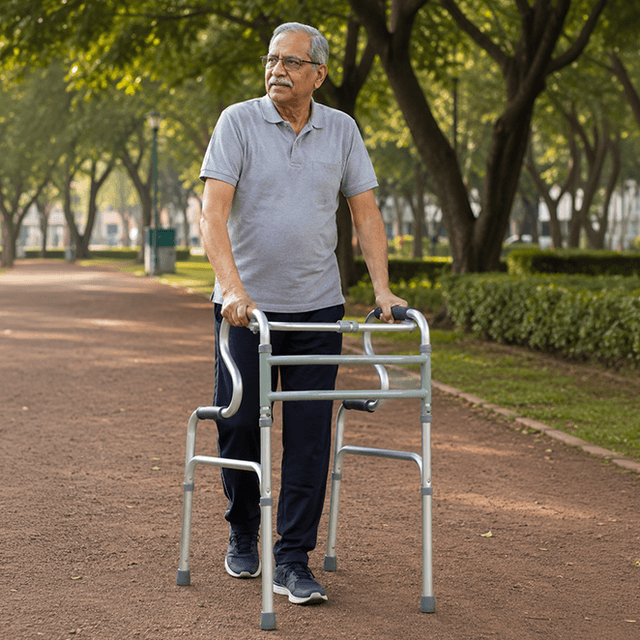
For example, a parent who has a hip replacement and receives excellent physiotherapy on a weekly basis is still unsafe if the bathroom has a missing grab rail. A nursing aide can’t prevent a parent from falling during the night if the parent has an aide in the home and the floor in the bathroom is wet.
A parent who can’t manage the stairs in a home during the day can’t do so at night if there is a medication management system in place.
For a home truly able to age in place, a home needs modifications that prevent an emergency, and that truly support the independence of a parent. This really can mean what the bathroom and bedroom looks like and what the floors in the kitchen and hallway are made of.
Home-based care is the default. Home-based care is the new norm.
The first step to making that care truly safe in your parent's home is to actually make it safe.
Families that organize both professional care and home safety typically sidestep the avoidable crisis. Families that choose one of these options typically experience the avoidable crisis and then usually organize both kinds of care and safety in a scramble.
Taking care of adult children - not all home care is equal
While we can organize home care services, it is the home modification that lead to a better quality of life for the senior adults in your famly.
However, you need to understand that it needs to be done in a manner to preserve their dignity, routines, and home so that seniors can trust that the care system will accommodate their needs.
Most of the home care services on offer in India's fast-growing and highly fragmented home care market are not organized services. They are small or one-person operations with no thresholds on the qualifications of the home care worker, no background checks, and no accountability in the case of something going wrong.
For the families that have never dealt with these services, it is almost impossible to tell the difference between someone that will provide a good and safe service and someone that simply puts up a listing on the Internet.
Hence, it is important that you find qualified and professional home care help. Just having a full time help is not enough.
So where does this lead to
By 2046, more Indians will be over 60 than under 15. This is not a far fetched future, we are dealing with this right now.
Successful families have a few things in common.
They started earlier than the rest. Therefore, they had straightforward conversations with their elders about what they actually wanted, rather than having assumptions.
They treated paid help and homemaking as 2 sides of the same coin, and they appreciated that every good system is temporary. Rather, it is flexible with the needs of the time.
The biggest challenge is not deciding on the right level of home care. For most Indian families and in most situations, it is becoming the preferred level of care.
The more important question, then, is, how ready is your parent’s home for this.
The biggest health care decisions are made at home and in the most mundane of moments before they become a crisis. The families who are empowered to make these choices early, maintain options.