
When Should You Replace an Orthopedic Pillow?
Jul 29, 2026
A pillow doesn't quit on you overnight. It fails slowly, one morning at a time.
You wake up with a stiff neck. You fluff the pillow and go back to sleep, figuring it was a one-off. The next morning, the ache is back. So you blame your posture, your age, or the way you slept. You don't seriously consider it might be the pillow.
While using orthopedic pillows, we often think that as long as it looks good, it's still functioning properly. This is not the case. Before the fabric on top of the pillow wears out, it will have lost the supportive qualities and structure. The foam will deflate slowly and by the time you notice the change, it's already too late.
That's why "Is my pillow old?" is not the right question to ask. Rather ask:
- Is it still supporting your spine?
- Is it still holding its shape through the night?
- Is it still helping you to wake up pain-free?
- Is it still doing the job you bought it to do?
Here's the good news: orthopedic pillows do not need to be replaced often. However, replacing it at the right time will have a significant positive impact on your sleep, neck, and spinal alignment.
This guide reviews how long orthopedic pillows last, signs that it's time to let go, and how to choose ones that will continue to help you sleep pain free.
How Long Can an Orthopedic Pillow Last?
The average orthopedic pillow lasts 18 to 24 months before it needs to be replaced. With proper care, a memory foam, latex, or contoured cervical design pillow can last up to 3 years. However, if the individual has a tendency to sweat at night, the pillow will wear out quickly, especially if it is used every night without rotating it.
The range of years listed above is not a hard rule or law. It is an average based on use, materials, and the weight of the individual. Memory foam pillows do have a tendency to spring back to their original form until the foam cells break down, to the point that the pillow will look normal but the support for the individual's neck will be lost. This is why people get into trouble when they only use sight to judge the pillow's health. The average orthopedic pillow may look flat and appear normal, but can be truly lacking in supportive foam.
Pillow Replacement Warning Signs
Instead of waiting for a certain date on a calendar, it is more helpful to pay attention to your body and the pillow. The following signs indicate that it is time to replace your pillow:
- If you experience neck and/or shoulder stiffness that gets better as the day goes on, this suggests you may have a sleeping support problem, as opposed to an actual muscle problem.
- If your pillow used to spring back but now it doesn't. You can assess this by doing a press test: press down at the center, and if it takes only a few seconds to bounce back, it's fine. And if it takes longer, then it's probably time to change.
- If you can see a dent where your head rests on the pillow, it means the foam has compressed and is not distributing pressure evenly in that area.
- If the original pillow feels flat and you have to place a second pillow under it to add height, it is a clear sign that it needs replacement.
- If your pillow has an odor that doesn't go away even after you keep it in open air for some time or wash the cover, it is a sign that moisture is trapped deep in the foam, which usually alters the foam's structure.
- If a night away from home leaves you feeling more rested than usual, it is a strong sign that your regular pillow has stopped doing its job.
Each symptom makes sense. An orthopedic pillow is not going to announce its malfunctions; instead, it is going to stop working to the standards of the user, and the user's body will pay the price.
Why This Is More Important As You Get Older
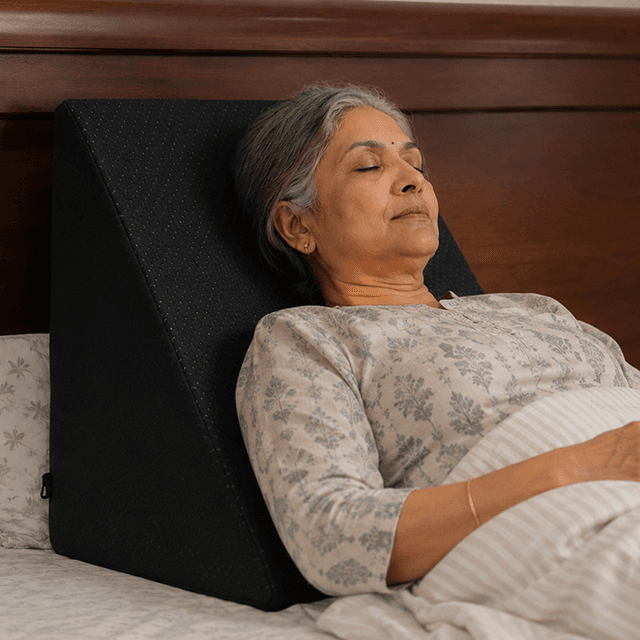
Sleep posture and spinal support become more important as you age. This is because the sleep scenario and waking situation are going to become complicated. The muscles will be slower to recuperate from the strain that is inflicted during the night. The joints will take even more time to recover from the burden that was dealt to them. Some older people have to deal with neck stiffness or general joint issues. This makes it even more important to have a pillow that is going to offer you support, because having a pillow that loses its support over time is going to counteract the benefits that your body would otherwise get from a good routine.
Keeping track of your sleep is as important as tracking any other health metric. Good quality sleep puts the body and system into a more peaceful state. It will help with better cardiovascular recovery, and in managing the overall heart rate of the body. Poor quality sleep will do the exact opposite.
Quality sleep ultimately provides a sense of peace and lowers the overall stress levels on the heart. Many people keep track of various health metrics like blood pressure and oxygen level regularly; combining this with a check on sleep quality closes the loop. The AGEasy Wrist BP Monitor makes tracking blood pressure extremely easy, and it will help you monitor your overall wellbeing without the need to rely on how you feel on a particular morning.
Choosing the Right Replacement
Once it's time to buy a new orthopedic pillow, a few practical factors will probably help you more than the marketing jargon of brands.
Start with your sleeping position: Side sleepers usually require a higher, firmer pillow to fill the gap between the ear and shoulder. Back sleepers typically do best with a medium loft pillow which supports the curve of the neck, and stomach sleepers require the flattest option available as any loft will cause the neck to be misaligned.
Material and adjustability: Regarding the pillow's material, memory foam provides good contouring but tends to retain heat, while latex holds its shape longer and remains cool but is firmer. This means you may want a pillow with cooling gel layers or ventilation if you sleep often in a hot environment.
Certifications and testing: Pillows and covers that have been tested for durability and pressure relief are better than the ones that simply claim to be soft, as your pillow should primarily provide support rather than just a temporary comfort.
Trial period: Consider a short return or trial window as one of the most important features when buying a new pillow. While a pillow may feel soft or comfortable when tested in-store, that same pillow could feel totally different after one night of sleeping on it.
A Simple Way to Check In
You don't have to overhaul your entire sleep setup to catch this early. Every couple of months, take two minutes to check: press into the center of the pillow and note the time it takes to recover, look for permanent dents, and ask yourself if you've been reaching for a second pillow. If two or more of these signs are showing up, it doesn't matter how long you've owned the pillow — the answer is there.
An orthopedic pillow's job isn't to look good on the bed; it is to keep your neck in a position so that the rest of your body can actually recover overnight. When it stops performing this function, there is no amount of fluffing that can bring it back. Replacing it at the right time is not an upgrade for the sake of it; it is closing a gap in your sleep that has probably been spoiled longer than you realized.