

Arch Support Insoles: 3 Home Tests to See If Your Parent Needs Them
Sep 7, 2026


You’ve noticed that your parent’s feet hurt after a walk, so you have decided to start looking at insoles. The first question is: does your parent actually require arch support?
Arch support insoles are not always the best solution. An insole with a thick arch, a long list of reviews, or another person’s recommendation will not necessarily help your parent. Flat feet do not always mean that firm arch support is required.
Before purchasing an insole, take a look at three aspects of your parent’s feet:
- How do their feet look while they are standing?
- What do their feet look like while they are walking?
- Where does the pain start?
The shape of your parent’s feet is only one part of the picture. It is possible for someone to have flat feet and require no insoles at all. Visible rubbing around the arches may instead indicate a need for cushioning or additional support.
New or worsening pain requires more than simply buying insoles. An unsuitable insole can cause discomfort, affect the way your parent walks, and lead to repeated purchases without addressing the underlying problem.
These simple home checks can help you:
- Understand how your parent’s feet respond to weight.
- Consider whether arch support may be appropriate.
- Select an insole based on movement and comfort.
- Recognise when a foot-pain assessment may be needed.
These checks should be performed before purchasing arch-support insoles. They provide useful observations, but they are not a diagnosis.
What Are Arch Support Insoles?
Arch support insoles sit inside a shoe and provide cushioning or support beneath the middle portion of the foot. Some designs may also provide cushioning around the heel or forefoot.
Arch support insoles do not permanently change or reshape an adult foot. They are generally used to provide cushioning and support within the shoe and may improve comfort for some people while standing or walking.
However, some people with flat feet do not need arch support if they have no pain or movement restrictions.
Foot pain can have many causes. In addition to footwear problems, possible causes include plantar fasciitis, arthritis, tendon problems, nerve impingement, inflammation, and injury.
Arch support insoles may be appropriate in some situations, but they should not be used as a substitute for a proper clinical assessment when pain or other concerning symptoms are present.
Test 1: Look at the Arch While Your Parent Stands
Ask your parent to stand barefoot on a firm, safe surface. Look at their feet from the side and from behind.
Make sure they distribute their weight evenly between both feet. Observe the following:
- A noticeable gap along the inside of the foot
- An arch that appears to drop while standing
- A heel that rolls outward
- An ankle that rolls inward
- One foot looking different from the other
- Redness, swelling, or changes in foot shape
Next, ask your parent to hold onto a stable object and slowly rise onto their toes with their heels lifted. Observe whether the arch becomes more visible.
If the arch lifts while your parent is on their toes, this can indicate a flexible flat-foot pattern.
If the arch remains flat and your parent also has pain, stiffness, or both, arrange an assessment before choosing firm arch-support insoles.
This test provides clues rather than a diagnosis. Do not press hard underneath the arch or attempt to test for pain by applying pressure.
Pain or tenderness, swelling, or a change in the shape of the foot should be assessed by a healthcare professional.
Test 2: Compare Walking With and Without Shoes
Ask your parent to walk barefoot on a safe floor without obstacles. Let them walk at their normal pace and for their usual distance. Do not ask them to walk farther than they normally would or deliberately change their stride.
Then have them walk in their usual shoes and observe whether there are any noticeable differences.
Look for:
- One foot rolling more than the other
- The heel moving rapidly from side to side
- More wear on one side of the shoe
- Shorter walking steps
- Avoiding weight on one side
- Pain that increases after a few minutes of walking
You can also check the heels and soles of your parent’s shoes. Uneven wear can provide information about the walking pattern, but it cannot tell you why the walking pattern has developed.
Before and after the walk, ask your parent to rate their comfort on a scale from zero to ten. Also note where the pain is located, such as the heel, arch, ball of the foot, or toes.
Recording the pain level and location can help you compare comfort when considering different insole designs and can also provide useful information to a clinician if the pain continues.
Stop the test immediately if your parent experiences sharp pain, weakness, numbness, dizziness, or signs of instability.
Because older adults may have an increased risk of falls, remove loose rugs and other obstacles before carrying out the walking check.
Test 3: Check the Shoe Fit
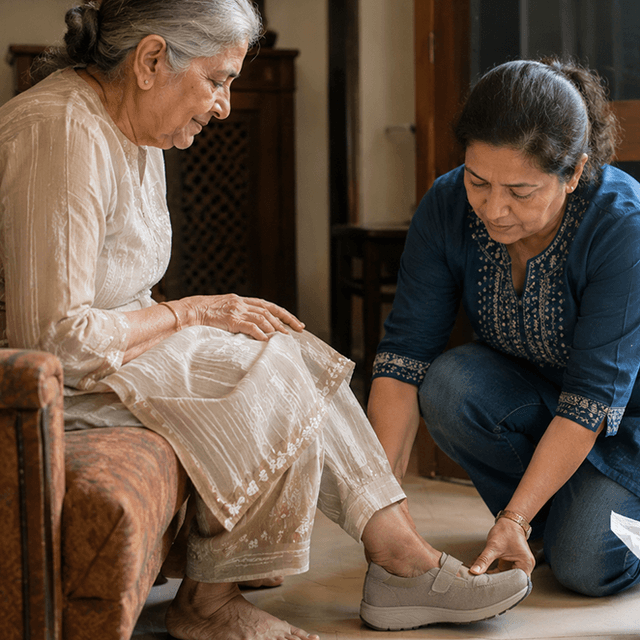
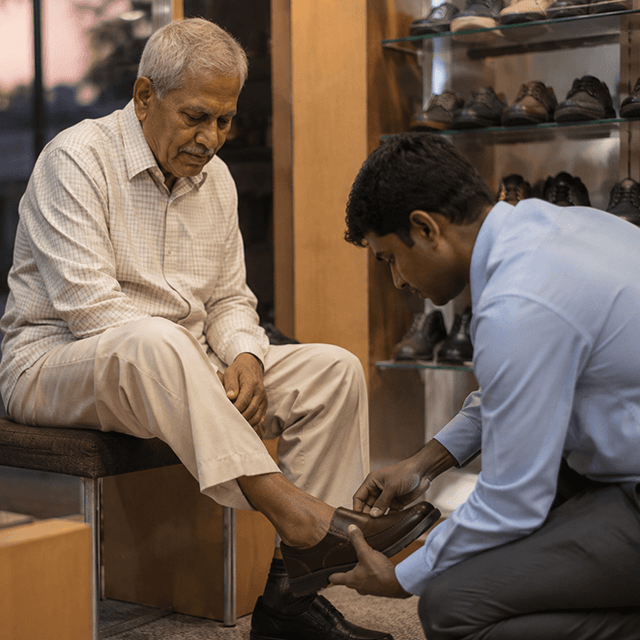
An insole cannot correct a shoe that does not fit properly. Ask your parent to put both feet into their shoes and check whether the heel remains in place and whether they can move their toes comfortably.
Check whether:
- The toes are being pushed against the front of the shoe
- The shoe becomes too small when the insole is added
- The heel slips up and down
- A seam presses against a sore area
- The foot sits too high inside the shoe
Have your parent try on the shoes towards the end of the day, when their feet may be slightly more swollen. They should wear their usual socks during the fitting.
Most insoles require sufficient space inside the shoe. If the original insole is removable, it may need to be taken out before the replacement is inserted, depending on the product instructions.
Never force an insole into a shoe. If the shoe becomes too tight, it can cause discomfort and may press the toes upwards.
How to Interpret the 3 Tests
The three checks should be considered together rather than relying on the appearance of the arch alone.
- Possible insole trial: If your parent experiences discomfort mainly during physical activity, has a flexible arch, and has a stable walking pattern, an insole trial may be reasonable.
- Comfort matters more than firmness: An insole should feel supportive without being painful. Make sure there is no sharp edge pressing against the arch and that the heel or ball of the foot does not feel excessive pressure.
- Know when to seek assessment: Arrange an assessment if there is a noticeable change in walking pattern, increased pain, pain that is significantly worse in one foot, pain that disrupts sleep or daily activities, or balance problems.
- Consider the source of the pain: If pain in the feet or lower limbs is affecting daily activities, an appropriate arch-support insole may provide comfort for some people, but the cause of the pain should still be considered.
- Choose based on fit and activity: Consider your parent's shoe type, foot size, comfort, and the amount of support required. An insole designed for a walking shoe may not be appropriate for a court shoe, sandal, or narrow shoe.
If your parent has diabetes, reduced sensation, poor circulation, a history of foot sores, or has previously had foot surgery, consult their doctor before using insoles. Reduced sensation can make it difficult for someone to notice pressure or skin damage.
The goal is not to choose the firmest or thickest insole. The goal is to find support that fits the shoe and feels comfortable without creating new pressure points.
How to Introduce Insoles Safely
Your parent should not wear a new pair of insoles all day from the beginning.
Start with a short period of around 30 to 60 minutes at home or during a short walk. After removing the shoes, check the feet for signs of blistering, redness, rubbing, swelling, or pain.
Mild pressure may reduce as the feet adjust to a new insole. However, pain or changes to the skin should be treated as a reason to remove the insoles.
If the initial use is comfortable, gradually increase the wearing time by a couple of hours each day.
Also check the insole itself. If it folds, moves forward, or slides inside the shoe, it may not be positioned correctly or may need to be replaced.
When Does Your Parent Need a Medical Assessment?
Home checks can help you observe changes, but they do not replace a medical assessment.
Arrange an appointment with a doctor, podiatrist, physiotherapist, or orthopaedic specialist if your parent has:
- Foot pain following direct or recent trauma
- Foot pain related to a new or previous injury
- Swollen feet
- Warm feet
- Redness
- Bruising
- A change in the shape of the foot
- Numbness, tingling, or weakness in the foot
- Non-healing wounds or changes in skin colour
- Limping
- Difficulty with balance
- Persistent foot pain despite supportive footwear and cushioning
Seek immediate medical care if your parent has severe foot injury pain, severe swelling, cold toes, or a foot that has turned blue.
These symptoms require appropriate medical evaluation rather than simply trying another insole.
A Simple Checklist Before Buying Arch Support Insoles
Before purchasing an insole, take a few minutes to document what you have observed.
- When did your parent's foot pain begin?
- Does the pain affect one foot or both?
- Where exactly does the pain occur?
- How long can your parent walk before discomfort begins?
- Is there visible swelling or a change in foot shape?
- Is there uneven wear on the shoes?
- Does your parent have a stable walking pattern?
- Does the shoe still fit properly when the insole is inserted?
If you are considering the AGEasy ArchPro Insoles for Flat Feet , check the size and fit before use and introduce them gradually.
The insoles should not cause pain, loss of sensation, rubbing, or imbalance. If any of these occur, discontinue use and seek appropriate professional advice.
The Right Insole Starts With the Right Assessment
Seeing a flat arch does not automatically mean your parent needs firm arch support.
Before buying an insole, observe how the foot looks while standing, how it behaves while walking, where the pain occurs, and whether the shoe itself fits properly.
These simple checks can help you make a more informed decision about whether an insole is worth trying. If your parent has significant or worsening pain, changes in foot shape, balance problems, numbness, swelling, or other concerning symptoms, professional assessment should come before experimenting with different insoles.
An insole should provide comfortable support, not create additional pressure or pain. The right choice is therefore based on your parent's foot, footwear, movement, symptoms, and comfort rather than simply choosing the thickest or most rigid arch support.
Disclaimer: This article is intended for general informational purposes and does not replace medical advice, diagnosis, or treatment. The home checks described above are observational only and cannot diagnose a foot condition. If your parent has persistent or worsening foot pain, swelling, changes in foot shape, numbness, weakness, balance problems, a recent injury, or other concerning symptoms, consult a qualified healthcare professional.