


Lower Back Pain Exercises for Seniors: 8 Movements Physios Actually Prescribe
Article by: Priyam
Jul 22, 2026. 9 min read
The worst thing for your back is often the first thing you reach for.
You sit a little longer. You skip the morning walk. You stop bending, stretching, reaching for things on the top shelf. It feels safer that way.
However, not moving is usually not the answer to the problem. Although resting for a day or two could help, a stiff back ultimately needs movement. Weak muscles need something to push against. Tight joints need gentle, regular use.
This is why physiotherapy goes beyond telling a patient to take it easy. They teach people how to do certain movements which can add strength, one exercise at a time. They progressively work on balance and help people build trust with their bodies.
You do not have to go to a gym to do intensive workouts to strengthen your muscles. You can do some safe and simple physical exercises regularly to decrease stiffness, and improve your range of motion. This will make everyday tasks less difficult.
People who experience back pain regularly will benefit from these eight exercises. These are the exercises that physiotherapists have recommended to help people move pain free again and build confidence.
Before You Start: A Few Ground Rules
Discomfort from stretching is typical, but sharp pain is not. It is common for a stretch to feel tight. But if the sensation is sharp, shooting, or especially if it travels down to your leg, you should stop.
These movements take time, just one session of high intensity will not fix the issue. Injury is a result of rushing.
If you are trying to relax your muscles, holding your breath will only tighten them further.
You'll want to have something stable nearby to hold on to (like a wall, chair, or countertop) especially for balancing exercises.
Furthermore, if you have undergone any spinal surgery, falls or fractures, osteoporosis, unexplained weight loss with back pain, leg numbness or weakness, or any issues with bowel or bladder control, you need to see a doctor. For these conditions, a home exercise plan is not appropriate.
These exercises are most beneficial when stiffness is at its worst, most people find mornings most helpful. In the evenings, the exercises can help to unwind the day. Ten to fifteen minutes are enough.
Eight Exercises
1. Pelvic Tilts
The reason why physiotherapists recommend this exercise is that it is the most gentle way to engage the deep abdominal muscles that stabilise the lower spine, which can become inactive after a back has been guarded for months.
Lie on your back with your knees bent and your feet flat on the floor. Tighten your abdominal muscles and gently touch your lower back to the floor while slightly tilting your pelvis forward. Hold this position for five seconds, and then let it go. Do this 10 times.
The movement is intentionally small, and if your hips are lifted much off the ground, you're doing too much.
2. Knee-to-Chest Stretch
This exercise releases tension in the lower back, as well as the hip flexors, which tighten as a result of prolonged periods of sitting.
Start in the same position, and this time bring one knee towards your chest. Make sure to hold behind the knee, not on top of the kneecap. Hold for 20–30 seconds. Lower your leg slowly and then switch to the other leg. Do three rounds per leg.
If you find it hard to get down on the floor, this can also be done on a firm bed.
3. Cat-Cow (Modified for Seniors)
This restores movements segmentally through the spine, rather than having the whole back move as one stiff block.
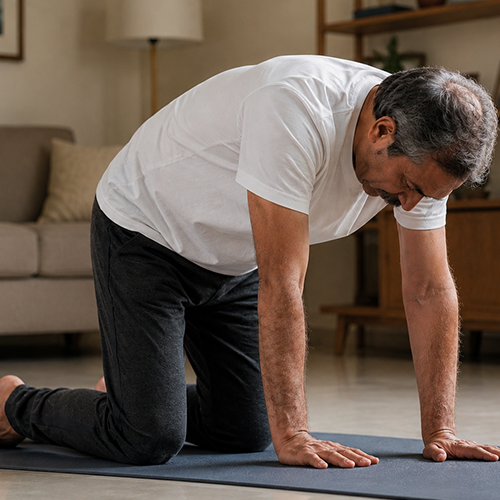
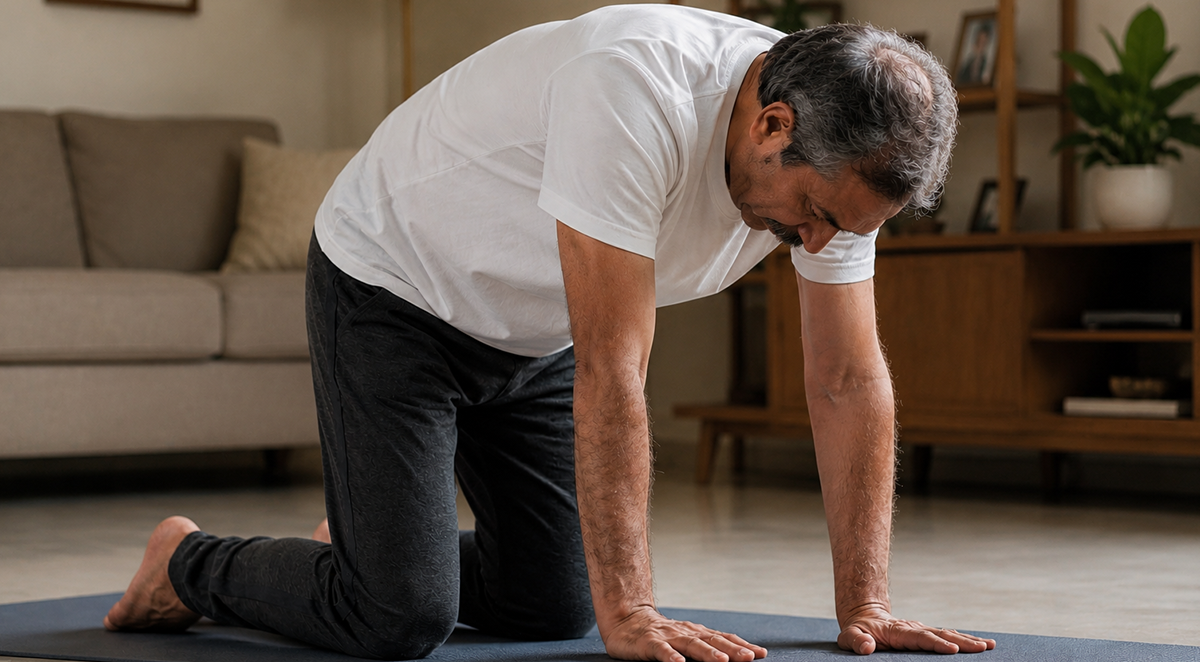
Be on your hands and knees, then gently arch your back and drop your head. Reverse this slowly. Let your stomach sink and lift your chest. Move with your breath. Do this for 8 to 10 cycles.
If you find your wrists or knees are opposed to this, then do it while sitting. Sit on a chair and gently alternate between arching and rounding your back. The impact will be similar.
4. Bridging
Weak glute muscles force the lower back to do the work of the glutes. Bridging is the solution.
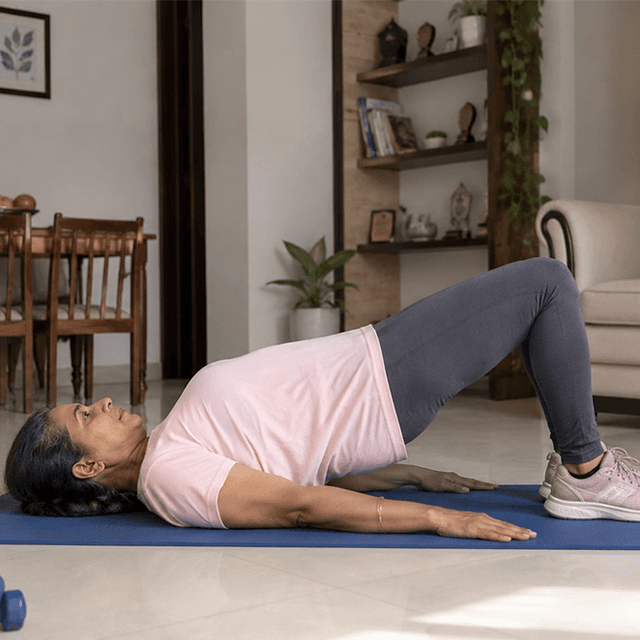
While lying on your back with knees bent, squeeze your glutes and lift your hips a couple of inches off the floor. Hold for three seconds and lower with control. Aim to complete 8 repetitions and then gradually build up to 15.
Here is the key, height isn't the focus. Control is.
5. Seated Spinal Rotation
The first movement seniors tend to lose is rotation. Yet, rotation is critical for turning and looking behind you, especially when walking or reversing a car.
Sit up straight in a sturdy chair with your feet flat on the ground. Place your right hand on the outside of your left thigh and gently twist your upper body to the left. Hold for 15 seconds. Do the same on the right side. Complete three rounds on each side.
When doing this, ensure that you are turning from your ribs instead of your neck. If your chair easily lets you slump, then placing a lumbar back support cushion at your lower back will make it much easier to maintain an upright position. This will be beneficial for both this exercise and all the sitting that likely caused the stiffness you are experiencing. AGEasy has these in their back support range.
6. Standing Hip Hinge
The majority of back injuries in older adults occur when they bend down to pick something up. This exercise teaches the safe pattern.
Perform this while standing, feet at hip distance apart, with hands on hips (or holding onto something like a counter). The goal is to push your hips backward while keeping your back straight and bending your legs slightly. You should be able to return to a standing position by squeezing your glutes. You should complete ten repetitions.
Your back should stay flat throughout the movement. This is how you should pick everything off the ground.
7. Wall Sit (Shallow)
This develops endurance in the thighs and core without adding load to the spine. Core strength is important to stand up from a chair or toilet seat without using your arms or any other assistance.
With your back straight against the wall and feet about a foot in front of you. Slide down a little, and don't go to a full squat. Try to hold this for 10–20 seconds. You should do this five times.
As soon as your knees become problematic, you should stop.
8. Walking
This may be the most effective method for chronic lower back pain from research available. It improves blood flow to the tissues in the spine, helps maintain bone density, and also helps rebuild the confidence that pain can destroy.
Start with a goal of 10 minutes every day and slowly find your way to walk for 30 minutes everyday. The speed of your walking is not as important as consistency. If you are worried about balance, a walking stick can give you enough stability to keep you walking instead of avoiding it. Options like the AGEasy Single-Leg Walking Stick or the Pivot Explorer Carbon Walking Stick allow you to choose the exact level of physical support your body requires. If you are walking on smooth floors indoors, slipping may be a concern, so it's a good idea to wear walking socks that are anti-slip.
What Supports Help and What They Don't
A common mistake is to use a back brace as a substitute for exercise. When you wear a rigid support all day, every day, you've created a situation that can cause the muscles to weaken further.
When used correctly, supports can have a real benefit:
- A lumbar-sacral belt can provide firm compression during a flare-up or while engaging in activities that consistently irritate your back like long driving trips or chore marathons. Wear it for these tasks and then remove it when you are done.
- A posture corrector should be viewed as a training cue, and not a crutch that you become dependent on. For no longer than two hours, you can use it as a reminder of what good posture feels like.
- A coccyx cushion can definitely help if your pain is related to your tailbone and is worsened by sitting on hard surfaces.
- A pain relief gel or a small massager can help loosen tight areas to make the exercises more comfortable.
All of these items can be obtained through AGEasy. Regardless of the brand, the principle holds true: supports are meant to help you move, not to be a replacement for active movement.
How to Build the Habit
Aim to complete five of the eight exercises, if not all eight, and do them properly. Choose the exercises from which you notice a favorable response from your body. Perform these exercises at the same time each day in order for them to become automatic. Changes can be expected in four to six weeks, not four to six days.
Also, keep track of your progress. If an exercise is consistently more painful, this is something you need to discuss with your physiotherapist.
When to Stop and Seek Help
Consult a physician if you experience pain that radiates below the knee, leg or foot numbness or tingling, leg weakness episodes, night pain, back pain combined with fever, or back pain associated with any loss of bladder or bowel control. The last concern is especially urgent and requires immediate attention.
A one-off assessment by a physiotherapist is also worth the money even if nothing is alarming. They will advise on which of the eight exercises are appropriate for your back, and which ones to avoid.
Recommended Blogs




















You May Also Like
 No products found
Article by:

Priyam
Article Category:
General Wellness