
Urine Bag and Catheter Care at Home: Positioning, Emptying and Infection Signs
Oct 26, 2026
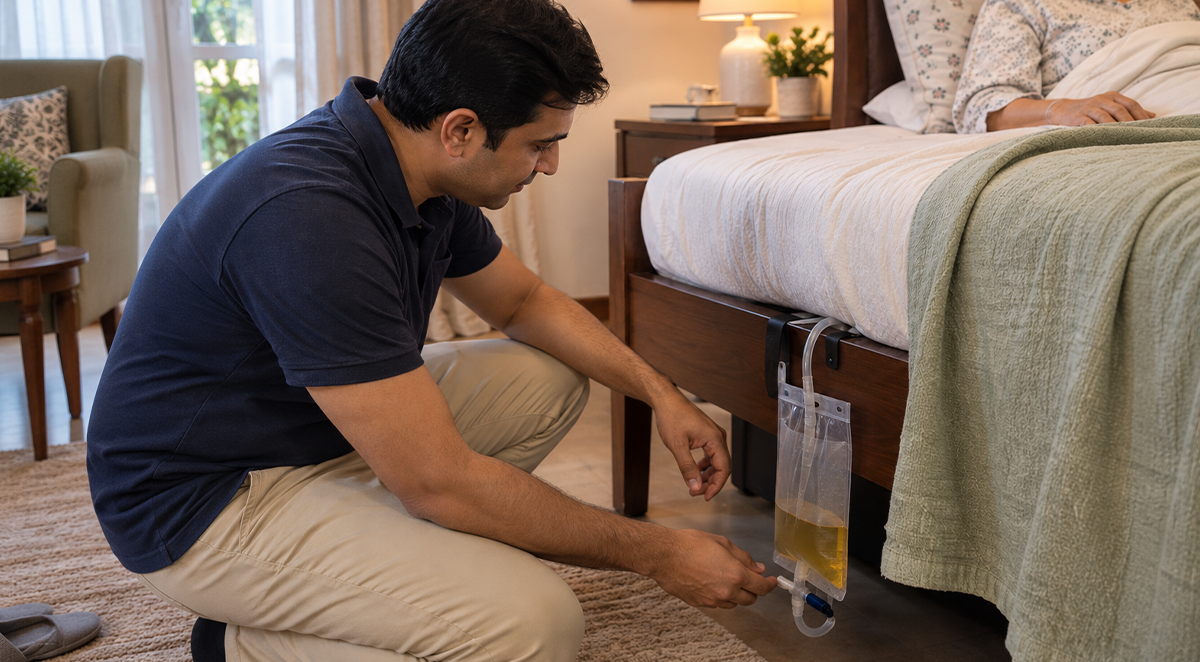
Urine Bag and Catheter Care at Home: Positioning, Emptying and Infection Signs
Care of the leg bags must include emptying the bags regularly, proper positioning, infection control, and hand hygiene, among other considerations. In order to maintain the health of a relative who is catheterised, you must develop a daily routine to maintain the drainage system and avoid infection.
A urinary catheter is a small, flexible tube that is inserted into the bladder via the urethra. Urine passes through the tube and into a collection bag. The bags can be larger and positioned beside the bed, or, for greater mobility and less hindrance to normal daily activities, a smaller leg bag.
The urinary catheter tube must be coupled with a bag to form a closed drainage system. In the absence of instructions from a nurse or other healthcare professional, the drainage bag should not be disconnected.
Find out from the healthcare professional who inserted the catheter how long it will remain, how often it should be changed, and which bag you should use. Never remove the catheter yourself unless you have been told to do so.
Position the Urine Bag Properly
Correct placement will allow urine to drain with ease and will also help prevent a backflow of urine.
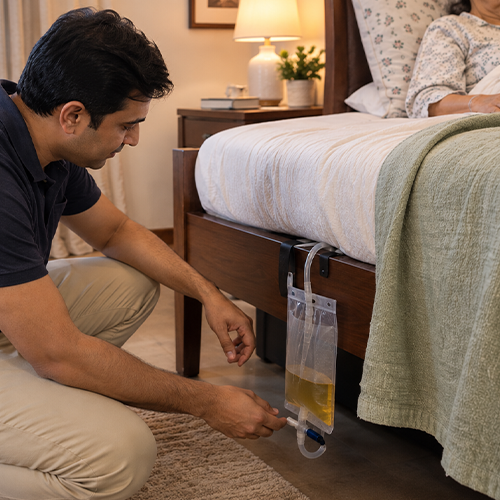
The bag must be below the bladder at all times. If your parent is lying in bed, place the bag on the bed frame and do not allow the bag to rest on the mattress. If your parent is sitting in a chair, then place the bag against a support which is below the bladder. A leg bag must be secured around the lower leg and must not be too tight against the skin.
A urine bag must never be placed on the floor. The floor is unsanitary and can contaminate the urine drainage tube. If the urine bag is hung on the side rail of the bed, then the catheter could be pulled, causing it to become dislodged.
The tubing must always be checked, especially during transfers, for kinks, twists, tight loops, or bending which could cause the catheter pressure to increase. The tubing must never be compressed against the leg where it attaches to the body. The tubing must have a smooth, unobstructed path to the urine collection bag.
I recommend you fix the catheter tubing to the thigh with the strap or other fixation equipment provided. You want to have some slack so the tube does not pull on the urethra and cause pain. If the catheter falls out, do not push it back in. Call your healthcare worker.
How to Empty a Urine Bag
Empty it before it’s too full. Many caregivers do it when the urine bag is between half and two-thirds full. A heavy bag pulls on the tubing and increases the chances of leaks.
Here are the steps:
- Wash your hands thoroughly with soap and water. If your routine involves the usage of gloves, put on disposable gloves.
- Place a measuring container, with the outlet positioned away from the side of the container, beneath the drainage outlet.
- Do not allow the outlet to touch the container, the floor, or any part of your body.
- Drain the urine slowly and steadily.
- After emptying the bag, close the outlet.
- Wipe the outlet with a clean tissue or the wiping agent preferred by the healthcare worker.
- Report the quantity, time, and any abnormal changes to your healthcare worker if the urine output is recorded.
- Remove gloves and wash your hands.
Use a separate container for measuring urine. After usage, wash it as per the instructions of healthcare workers. Do not store the measuring container with other household items.
If urine flow stops, look for kinks, a twisted tube, a compressed tube, or a tube or bag that is positioned too high. Check to see if your parent's position is putting pressure on the tube. Follow the doctor's orders to provide fluids. Do not flush the catheter or inject anything unless directed by a professional.
Daily Cleaning and Personal Hygiene
Wash the area once each day and after bowel movements. Pat the area dry. Pulling on the catheter is to be avoided along with the use of powders, creams, or antiseptics. Use warm water and soap unless otherwise instructed. Clean from the body outward with a new portion of the cloth for each wipe. Clean from front to back for women and men from where the catheter enters the penis. If the foreskin is pulled back during cleaning, return it to the normal position.
Keep the tube system and the drainage bag clean and dry. Replace wet clothing and bedding immediately. An AGEasy Disposable Undersheet is a convenient way to provide a protective barrier beneath the parent during leakage, personal care, or changing of the drainage bag.
Use it as a surface-protection product, not as a substitute for care around the catheter or for catheter hygiene or skin cleaning. Check the skin each time the undersheet is changed.
Common Issues Caregivers Should Address
| Issue | What to Check or Do |
|---|---|
| Urine bag or catheter leaks | Check for a full bag, tube blockage, loose connection, or rapid movements. If leakage persists, contact your healthcare provider. |
| Leaking urine | Catheter displacement, bladder spasms, or blockage may be responsible. Do not treat the problem yourself. Report urine leakage. |
| Strong-smelling or cloudy urine | Consider several factors, including urine sitting in the bag, dehydration, or medicines. Look at several factors and symptoms. |
| Bright red blood in the urine | This necessitates medical care. Contact your doctor to evaluate blood in the urine after catheter insertion or movement. |
| Urine flow stops | Check for kinks, twists, compression, or incorrect positioning. Do not flush the catheter unless directed by a professional. |
Some bag or catheter leaks can be caused by a full bag, tube blockage, loose connection, or rapid movements. Check the system. If leakage persists, contact your healthcare provider.
There are a number of reasons for leaking urine, such as catheter displacement, bladder spasms, or blockage. Leaking urine on your clothes can happen if the catheter is blocking your bladder. You should not treat the problem. Report urine leakage.
Urine in the bag can have a strong odour and appear cloudy. There can be several reasons for that, like urine sitting in the bag, dehydration, or even the medicines you take. Look at several factors.
Bright red blood in the urine necessitates medical care. This can happen if there is a blockage or spasm in the bladder. You should contact your doctor to evaluate blood in the urine after catheter insertion or movement.
Signs of a Possible Catheter-Associated Infection
Call the doctor or nurse if your parent has any of these symptoms:
- A fever or chills
- Confusion, unusual sleepiness, change in behavior
- Lower back or lower abdomen aches (including the side)
- Catheter site discomfort or burning
- Increase in redness, swelling, or tenderness with discharge
- Thick or cloudy urine that is bloody
- Smelly urine coupled with behavior change, pain, or a fever
- Decreased output of urine after drinking large amounts of fluids
Older adults do not always show signs of high fever. Call the caregiver if they develop new signs such as confusion, weakness, loss of appetite, or a decrease in normal activity.
A Simple Family Care Routine
The care kit should be in one easy-to-access place. Make sure you have gloves, tissues, soap, a measuring container, and extra bedding in the kit. Make sure to write down the times for catheter emptying if multiple family members administer care. This helps everyone quickly adopt a routine.
Check the bag position relative to tubing placement every time you shift your parent from bed to chair. Make sure the bag is always below the bladder. Close the outlet on the bag before sleep. During every care session, check the skin and the area around the catheter and bag to ensure there is no excessive moisture.
Throughout the process, protect your parent’s dignity by always covering their body, explaining what you need to do, and allowing your parent to participate as much as possible while providing them with the opportunity to be more independent. This can simply be holding a towel, checking the bag placement, and performing other simple tasks.
Disclaimer
This article was prepared for educational use only. Information included in this article is not a substitute for medical advice under any circumstances. Follow the instructions for your parent’s catheter care. Contact medical support for any problem that is severe, new, or worsening.