

NFHS-6 Reports A Silent BP Crisis
Article Category: BP Monitors & Other Devices
Article by: Alok
Jul 23, 2026
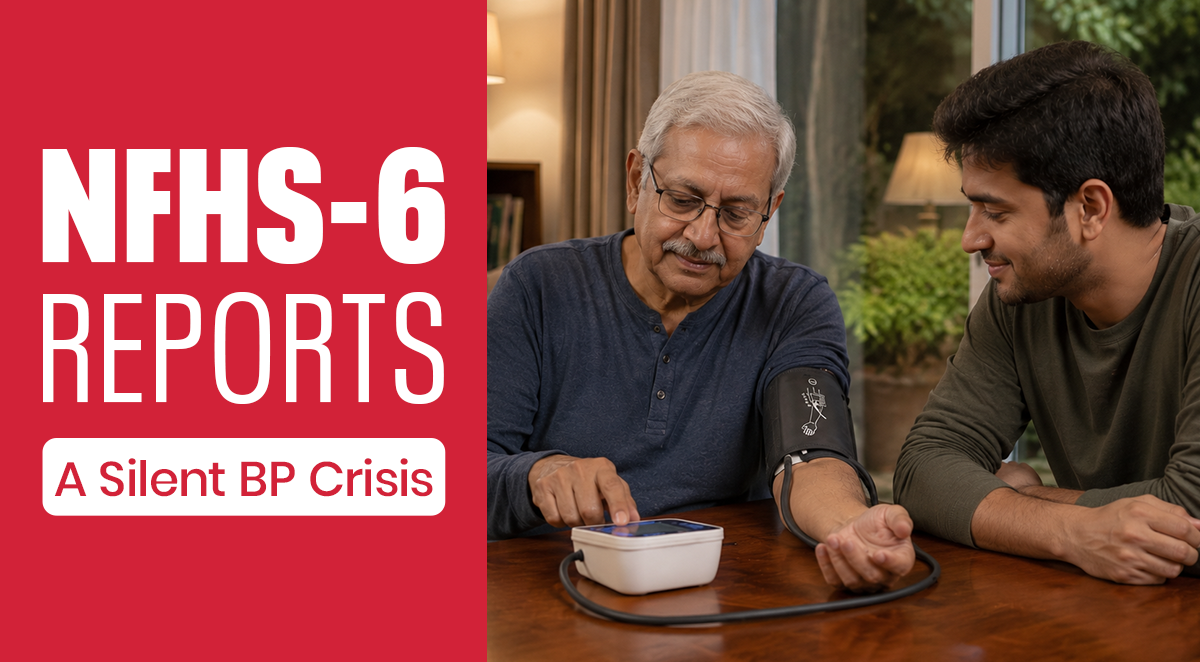
And Your Parents Are Right At the Center of It
Based on NFHS-6 (2023-24) Data
India's largest national health survey has confirmed what countless families have been living with. And the bad news is that the numbers do not offer us an escape.
Picture this.
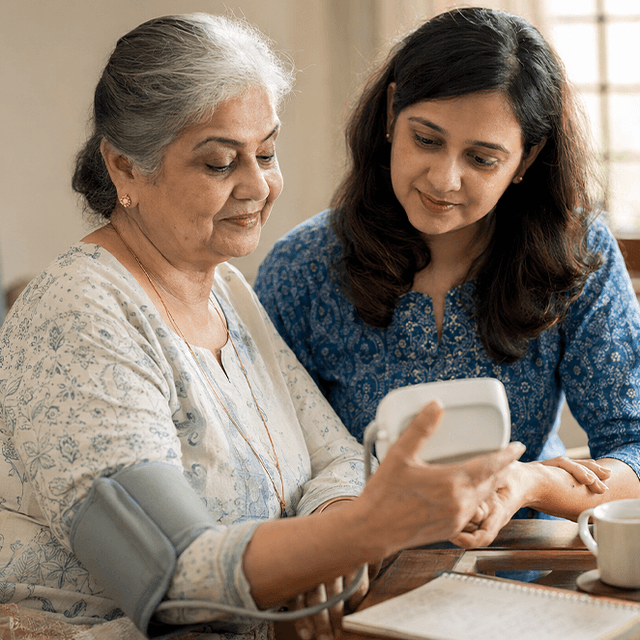
You're visiting your parents on a Sunday afternoon. Lunch is done, everyone's a little drowsy, and your father is settling into his chair with the TV remote. You ask, as a complete afterthought, "Papa, when did you last check your BP?".
He waves it off. "Theek hai. Don't worry. I feel fine."
Mom jumps in and adds, helpfully, that he had it checked perhaps 8 months ago at the local clinic. It was a little high, but the doctor said it was nothing to worry about. No meds were prescribed. He has not been back since.
And that, right there, is how a crisis builds. Quietly. Between the Sunday lunches and the reassuring hand-waves and the "I feel fine" moments that happen day after day until one day they don't.
India's National Family Health Survey 6 has just been released with data from 2023 to 2024. This is not a small poll or a regional study. It is the largest health census to have been done in the country with data collected across hundreds of thousands of households.
And it has found something families across India need to grapple with.
Over 20% of men and close to 20% of women in India have elevated blood pressure and are either already on medication or are non-medicated.
These are adults aged 15 and above. Which means the true numbers for people in their 60s and 70s are almost certainly far higher.
If your parents are in that age bracket, they are probably in the most categorically dangerous zone in this dataset.
This article is about what that means in real life. And more importantly, what your family can actually do about it.
Let's Actually Look at the Numbers
Health statistics can often seem overwhelming and 22% is just a number. It is easy to dismiss as an abstraction that won't affect your family.
Let's make it concrete.
Look around the room. If there are 5 Indian men over 40, then at least one of them has undiagnosed high blood pressure that is already causing damage. The same numbers apply to Indian women over 40.
Here is what NFHS-6 actually recorded:
| MEN (aged 15+) | WOMEN (aged 15+) |
|---|---|
| 22.1% have elevated BP or are on medication | 19.4% have elevated BP or are on medication |
| 12.4% mildly elevated (systolic 140-159 mmHg) | 9.4% mildly elevated (systolic 140-159 mmHg) |
| 3.3% moderately or severely elevated | 4.8% moderately or severely elevated |
Now, let's compare rural areas to urban areas:
| URBAN | RURAL |
|---|---|
| Men: 26.2% | Men: 20.4% |
| Women: 23.5% | Women: 17.8% |
That rural number is the one that surprised researchers. We tend to think of hypertension as a city disease. Desk jobs, traffic stress, processed food, late nights. And yes, urban rates are higher.
More than 1 in 5 rural Indian men currently have hypertension. The gap is closing faster than expected. Whether your parents are in a small town in Bihar or Gurgaon, the danger is present.
Hypertension was considered to be a disease of affluence. NFHS-6 shows us it has become a disease of India.
Is The Situation Improving or Getting Worse?
In order to compare: NFHS-4 within 2015-16 recorded elevated BP in 17% of males and 19% of females. NFHS-5 within 2019-20, it jumped to 24% in males and 21.3% in females.
NFHS-6 shows a very slight to no change. The figure for men has gone from 24% to 22.1% and for women from 21.3% to 19.4%. This is partially due to a rise in the supply of medication, and an increase in the momentum of health awareness campaigns.
But this improvement does not mean the problem has been solved, or that the millions of people who still remain undiagnosed and unmedicated and completely unaware of their blood vessel issues are safe.
The trend is not reversing, it is merely moderating.
The Term "Silent Killer" Often Loses Its Meaning
We've heard it with hypertension and while we may understand it when we hear it, we don't tend to absorb it.
So let me try it this way.
Think about your home's plumbing.
Under normal circumstances, water flows freely through the pipes. But if the water pressure is set to be too high permanently, the pipes don't break right away. Instead, they develop tiny cracks and at the joints of the pipes there are weak spots. The walls of the pipe gradually thin out in places where you cannot see.
For years, it may seem that everything is fine on the outside.
And then something is inevitably going to give at the worst possible time.
The cracked pipe doesn't give you any warning. It just fails at the worst possible time.
This is how high blood pressure works. It does not provide a warning. However, it leads to the slow, painless, and structural weakening of the arteries, heart, kidneys, and brain.
When blood pressure finally shows symptoms, they will most likely be severe.
- Chronic pressure may lead to heart attacks, and causes the coronary arteries to narrow or become blocked and cuts off the heart muscle from receiving oxygen.
- Stroke occurs when a blood vessel in the brain ruptures or becomes blocked, resulting in varying degrees of impact, including partial paralysis, loss of speech, or even death. These events don't always manifest as severe episodes. There can be episodes of sudden confusion, which can be just as serious, lasting minutes or hours.
- Kidney failure occurs as a result of damage to a network of tiny vessels that filter blood. Sustained high blood pressure causes these vessels to become damaged. By the time the kidneys show signs of losing their function, the damage has already been done over the course of many years.
- With loss of vision, the small blood vessels that supply the retina can either rupture or become scarred over time. This may be described by someone as an occasional blurring of vision or things looking different. By the time they become aware of it, the damage may be significant.
The worst part about all of this is that there are no warnings. With the body, the whispers come before the screams. With high blood pressure, even the whispers are absent.
Your Parents are in the Highest Risk Category
An analysis of the NFHS-6 data shows these numbers for all adults aged 15 and above. Men's prevalence is 22% and women's is 19%. This includes children, young adults, middle-aged, and senior citizens.
Age changes everything about these numbers.
As people grow older, blood pressure tends to rise. This is because the arteries lose their elasticity and become stiffer. The kidneys also become less efficient. The effects of a person's diet, stress, and lifestyle begin to show after many years. Research shows that in people aged over 60, the rates of hypertension are greater than 60%. This is in stark contrast to people under 30 where the rates of hypertension are in single digits.
Here's the math that should stop you:
If more than 1 in 5 adults of all ages in India have hypertension, the proportion among people in their 60s and 70s is not 1 in 5.
It is significantly more than that.
The 22% average for hypertension diagnosis is skewed lower due to a large number of young healthy adults. Take these healthy young adults out of the calculation and the picture becomes much bleaker for older parents.
The Other Issue: No Condition Travels Alone
High blood pressure almost never shows up by itself.
The NFHS-6 data shows that 17.8% of women and 20.9% of men have either high blood sugar or are on medication for diabetes. Among women, 27.3% are classified as overweight or obese.
Doctors tend to refer to the combination of hypertension, diabetes, and excess weight as a metabolic cluster. The term sounds technical. What it actually means is this: each condition makes the others worse.
Diabetes causes damage to blood vessels. Obesity puts additional strain on the heart. High blood pressure causes all of these problems to occur simultaneously. Managing these 3 conditions means someone is not just dealing with 3 separate issues. They are dealing with one complex problem that significantly increases risk.
For older parents, who are more likely to have one or more of these conditions, the risk associated with this combination is not simply additive. It's multiplicative.
The Indian Diet Factor
This point needs to be discussed honestly in the family.
The average Indian diet is high in sodium. Not because anyone is being careless, but because our food culture is built around salt in ways that are almost invisible: the pickle at every meal, the papad, the packaged snacks, the restaurant food that tastes "just right" because it's been heavily seasoned, the chai that comes with salted biscuits.
Research on dietary patterns specific to South Asians finds that high sodium intake is a key contributor to raised blood pressure and it is something that can be controlled. This is a unique factor when considering modifications, as things like age and genetic make-up cannot be altered.
Stress is also a considerable factor. Whether it be due to money, family, or the stress of carrying the weight of a worrying and anxious mind over several decades, all contribute to measurable declines in cardiovascular health.
There has also been a concerning decrease in physical activity among all age groups. People are walking less and sitting more. They are opting to move through life by auto-rickshaw or by sofa instead of using their feet.
While all of the above information has weight, it is not meant to instill a sense of guilt. It is meant to show the factors that lead to the problem and help identify what drives risk which is the first step toward changing it.
What Families Often Perceive Prior to Doctors
Family members often catch things first. Not because they're medically trained, but because they're paying attention.
A daughter sees that her father is getting breathless after just one flight of stairs when six months ago he could go up and down 3 times without a problem.
A son sees that his mother has complained of headaches 3 times this week, which she always dismissed as "tiredness."
A spouse might see their partner sleeping restlessly, or notices that he wakes up at night more often than before, and although it might be hard to put into words, it's there and it's real.
What families see is not nervousness. These are facts and they are important.
Hypertension is an example of a chronic condition that is often symptomless until it has reached the point where the body begins to show signs of distress. These individual symptoms can be dismissed, but when they occur together, they should be taken seriously.
- Recurring headaches at the back of the head, especially in the morning. These are often dismissed as tension headaches or due to poor quality sleep. If these happen repeatedly, seek medical attention.
- Blurred vision or visual disturbances. These are often described as "seeing spots" or "things looking hazy." These symptoms are often overlooked unless someone asks about them directly.
- Shortness of breath with mild exertion. This includes activities such as climbing stairs, carrying groceries or walking from the car to the house. If you experience breathlessness more than a year ago, see a doctor.
- A sensation of the heart skipping or pounding. This is often described as the heart "doing something strange". This can easily be dismissed but should be medically examined.
- Nosebleeds can occur without any explanation and are less common than other symptoms, but may indicate severe hypertension in some cases.
- When someone experiences extreme fatigue to the point when the person does not feel tired from work, it may indicate an underlying condition. No amount of rest seems to alleviate the issue, as it seems to be a much deeper issue.
While it's important to clarify that the majority of people with hypertension exhibit none of the symptoms listed above, it is precisely that what makes it one of the most dangerous conditions someone can have. There is an absence of symptoms, but that does not mean that blood pressure is normal. The only way to confirm this is an actual reading.
What most families need to hear:
Hypertension starts causing damage before a single symptom appears. It is not until the pressure has exceeded safe levels that the damage begins accumulating silently.
- Symptoms are a late signal.
- A blood pressure reading is an early one.
These 2 things will determine whether someone lives or dies.
Steps to Keep Blood Pressure Under Control
In public health, there's a concept called the hypertension cascade. It describes the sequence a person has to travel through before their blood pressure is actually under control.
These are: having an awareness of elevated blood pressure, then being diagnosed, followed by a treatment plan, and finally leading to an actual control of the condition.
In India, many people drop off at the first step, as most people remain unaware.
It is not out of disregard for the situation. It's simply the nature of hypertension. The nature of the disease does not give them the cause for concern. The candidacy for a clinic visit does not even consider one single blood pressure measuring that would take place under the doctor's time constraints in a busy waiting room. The blood pressure reading will not capture the average of a multitude of other readings taken in the days and weeks leading up to that blood pressure reading.
You cannot treat what you have not measured. And that is precisely the paradox of most people with high blood pressure in India. Most people have never measured their blood pressure at home.
This is where entire families have the greatest opportunity to affect change.
The single measurement taken during a clinic visit represents a situation, in a specific place, at a specific time. That measurement can even be high due to situational anxiety, a time-sensitive rush, and what is known in the field as white coat hypertension (blood pressure spikes when in the presence of a doctor).
In contrast, the repeated measurements of home blood pressure monitoring will reflect the true physiological activity of the cardiovascular system.
The most recent clinical guidelines from the European Society of Cardiology endorse home blood pressure monitoring as an add-on to clinic blood pressure measurement. In contrast, home blood pressure monitoring must be used as a stand-alone.
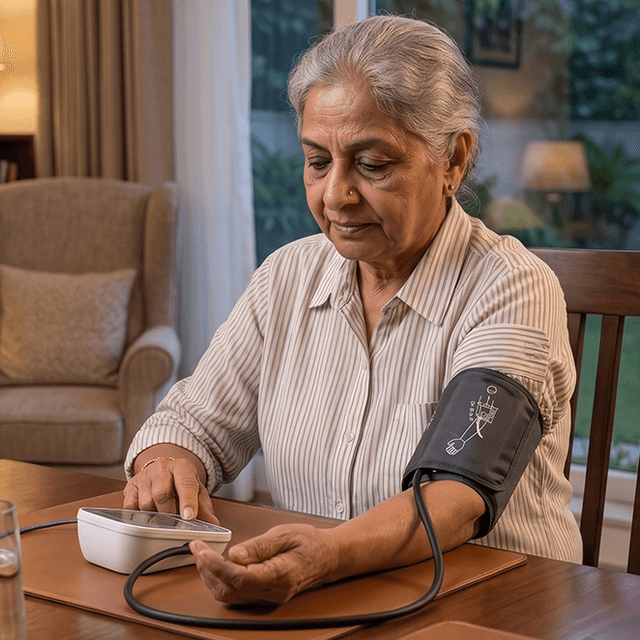
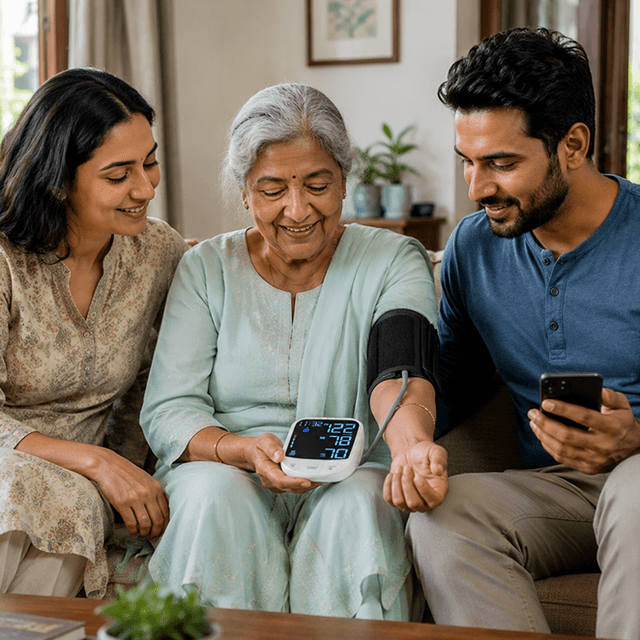
The necessary technology is inexpensive and undemanding. The usage of a digital upper-arm blood pressure monitor which is used correctly provides a reading that a doctor can trust. The devices are not highly sophisticated. They are used at home like thermometers and provide a measurement of critical importance.
What Your Family Can Actually Do, Starting This Week
Let's get practical. Because information without action is just worrying with better vocabulary.
Step 1: Have the Real Conversation
Not a passing comment. An actual conversation.
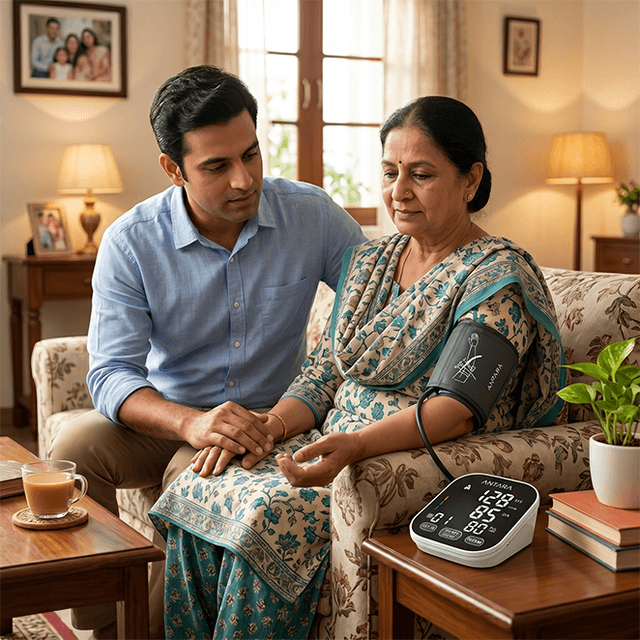
Ask your parents when they last had their blood pressure checked. Do you know what the numbers are? Have people advised you to do home monitoring? Are you on any medication, and do you take it daily, or as you remember?
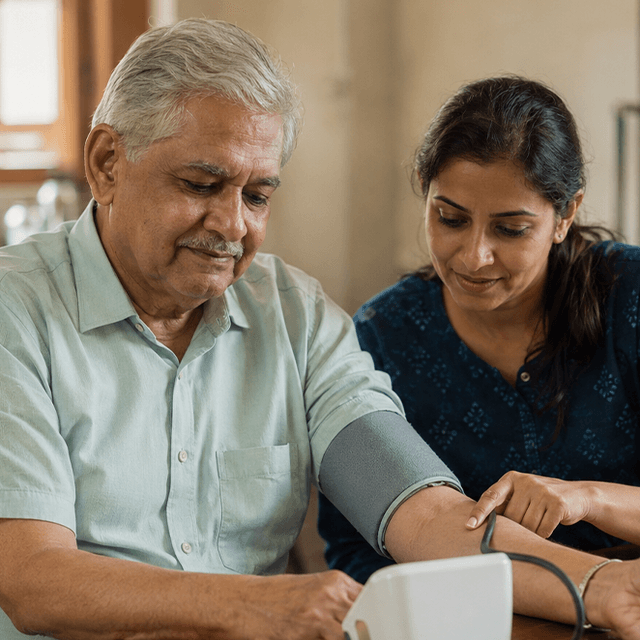
Most older parents won't volunteer this type of information. It's not because they are hiding anything, but because they do not want to worry someone, or they convince themselves that it is not serious. That tendency to downplay health issues in front of family members is real, and it comes with a price.
Your parents could be hiding serious issues and this type of culture can cover it up.
Step 2: Get a Reliable Home Monitor
This is probably the single most consequential thing a family can do for an ageing parent's cardiovascular health.
What to consider when purchasing a home blood pressure monitor:
- Cuff on the upper arm not the wrist. Upper arm blood pressure monitors are more accurate for adults, especially those with specific sizes or conditions regarding their arms.
- Clinically validated. Look for blood pressure monitors that have been validated by a third party.
- Easier to read. A monitor with a large display is often more convenient.
- Memory storage. The possibility of storing several readings over time is essential if a gadget is to be upgraded to a health tool.
- One button to make it easier. If your parents can't do it by themselves, they won't do it regularly.
- Irregular heartbeat detection. A good monitor will flag an irregular rhythm during measurement.
Platforms like AGEasy carry a curated range of medically graded monitors specifically chosen with older adults in mind, designed for ease of use, readability, and the kind of accuracy that holds up when you bring the numbers to a doctor.
Step 3: Build a Simple Monitoring Habit
One-off readings are better than nothing, however it's the consistent readings that create real value. This is especially the case for your parent's doctor, as they will be able to use this data to further assess your parent's condition.
Most cardiologists provide the following recommendations:
- When: In the morning, take a reading before any medication has been taken or breakfast been eaten. In the evening, take a reading before dinner.
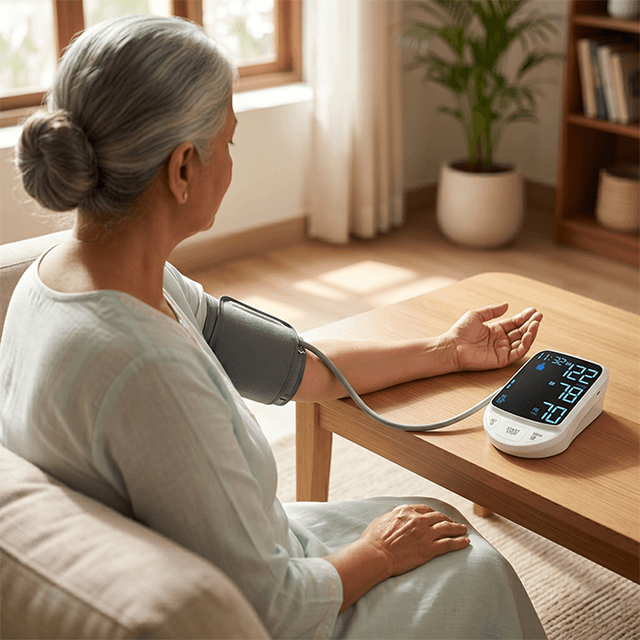
- Position: Seated with feet flat on the floor. The arm should be resting on a table that is approximately at heart level.
- Prior to measurement: Sit quietly for five minutes. Avoid drinking tea or coffee 30 minutes before reading. Don't engage in any form of exercise 30 minutes before.
- Number of readings: Two readings should be taken, one minute apart. The average of the two readings should be calculated.
- Record each date, time, and both readings. The monitor has memory functionality, and so does a good old notebook.
Step 4: Understand When a Reading Needs Immediate Attention
Most readings above expected values are informative, not emergency readings. They say what needs to be addressed. However, some readings do require immediate action:
- Systolic readings above 180 mmHg or diastolic readings above 110 mmHg: This is a hypertensive crisis. Do not wait for tomorrow. Do not wait to see if it goes down. Seek medical attention, especially if there is concomitant chest pain, severe headache, visual problems, shortness of breath, or confusion.
- Consistently elevated above 140/90 mmHg: make a doctor's appointment. This week, not next month.
Step 5: Consider the Whole Picture
The cross-sectional information NFHS-6 provides us concerning the co-morbidities of hypertension, diabetes, and excess weight allows for a truly useful approach that tackles all 3. Evidence based lifestyle change for blood pressure:
- Sodium intake reduction - This goes beyond the salt shaker and your friends' tasting-their-homes-seasoning packs. Watch out for the salt in your hometown restaurant meals, and even in the packets in your kitchen.
- Blood sugar monitoring - Since diabetes and hypertension frequently co-occur, blood glucose levels should be checked regularly to monitor blood sugar levels. Elevated blood pressure should be accompanied by management of both conditions.
- Weight management - Even slight sustained weight loss is associated with a significant decrease in blood pressure. It is not about a dramatic change, it is about consistent change.
- Physical activity - Evidence that 30 minutes of walking on most days improves cardiovascular health is both clear and compelling. The main barrier is a lack of habit, not ability.
- Adherence & Consistency - The most important thing about blood pressure medications is that they have to be taken every day. Not just when your parents feel sick. Blood pressure is a chronic illness, and the medications work by controlling the blood pressure. If a dose is missed, it is not a small mistake. It is a step backward, and control is lost.
To Families Whose Parents Are Not In The City
The NFHS-6 result that the rural numbers have drawn less attention than they deserve. The rural male figure is 20.4%. The rural female figure is 17.8%.
The challenge of obtaining routine medical services in rural India is unqualifiedly distinct than obtaining these services in urban areas. Urban hospitals house specialty services, such as cardiology. A good diagnostic center may be many miles away. Few, if any, of the families in these areas can afford the time and resources to travel to a monitoring clinic.
For these families, home monitoring isn't a nice-to-have. It's the only practical option for consistent tracking.
A reliable monitor in the hands of a family caregiver, combined with India's increasingly accessible telemedicine infrastructure, makes it possible to track a parent's blood pressure meaningfully without requiring a city trip for every reading. The data can be shared with a doctor remotely. Decisions can be made on actual evidence rather than guesswork.
Distance from a city is no longer a reason to forgo monitoring. It's more of a reason to start.
What NFHS-6 Is Really Asking of Indian Families
The NFHS-6 report is asking more of families in India than just numbers. Each person represented by a number is a person whose family loves and cares about them, yet they are not actively involved in matters concerning their health that could be critical. The report highlights India's serious problem with unrecognized hypertension that is not confined to a geographic locale, a level of affluence, or a niche demographic. Rather, it exists in the middle-aged populations that many families are currently balancing.
Each year, the blood vessels experience greater damage due to unchecked pressures.
Waiting for a crisis to begin dialogue, however, is less straightforward.
The invisibility of prevention makes it easily postponable.
The big decisions for health, uncommonly found in hospitals, are made in homes, in families that observed something, asked something, and answered with "theek hai," knowing full well that this was inadequate.
That talk you've been wanting to have with your dad about his hypertension? It's overdue.
Not next month. This weekend.
Important Note
This article is for educational purposes only and does not constitute medical advice. If you have concerns about your own or a family member's blood pressure, please consult a qualified healthcare professional. Home blood pressure monitors support, but do not replace, medical diagnosis and treatment.
Sources & References
- National Family Health Survey (NFHS-6), 2023-24. International Institute for Population Sciences (IIPS), Mumbai. Data reported by The Week, June 1, 2026.
- National Family Health Survey (NFHS-5), 2019-21. IIPS, Mumbai.
- Anchala R. et al. (2014). Hypertension in India: A systematic review and meta-analysis of prevalence, awareness, and control of hypertension. Journal of Hypertension.
- Williams B. et al. (2018). 2018 ESC/ESH Guidelines for the management of arterial hypertension. European Heart Journal.
- Carey RM. et al. (2022). Global Hypertension Practice Guidelines. Journal of the American College of Cardiology.
- GBD 2019 Risk Factors Collaborators (2020). Global burden of 87 risk factors in 204 countries and territories. The Lancet.