
Walking Stick with Seat for Seniors in India: What It Is, Who It's Really For, and How to Pick the Right One
Aug 6, 2026
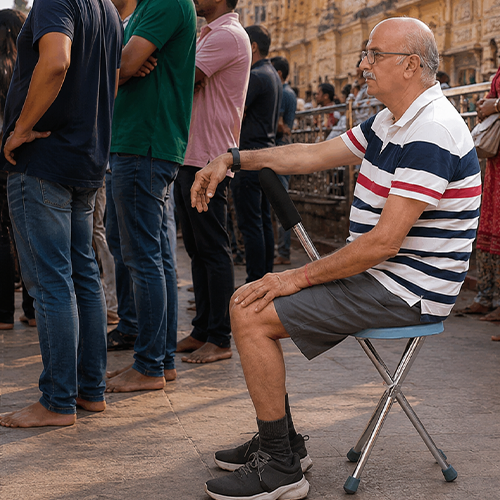
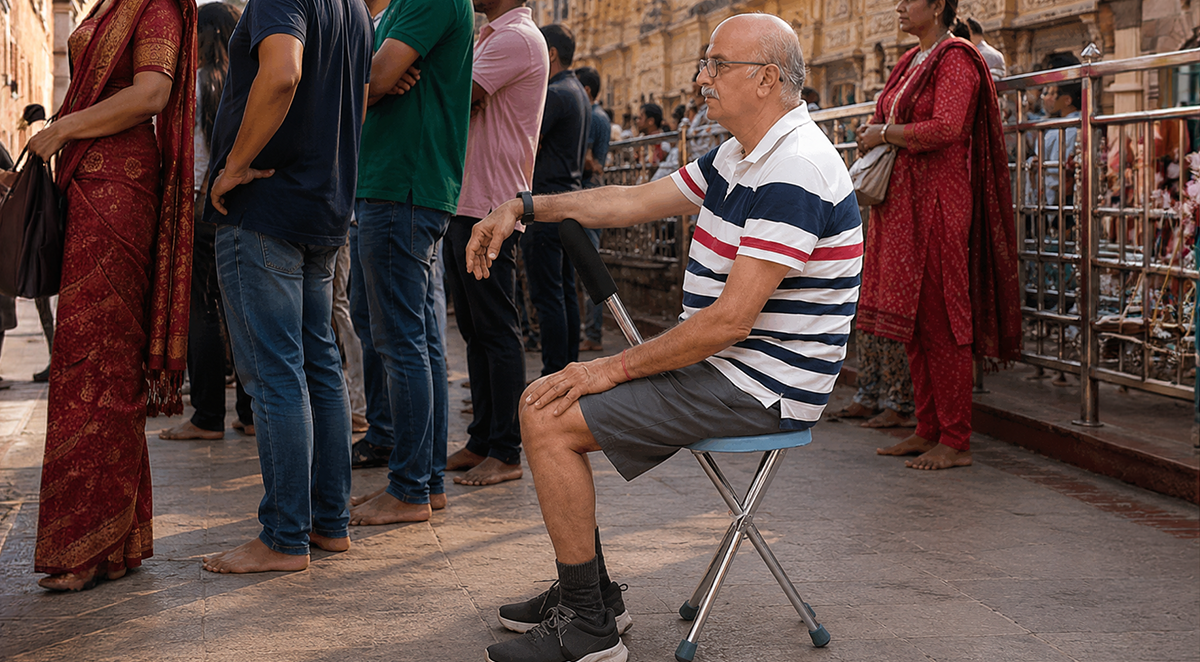
We often think of mobility aids as tools for walking, but sometimes the greatest act of care is giving your parents the freedom to stop.
Only caregivers know this kind of exhaustion. It is not the typical exhaustion one gets from working all day. It is more serious and more painful. It involves watching someone you love stand in a hospital queue for forty minutes literally shifting their weight from one side to the other, resting against the wall when they think you are not looking, and asking someone to find a spare chair for them.
Or maybe it's that moment at a wedding, a visit to a temple, a Saturday at the market when you see that they have reached their limit, and no one is saying it out loud. So the trip gets cut short. Again.
This is exactly the issue that a walking stick with a seat is designed to solve. It is not a highly medicalized device, nor is it a clinical intervention with a dangerous name, but it is a brilliant simple tool that says: whenever you need to take a seat you do not have to wait for a bench, a wall, or someone to give you permission.
So let's see what it is, how it works, who it really assists, and what features to look for before you buy one in India.
What is a Walking Stick with Seat?
To put it simply, it's a walking cane with a seat that you can fold out and use to sit on when you need it.
Depending on the seller, a foldable chair stick can also be referred to as a seat cane or walking stick chair. However, there is no difference between the products.
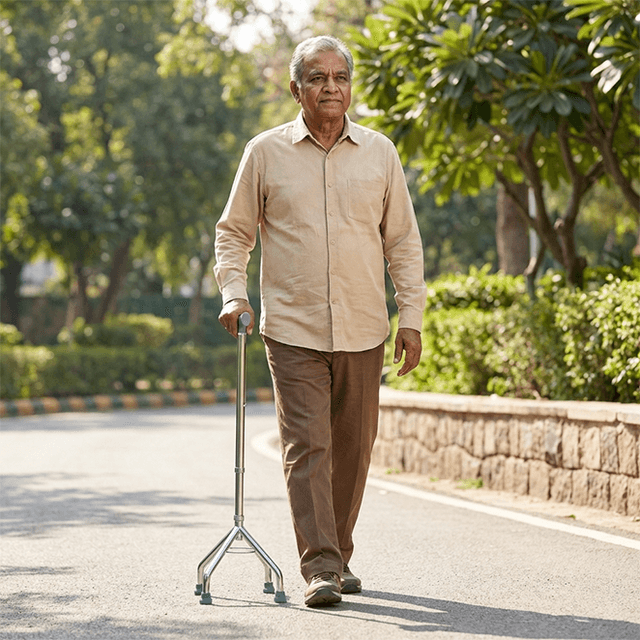
The way this cane works is when someone is walking, it acts like a regular cane. But when someone using the cane wants to take a rest, whether standing at a line, on the street, or anywhere else, a small seat that is hinged folds out from underneath the handle. The seat is typically triangular or round, and made out of fabric or molded plastic. The user will sit on the seat, and the shaft of the cane, along with its base (either a single rubber tip or a wider tripod), takes all of the weight. Then when the user is ready to start walking again, the seat gets folded back up and it acts as a cane again.
The nice part about this is that it takes away the dependency. People do not have to feel like they are having the potentially awkward conversation of asking someone to help them find a place to sit.
Real-World Problems Addressed
When many people think about accessibility for seniors, there are usually large barriers that come to mind such as large entrance stairs, elevators, and wheelchairs.
However, the day to day struggle is often much smaller and much more tiring than that.
A trip to a public hospital? For a journey to see a physician, it could be anywhere from 30 to 60 minutes waiting in a queue at registration without any assurances you will even get to sit down. A trip to the bank at the beginning of the month? The room is packed, and everyone is standing. An outdoor religious ceremony or wedding? There is a crowd to get through, and then you can rest your tired knees on the seating that is provided. A market or a fair? You will be walking for a long time with little to no breaks.
These annoyances may seem trivial to us.
But for elderly people with joint pain, low stamina, mild breathlessness, or fatigue that comes with aging, these scenarios become real hindrances to their independence. Not access, but going at all. They quietly lose the ability to choose as a dependent person either wait for someone to take their place, end the activity prematurely, or endure discomfort until it becomes unbearable.
A foldable chair stick shifts your mental model. It will not restore your mobility or prevent falling but it will give you the ability to set the pace of your outing without relying on someone else.
Why You Need to Test the Folding Mechanism First
Most folding chair sticks in India have one of two designs for the seats.
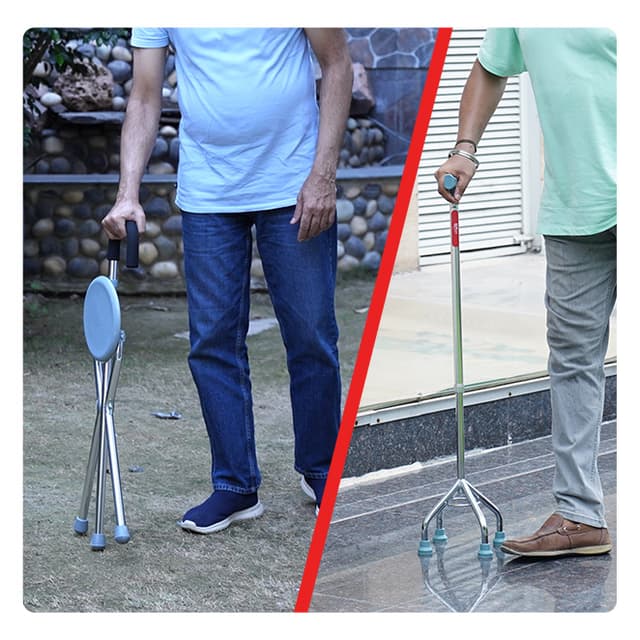
The folding fabric seat is the most common. A small cloth panel made of nylon or canvas, is attached to a collapsible triangular or U-shaped frame. When unfolded, the fabric snaps tight to form a sitting surface. The weight of the user is spread across the fabric and is transferred down through the shaft to the ground. When folded back, the frame collapses. The seat is lightweight, compact, and serves most use cases well.
The moulded seat is the less common option. A rigid plastic or padded disc sits at the top of the stick, providing a firmer surface. Though it has a more solid feeling, it is also heavier and bulkier when folded. This type of seat is typically found on sturdier, heavier-duty models.
The folding fabric seat and the moulded seat both give the stick the capability to act as a regular walking aid while the seat is closed. The height adjustment on the lower shaft operates completely independently of the seat mechanism.
One practical tip: the folding seat does take some getting used to. Most people become comfortable with it after a few uses. This is important if the person you are buying for has significant grip weakness or dexterity problems in their hands, please test the mechanism before making a purchase. Some seats are much easier to open than others, and that can make a significant difference in the moment.
The Walk & Rest Walking Stick and the Unibase Seated Walking Stick sold by AGEasy are walking sticks for seniors that provide walking assistance and a foldable seat.
Materials: Daily Use Considerations
You would mostly find aluminium alloy and steel on the Indian market. Here's the complete analysis.
Aluminium alloy is lighter - usually between 600 to 900 grams depending on the model. And weight really does matter. While choosing a model, a stick that seems totally fine at the shop could really just become tiring to carry at the end of a long hospital visit. There is an added complexity for construction of thinner aluminum that could provide a less rigid feel when loaded.
Steel is heavier - commonly goes as high as 900 grams to 1.2 kilograms or more but is usually more robust and can take on higher weight limits. If the user is larger or heavier, a steel-framed model may provide higher confidence and peace of mind. The disadvantages are fatigue from over long use and the necessity for care to avoid rust.
For the seat surface, nylon and canvas fabrics are lightweight, breathable, and comfy in warm weather but have low weight ratings. Moulded plastic or padded seats are more bulky but tougher.
Whatever you consider, get the manufacturer's stated load-bearing limit in writing. Do not estimate. We'll discuss why next.
Important: Maximum Weight Capacity
Every cross-brace chair is designed for a specific maximum weight. This is not a suggestion or a guideline, but a safety and structural specification. It is the value that the product is designed and tested for.
Cross-brace chairs in India commonly range from about 90 kg to 120 kg, but this differs a lot based on the product and construction, so be sure to read the documentation for the exact product, not an estimate.
What happens if that limit is exceeded? The fabric could tear while sitting on it, the frame can break, and the shaft could buckle under compression. This is not a moment that anyone managing balance issues can afford. It creates a fall risk.
If the person you are buying for is around the upper end of a model's stated limit, choose a model that has a greater delta. The price difference between models is almost never significant. The difference in safety is not a gamble worth taking.
Getting the Height Right
A walking aid that is the wrong height not only doesn't feel comfortable, it can cause active problems. If it is too short then the user will hunch, which will put a strain on their shoulder and back. If it is too tall then they will lose control and leverage while walking.
The standard guidance for physiotherapy regarding the height of a cane applies here too: the handle should reach approximately to the user's wrist when standing upright with both arms down at the side of the body. This will create a slight elbow bend during use, the position biomechanically most efficient to take weight through a cane.
Most Indian market chair sticks offer push-button height adjustment, usually covering a range of about 75 cm to 95 cm (though this can differ by product, always check). Before buying, make sure the range fits the user's actual height.
If you are shopping online and the user isn't there to try it, measure their wrist to floor height when they are in their regular shoes. This measurement is the most reliable indicator of the minimum handle height required.
Who This Product Actually Helps
We will be clear here, the right implement for the right person is genuinely useful, and the wrong implement for the wrong situation can lead to a misplaced confidence.
A walking stick with seat is appropriate for elder people who:
- May walk independently or with some support but can get tired or feel discomfort during longer outings.
- Possibly mild balance issues or some joint pain that makes standing still for a long time genuinely challenging.
- May attend appointments, religious activities, or social events where wait times are unknown.
- Possibly use public transport where seats may not be available.
- Lead an active lifestyle but may want to be able to take a break.
It's about being able to maintain an active lifestyle with less reliance on others.
Who This Product Is Not For
This is equally important.
A foldable chair stick is not the best primary aid if some serious instability is affecting the person you take care of:
- If they have fallen a lot or have had recent falls
- If they have to use both hands for support to maintain stability while walking
- If they have moderate to severe neurological issues that make walking very difficult
- If they cannot safely put weight on their legs for more than a couple of steps
- If a physician or physiotherapist has recommended the use of a walker or a wheelchair
Then that person would not be an appropriate user of a chair stick. It may possibly be used in addition to other mobility aids, but it will not replace the need for a more supportive aid.
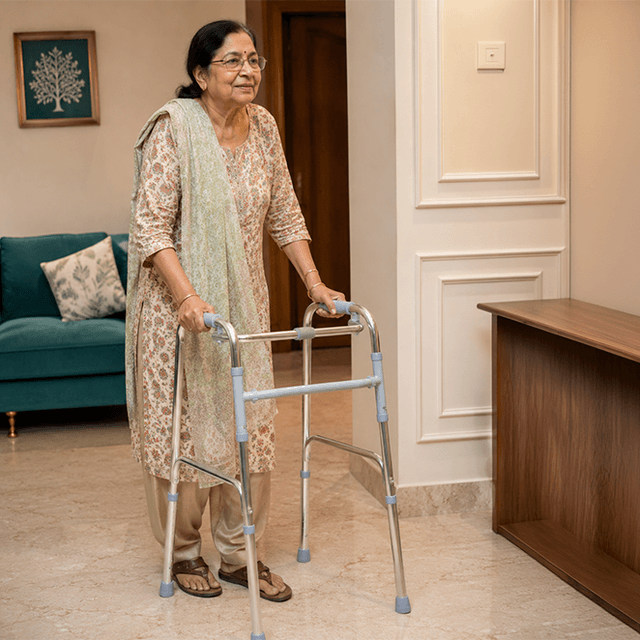
For seniors requiring a wider base of support and additional stability, wheeled walkers provide more than just a frame to hold with both hands. They also offer additional balancing support and typically come with a seat. For finding the right mobility aid, one should consult their physiotherapist or orthopedic surgeon. AGEasy offers walkers with wheels for seniors, which may be worth considering if their balance issues go beyond the safety offered by a single-point cane.
Portability: The Practical Details That Actually Matter
One of the advantages that are often overlooked with a chair stick, as opposed to bigger seated mobility aids, is that when folded, it is simply a walking cane.
Most of these stick chairs fold to lengths of between 75 cm and 95 cm and can be carried in hand, hooked over a wrist, or placed in the footwell of a car or autorickshaw, with no boot space needed, and no separate bag or carrier needed. This will be especially appreciated by families when using public transport or navigating busy urban areas.
The weight of these stick chairs when folded is typically under a kilogram if made of aluminum, which is light enough to not become a burden during those parts of a journey where it is being carried, instead of being used.
Some models come with a wrist strap or loop. While it is a small feature, it can be useful for seniors with reduced grip strength as it prevents the stick chair from being dropped without requiring them to hold on to it.
A Practical Buying Checklist for India
Before making a decision about buying anything, there are a few questions to consider:
- What is the user's weight? This needs to be assessed against the load bearing limit provided by the manufacturer. This is a safety consideration, and should not be guessed.
- What is the user's height? Check any adjustability of the product, to ensure it can be set to a height that matches the user's wrists, with their arms fully relaxed, so that the handles align.
- Where will it be used primarily? Different surfaces such as hospital lines, open spaces, and urban areas with uneven surfaces can present various challenges to mobility. If using it outdoors often on uneven surfaces, consider products with wider bases for stability rather than one with a single rubber tip.
- What is the level of the user's grip strength? If it is low, ensure you test the folding mechanism before purchasing it. Not all seats deploy as easily as each other and this matters in practice.
- What material is most suited to the usage pattern? Aluminium and breathable fabric is usually the right choice for lighter users and humid climates. Conversely, a steel frame with a more rigid seat is better suited for heavier users or for cases of less frequent use, even if it is an additional weight.
- Does the product have good accompanying documentation? It should be clear what the load bearing limits, materials used, and height adjustments are, no estimates, vagueness, or ambiguity. If a seller cannot provide you with the weight limit, that is valuable information to help determine how much trust you should place in them.
- Is there a process for returns or exchanges? For items that people depend on physically, being able to exchange or replace for a different height or for a broken part is something to confirm beforehand.
Addressing Foot Fatigue
The chair stick handles short rests. But it doesn't take away the accumulated impact of hours spent on hard floor surfaces like those found in hospital corridors, bank waiting rooms, and paved event spaces.
For seniors who are already dealing with foot fatigue, arch pain, or flat-foot discomfort, supportive insoles can help alleviate the discomfort that builds up during prolonged walking and standing. It isn't dramatic, but it is something.
If foot fatigue is a common issue during outings, consider the ArchPro insoles from AGEasy.
Outing Crisis Prevention
The signs are usually subtle, long before they become obvious, and anything becomes a crisis.
The senior who walks more slowly from the car park. The parent who leaves early and states that they're just a little tired. The individual who complains about their legs "not being what they used to be" and then, gradually, almost imperceptibly begins to decline invitations.
These are not dramatic incidents. They are small withdrawals from everyday life, dismissed as "just getting older" when in reality it could be something significantly more manageable.
A walking stick with a seat might not reverse aging, but in some situations, for some people, it gets rid of a particular friction that makes going out more difficult than it needs to be.
The Difficult Question
It's not really about whether a chair stick is a good product.
The difficult question and one many caregivers are grappling with is whether the person who needs it will be willing to accept that type of device. Whether you will find the right time and the right phrases to bring it up.
Most mobility aids are met with resistance at first. Not because the aids wouldn't help them. But because using them requires someone to name a change that is uncomfortable, at best.
The best reframe that can be made is to move away from need or limitation. This is not about something being lost. This is about going further and staying longer without feeling exhausted, on your own, without asking someone for help.
That is what independence looks like.
One outing at a time.