
Pulse Oximeter Readings That Look Wrong: Motion, Cold Hands, Anaemia and Mehendi
Oct 26, 2026
Pulse Oximeter Readings That Look Wrong: Motion, Cold Hands, Anaemia and Mehendi
The small number shown on a fingertip pulse oximeter can decide the atmosphere in the room. One moment, your parent could be comfortable, and then, well, your parent could end up looking unhappy due to a fall in the oximeter reading.
A fingertip pulse oximeter reading can give some information, but can only provide part of the entire information related to a person’s health. Many factors like movement, poor positioning of the finger, cold hands, colour of nails, and anaemia can affect the reading.
One should never lose focus on the number. The person in front of you should never be neglected.
If a reading looks odd, first see if the pulse oximeter is faulty. If your parent has any symptoms like breathing difficulty, pain, confusion, bluish discoloration of lips, and severe weakness, treat your parent as an emergency and get him or her medical attention without waiting for a repeat of home readings.
What Does a Pulse Oximeter Measure?
A pulse oximeter shows the estimated level of blood oxygen saturation called SpO2 and also shows the pulse. It computationally estimates the level of oxygen saturation in blood, using a combination of red and infrared lights, by passing them through fingers.
It cannot detect or measure haemoglobin, lung capacity, blood pressure, or the cause of shortness of breath. A pulse oximeter measurement cannot be used in place of a complete clinical examination.
Healthy adults at sea level may register readings in the mid-90s or higher and in some cases possibly higher. Individual targets will need to be prescribed by a clinician for patients with chronic lung or heart conditions. Do not worry about comparing your parents’ readings to normal numbers.
Abnormal readings should not be acted upon until a follow-up measurement is taken. In the presence of symptoms, persistent low readings should be considered a medical emergency and visited upon.
Movement Interferes with Signals
The sensor will not detect a signal with motion. Movement will either produce a fluctuating reading, a no reading, or even an error message.
Shivering, repeated movement, tremors, and restless fingers cause issues. Older adults suffering from arthritis, Parkinson's disease, weakness, anxiety, and others with extenuating circumstances often have a hard time controlling movement. Hand tremors are often compounded by movements made by the caregiver.
Here are a few tips which may prove useful:
- Ask the person to keep quiet for roughly 5 minutes.
- Lower the hand and cushion it.
- Warm up the finger prior to placing the oximeter.
- Leave the hand below heart level unless a clinician tells you to do otherwise.
- Do not record the first number. Wait for the number to stop fluctuating and settle.
- Record three numbers with at most sixty seconds of separation.
If the readings become stable after movement, the first reading may not reflect the true number. Record the stable number and inform the doctor of this phenomenon.
Reduced Quality of Signal Due to Cold
Cold can restrict blood flow and reduce the reading to either weak and fluctuating or no reading at all. This is often the case after one has a bath, during winter and in air-conditioned rooms, especially for people with poor blood circulation. Cold can be felt in the fingers even when the rest of the body is warm.
To improve the blood flow to the fingers, before reading, warm your parents hand by placing it between warm palms or Cover the hand with a warm blanket. If your Parent has reduced sensation or diabetes, DON'T use heating pads.
If you have swollen fingers with rings on them, loosen the rings and test a different finger if the site showed a weak reading. Before placing the Oximeter on the fingertip, wash and dry the fingertip.
A cold hand does not mean low oxygen levels and does not mean a false reading. Wait and observe the symptoms and the trend after improving the circulation.
Mehendi, Nail Colour and Artificial Nails
Removing nail polish, gel polish and other dark artificial nails (e.g Acrylic nails, etc.) can improve the reading. The sensor light is blocked.
Due to individual variations and device differences, mehendi staining the fingertip can give you a false reading. We suggest you test without nail color if that is possible. If your parent has mehendi on both fingers and toes, you can try the side of the finger, a toe or the earlobe, if your device allows this. Again, DO NOT force the clip over any swollen and sore areas.
Comparing one finger to another is sufficient for a reading, instead of removing various layers of mehendi.
Take down the readings and the conditions of the measurements if outcomes are more favorable using other sites. Be sure to inform the healthcare professional about the mehendi and nail polish along with the results.
Anaemia Is Unlike Low Oxygen Saturation
Anaemia is defined either as an inadequate number of healthy red blood cells, or reduced haemoglobin. Red blood cells lose their ability to carry and distribute oxygen throughout the body if there is reduced haemoglobin.
A pulse oximeter only provides a percentage of the haemoglobin that is bound to oxygen. It does not indicate the amount of haemoglobin your parent possesses.
This is important. A person suffering from anaemia can still have normal oxygen saturation levels and still feel weak, tired, dizzy and short of breath. A pulse oximeter can show normal oxygen saturation levels with a lower total capacity of the blood to carry oxygen.
Never rely on a normal pulse oximeter reading to rule out anaemia. If your parent has a quick heart rate, feels dizzy, has unusual tiredness, paleness, low exercise tolerance and shortness of breath, then he/she should definitely be evaluated for anaemia. This can only be done by a physician, and a blood test.
Don't take it upon yourself to start iron supplements. There are many possible reasons for anaemia, like blood loss, chronic disease, and poor nutrition, to name a few.
How to Take a More Reliable Reading
- Use the same finger and hand every time.
- Make sure your parent has rested for at least 5 minutes.
- Make sure the hand is warm and relaxed.
- Make sure there is no nail polish on the finger.
- Clean the fingertip.
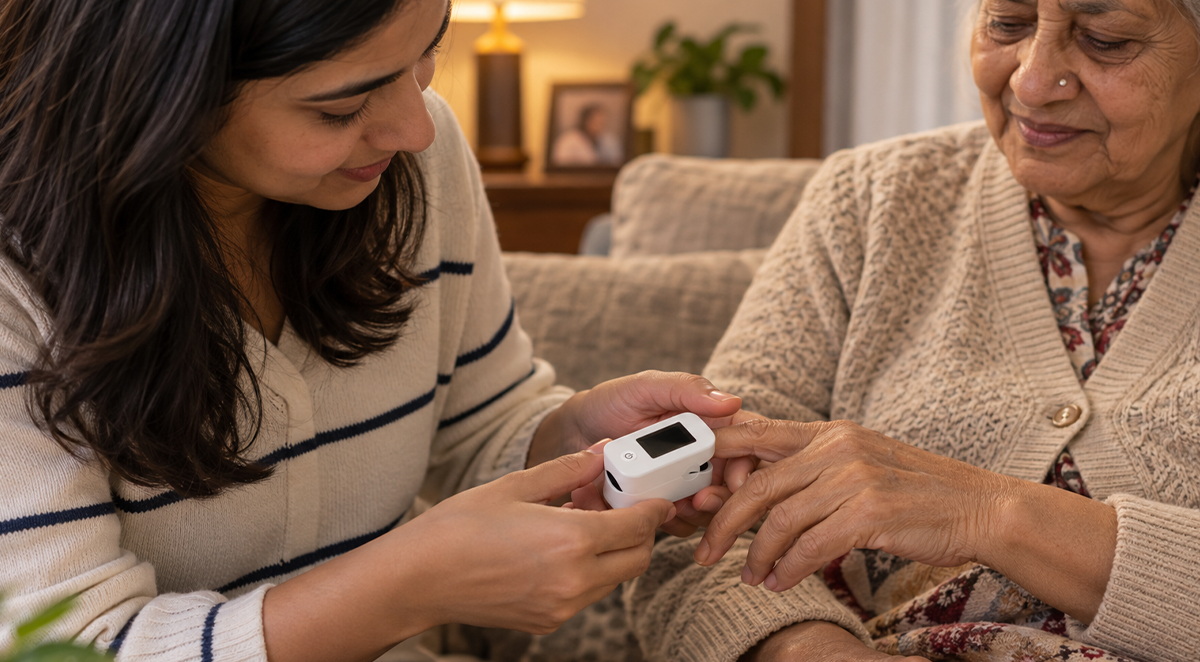
- Proper placement of the sensor is crucial for accurate results.
- Keep your hand still and do not talk while the reading is in progress.
- A stable reading of the SpO2 and pulse must be recorded.
- Symptoms recorded, including any movement or cold hands, must be logged along with the time, SpO2, and pulse.
A home log offers a doctor more relevant information than a single isolated reading. Note whether the reading was taken after movement, bathing/showering, exercise, medication, or sleep.
When Should You Seek Assistance?
Seek assistance at the nearest medical facility if your parent is suffering from severe shortness of breath, confusion, loss of consciousness, unusual sleepiness, slurring of speech, pain, or grey or blue lips. Do not waste time repeating the reading with different fingers.
Immediately contact the doctor if you get readings that are consistently lower than your parent’s normal values or if readings consistently fall below 90%. Depending on the person’s lung capacity or other health conditions, a doctor may set a target value different from 90%.
If you see a low value that is between 89% and 95%, the reading must be repeated. However, low values that are persistently repeated must be evaluated by a medical professional.
Do not increase the amount of oxygen provided to your parent unless the doctor provides you with a specific direct order for a home increase. Do not rely on the pulse oximeter to decide whether you are having an emergency; seek medical evaluation if you have symptoms.
Pulse Oximeter Selection and Use
The AGEasy Advanced Sensor Pulse Oximeter is one of the few at-home monitoring devices currently available that require the least adjustments to your parent’s daily routine and works best if you are consistent in your usage.
Before use, please go over the product instructions. See what the device has to offer in terms of how the device adjusts to finger placement, cleaning, where you put the battery, and other possible measurement sites. It is also important that you keep the device in a dry place and ensure that the caregiver instructions are available to everyone at all times.
Observation devices do not diagnose or confirm any pathologies. They do not explain what causes or how to manage the symptoms or provide any conclusive evidence to replace the professional clinician’s opinion.
The Safest Way to Interpret a “Wrong” Reading
An unusual reading should never be ignored, but should be verified by all possible means. Before checking the oximeter again and taking the reading, make sure your hand isn’t cold, there aren’t any barriers, and make sure your finger is properly supported.
After your parents hand is warm, take the reading and compare it with your parent’s other readings as well as their present symptoms.
In this case, motion, cold hands, and mehendi on your hands may also give a very poor or weak signal. Anaemia is concerning as the levels of Oxygen saturation and Hemoglobin are not the same.
Use the Device within the limits of your normal Routine as prescribed by your Doctor. If your symptoms or readings do not improve, seek help.
Disclaimer
This article is not medical advice. To treat the following as an emergency, seek medical attention: difficulty breathing, severe pain, confusion, loss of consciousness, bluish lips, or sudden changes in your parent. Contact your physician about low readings and symptoms for anemia.