


Cervical Pain Exercises You Can Do in a Chair: Neck Relief Without Equipment
Article by: Ayush
Jul 22, 2026. 10 min read
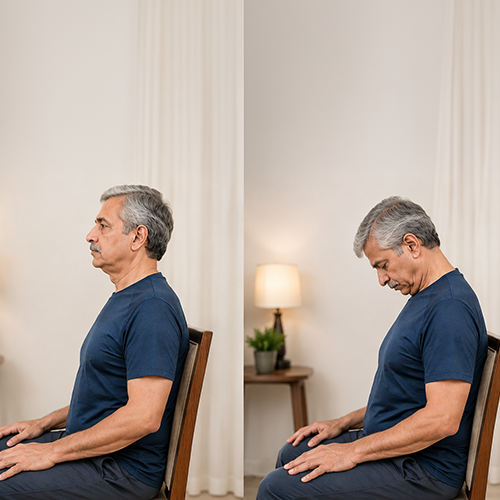
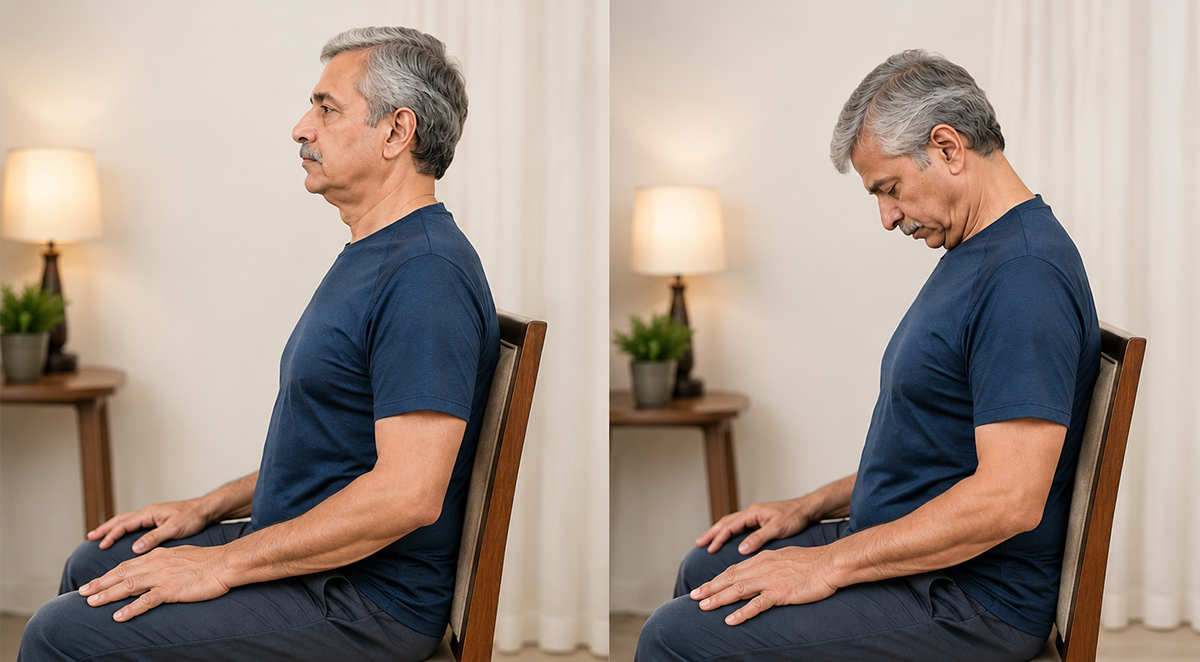
The first response most people have to neck pain is to avoid moving their neck. In many cases, this response actually makes the pain worse.
Over time, many older adults become nervous to turn their head at all. They might avoid looking over their shoulder. They may even sit still for longer periods of time. Unfortunately, this pattern causes their pain to get progressively worse, leading to a feeling of greater stiffness in the neck.
Many people believe that taking a break from moving will help them heal faster. Unfortunately, this is often one of the biggest misconceptions people have about recovery from neck pain and stiffness.
Some of the things you may encourage your parents to do include:
- Movements that are imitated from other people's experiences.
- Simple movements while sitting that do not require any equipment.
- Short stretches or movements that can be integrated into their daily activities.
These types of movements actually help to relieve neck conditions. In contrast, movements that create more stiffness should be avoided.
The goal is not to do more exercise, the aim is to get the neck moving again in a pain-free way.
Stiffness is not only the physical limitation caused by neck pain. It can also affect one's daily activities. When the head or neck cannot be turned, basic tasks like reading or even driving become problematic. Most people lose their confidence in their ability to move.
With simple, safe movements, your parent(s) can gain all of the things that were just stated including improved posture, increased confidence, decreased everyday neck stiffness, and greater range of motion.
This guide will show you what older adults can do at home, the best time to do it, and the signs that will show when it is time to quit and see a doctor.
Reasons Why Neck Stiffness and Discomfort Increases With Aging
As the head weighs around 5 kilograms, it is supported by the 7 cervical vertebrae. As the discs in the vertebrae are subjected to more friction, their water content is reduced and the discs become more pronounced. The joints are subjected to more friction, which causes the joints to wear. If un-used, the muscles in the neck will also weaken.
Most people over the age of 60 will have some form of cervical spondylosis on their scans and many won't have pain. A common cause of stiffness is reduced movement along with poor sleeping positions, and increased time looking down at phones, books and screens that are positioned below eye level.
If the reason for the stiffness is associated with disuse and poor posture then rest, movement and postural adjustments will assist in improving this. If the stiffness is due to nerve entrapment or some other related condition then medical evaluation and treatment is required.
Starting Guidelines
This may include safety parameters and other instructions on how to set this up, and run this, with your parent.
The person should sit on a proper chair with a firm seat, and with a back support, and flat feet on the floor. Sitting on a soft, cushioned sofa is counterproductive to the goal.
The person must be cautioned to move slowly during the entire exercise and to take several seconds for each movement in each direction. Rapid and jerky movements may increase strain or trigger dizziness, especially in older adults.
The person must be instructed to stop if he/she feels anything other than a mild pulling sensation to avoid pain. A sharp pain will require an immediate cessation.
Ensure that you are breathing normally during this procedure; holding your breath can raise your blood pressure, which is particularly important to manage if you have hypertension. For those with a parent on medication or starting a new activity, home monitors like the AGEasy One Touch Digital BP Monitor can help monitor the BP as a family.
Skip the session entirely on days with new dizziness, numbness, or fever.
Chair Exercises for Cervical Comfort
Each of these exercises takes less than one minute, so the entire routine takes roughly 8 minutes.
Chin Tucks
Start with a tall, relaxed position, with your shoulders back. Draw the chin straight back, as if making a double chin; do not tilt the head up or down. Hold for five seconds, then release. Repeat eight times.
This is the single most useful exercise for forward head posture, the rounded position that develops from years of looking down at devices. It strengthens the deep neck flexors that hold your head over your shoulders instead of in front.
Slow Head Turns
Slowly turn your head to the right until you feel a gentle stretch on the left side. Hold for five seconds, then return to center. Repeat on the left side. You should do this five times on each side.
This exercise directly improves the ability to rotate your neck for safe driving and for looking at someone speaking to you.
Side Bends
Lower your right ear down toward your right shoulder without lifting your shoulder up to meet it. Hold this for ten seconds. Return to center and switch to the left side. You should do three holds on each side.
Place the opposite hand on the chair seat. This helps keep the shoulder down more and will increase the stretch through the upper trapezius (where a lot of the tension is).
Shoulder Rolls
Going in a backward circle, roll your shoulders ten times. Then do it forward ten times.
Stiffness in the neck and shoulder stiffness goes hand-in-hand. Loosening the shoulders lessens the strain on the neck.
Shoulder Blade Squeezes
Pull both shoulder blades together as if they are holding a pencil between them. Hold this for five seconds, then relax and repeat ten times.
This acts to strengthen the muscles in the upper back which are responsible for good posture. If these muscles are weak, it will allow the head to move forward and the neck will take the strain.
Gentle Neck Flexion
Slowly lower your chin to your chest until there is a stretch around the back of your neck, hold for ten seconds then move it back to neutral. Repeat this five times.
As a home guideline, try to avoid extending the head backward. It can put pressure on the cervical joints and can cause dizziness for older adults due to less blood flow through the vertebral arteries.
Integrating the Routine Into Daily Life
In this case, consistency is more important than intensity. Two short sessions per day is more effective than one long session once a week.
Try and associate the exercises with a habit you already have, like after morning tea or before the evening news. The anchor being associated with the exercise is more important than the specific time.
Prior to stretching, applying heat can keep your muscles looser for easier movement. For example, applying a heat pack to the area for about 10 minutes before stretching will help ease the movements. Before or after the stretching routine, parents can use AGEasy pain relief gels and patches if they want to take a preemptive step toward discomfort relief.
Parents who experience more significant discomfort may find temporary support from the AGEasy Cervical Collar during flare-ups. This provides support for your neck, but your neck muscles will weaken if the collar is used for prolonged periods. It must be used with medical supervision.
What Happens During the Other Sixteen Hours
8 minutes of exercise is fairly pointless if everything else throughout the rest of the day directly works in the opposite direction.
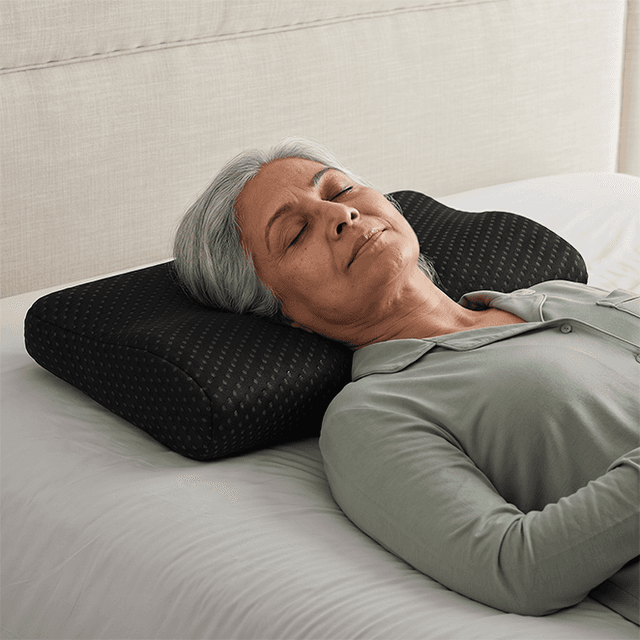
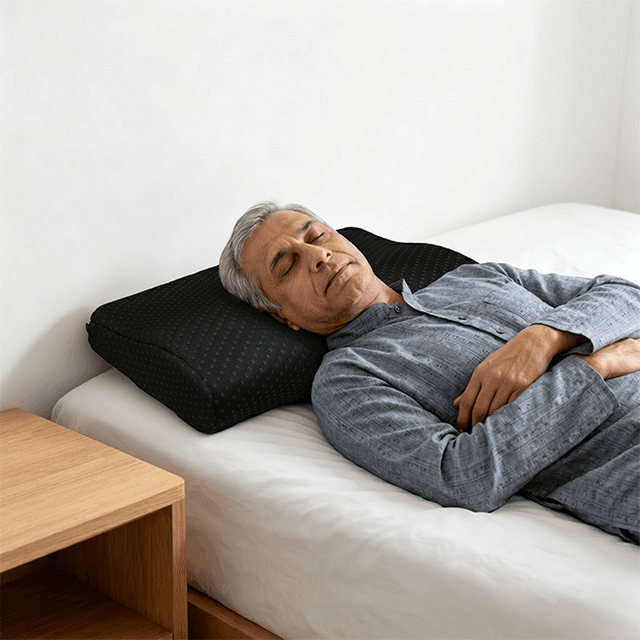
Sleep position is the most important of all. A flat pillow causes the head to drop below the shoulders which stretches the neck muscles for hours at a time. Conversely, an overstuffed pillow causes the head to be pushed too high which creates the opposite strain. The cervical pillow by AGEasy is designed specifically for this purpose with its contoured memory foam casing, and a hollow center. This keeps the neck in proper alignment during back and side sleeping, maintaining the neck's natural forward curve. Many older adults report improved stiffness in the mornings after just a few weeks of switching to this pillow.
Next is the height of your screen or reading material. Instead of dropping your chin to read, elevate your book, tablet, or phone to eye level. This is an easy fix, and will save you hours of daily strain on your neck. Simply place a few books under the device and you are done.
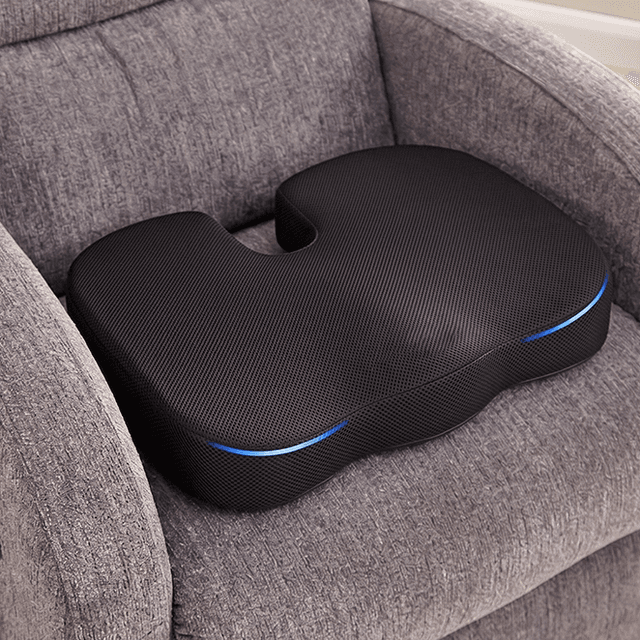
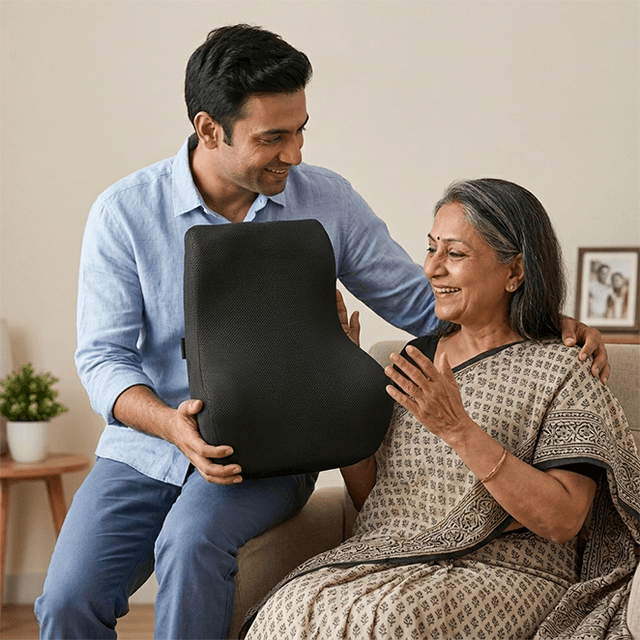
Your posture during sitting can also affect your back. If your parent sits for long periods of time in a chair, an AGEasy lumbar back support keeps the lower back aligned so the upper back and neck do not compensate by rounding.
When to Stop and See a Doctor
Chair exercises do not apply to all neck injuries. If your parent has these symptoms, stop performing your exercises and get a medical review.
- Pain, tingling, or numbness traveling down an arm or into the fingers may be a sign of nerve root compression.
- Weakness in the hand and arm, including difficulty gripping or dropping things.
- Pressure on the spinal cord manifested by balance problems, walking problems, or clumsiness in the hands.
- Neck pain combined with fever, unexplained weight loss, or night pain that wakes from sleep.
- Dizziness, vision changes, or nausea that occurs when moving the neck.
- Pain after a fall or injury, which requires imaging before starting any exercises.
- Neck stiffness that has lasted more than 6 weeks despite gentle daily movements.
- Severe pain that limits activity, which requires assessment rather than home management.
Your parent needs physiotherapy to assess their neck correctly and will adapt the routine to the specific limitations. People with spinal stenosis, previous cervical surgery, rheumatoid arthritis, or osteoporosis are not able to have any neck routine without professional clearance.
Setting Realistic Expectations
Flexibility only develops under a constant daily practice and it develops only gradually, 2-4 weeks to achieve improvement. There will be fluctuations and even poor days, but these are to be expected and are normal.
Progress can be evaluated functionally, rather than numerically. Can your parent check the blind spot while driving without turning their whole torso? Is it easy for them to read without shifting positions? Can they sleep through the night without waking up to readjust and shift positions? These tell you more than any range-of-motion measurement.
Keep track of it in the simplest way possible. Note once a week whether the stiffness is better, the same, or worse. If four weeks pass with no change, or if anything gets worse, book the appointment.
Disclaimer: This article presents general information only and is not a replacement for professional medical advice, diagnosis, or treatment. Neck pain can come from a variety of sources, some serious. Always talk to your health care provider or physiotherapist before beginning any exercise routine, especially if your parent has a prior spinal condition, recent injury, or symptoms that are still ongoing. Discontinue any exercise that causes pain, and seek medical assistance for any of the warning signs described above.
Recommended Blogs












You May Also Like
 No products found
Article by:

Ayush
Article Category:
Cushions & Pillows