

Why Home Nebulizer Searches Are Surging Across India Before the Monsoon
Article by: Admin
Jun 20, 2026. 5 min read
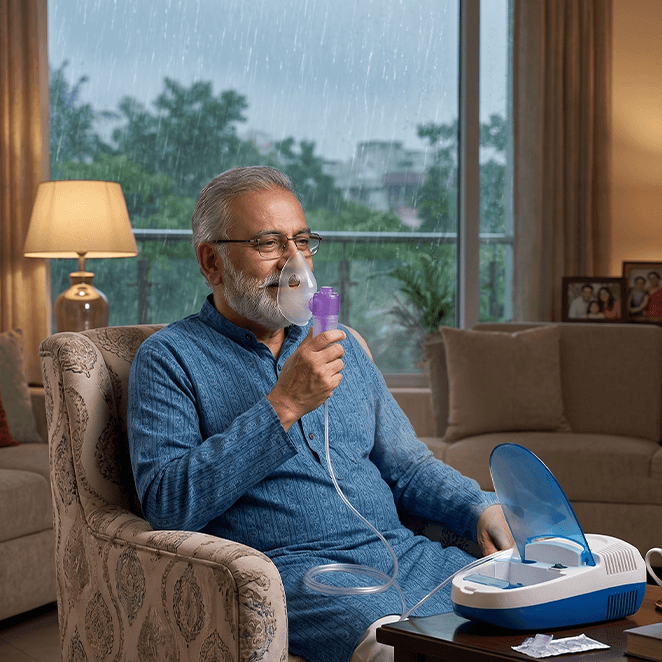

Something unusual just happened in India.
A search term that normally spikes during winter pollution season has suddenly exploded in popularity months ahead of schedule. Searches for "nebulizer machine" have reached breakout levels, crossing 100,000 monthly searches and hitting their highest point ever.
Odd behavior can be observed on India's data. I want to take you through it because it directly affects you if you take care of a parent who wheezes a little more than most.
At first glance, it makes little sense because it’s June.
December would be more understandable. Every winter in India, the smog blankets the cities and air quality worsens, and families start looking for inhalers, air purifiers and complain of respiratory problems.
But when the monsoon arrives, air quality is supposed to be cleaner. Yet families across the country are searching for home nebulizers like never before.
For older adults living with asthma, COPD, chronic bronchitis, or other respiratory conditions, the pre-monsoon weather with airborne irritants, June is becoming more challenging.
So the questions arise - what’s with the air right now, why are older lungs reacting more strongly, are families correct to consider a home nebulizer?
Let's unpack what is really driving India's sudden nebulizer search boom and what every family caring for an aging parent should know.
The monsoon is India's air purifier. This year, it's running late and is weak.
While many view the monsoon season from the perspective of water, the vast majority of people will think about how the monsoon will affect farming, reservoirs, and flooded underpasses, or how it will impact getting a cup of tea on the balcony.
The monsoons do something else, though it is a phenomenon that people are not particularly aware of. Monsoons wash the sky.
This means that months of built-up debris, soot, and contamination are removed from the atmosphere as a result of continuous rain. And the effect is not subtle.
In Kolkata, during the worst stretches of winter, the PM2.5 level rises to between 77 and 80 micrograms per cubic meter. After the onset of the monsoon season, this number drops to around 20 or 21 micrograms per cubic meter.
This also means that the months leading up to the monsoon are a waiting period. Dust continues to build up and the heat continues to cook the contaminants.
People's lungs are essentially waiting for the rain to arrive and do its work.
Unpleasant and uncomfortable as it may be, that is the reality today and it is one that may continue to be reality for a long time.
On May 29, 2026, the India Meteorological Department (IMD) revised its monsoon forecast to 90% of the Long Period Average, predicting an 84% likelihood of the season being below normal or even deficient. While the monsoon reached Kerala on June 4, a slight delay is expected. For residents in Delhi, UP, Punjab, and other northern regions, the first real monsoon rains will not arrive until the end of June or early July, potentially delayed until early July.
Put simply, the moody pre-monsoon winds will continue for some time. The seasonal precipitation event that will clear the air is postponed, and it will likely deliver an inadequate amount of rain.
This is a familiar story. In 2018, the monsoon rains were late, and the air in northern India was primed for an incident. One dust storm pushed the AQI in Delhi to 518. Authorities simply instructed residents to stay indoors.
Against this backdrop, families can sense the change in the air. It is likely the dry winds blowing through northern India are carrying dust.
What's actually in the air right now, city by city
Quick question. What comes to mind when you think of air pollution?
Most people think of winter smog, that grey soup of PM2.5, the ultrafine combustion particles from vehicles, industry, and crop burning. That's understandable, that's the version that gets coverage from the news.
The villain of summer is different. In summer pollution is dominated by PM10. Coarse dust. Bigger particles come from different sources and are still fully capable of entering the lungs and causing respiratory issues.
2 major factors drive the increase in summer PM10 levels, and one of them is a dust phenomenon that your grandmother would recognize. The loo are hot winds that bring dust from the Thar Desert and West Asia and cross all of North India. When combined with localized dust storms (Andhi), and then what we do to ourselves with road construction dust, kicked up and re-released into the air by traffic and heat, over and over, the impact is worse.
Then, of course, there's the second pollutant all too few people warn families about.
Ground level ozone. Ozone is especially strange because nothing is emitted that you would typically associate with the term "pollutant." Instead, ground-level ozone is created when nitrogen oxides and volatile organic compounds combust the right kind of heat and sunlight. As a result, the hotter and sunnier it is, the more ozone is formed, right at street level. To make matters worse, ozone itself is a known trigger for asthma and a host of other respiratory illnesses.
So what do the cities record for AQI between April 1 and May 31 this year? The numbers speak for themselves, and now that I've said that, I realize I should be embarrassed for that journey in over-confidence.
You May Also Like
 No products found
Article by:

Admin
Article Category:
Nebulizers