

Protecting Restorative Sleep: A Comprehensive Guide to Overnight Incontinence Care
Article by: Kunal
Article Category: Adult Diapers & More
Aug 10, 2026


No one mentions 2 AM bed changes.
But you know what it's like. The sounds that break the sleep barrier. The rustling of sheets. The silent struggle of someone who didn't want to wake you and certainly didn't ask for help. You get up. You take care of it. You get everyone else settled again.
And then you wonder how many more nights will be just like this.
This guide is about night incontinence and the everyday impact it has on families, and the differences in design between overnight and daytime adult diapers.
The Night Has Its Own Rules
Daytime incontinence and nighttime incontinence are distinct issues.
During the daytime, a wet brief is uncomfortable but not so bad that it can't be dealt with. A caregiver can check the brief, the client can signal that a change is needed, a change can be made and the day moves on.
Night time is a different problem. For a variety of reasons, the human body produces more urine at night, and older adults gradually lose the ability to feel the kind of urge that would wake them and prevent an accident.
An adult brief that is worn for 8-10 hours is subjected to a different kind of pressure than one that is worn for 2 hours. And when a night time brief failure occurs, the negative impact does not end there. The consequences can extend well beyond that one event, and can lead to hospital visits.
What the research tells us
The PMC Research report states that more than 60% of people aged 60 and above are reported to experience nocturia.
Nocturia refers to the medical condition of waking up at night to urinate. This isn't a small percentage of adults but a significant majority of people in the elderly age group. Amongst this age group, those over 70 years of age, as many as 60% may be urinating two times or even more during the night.
In no less than 76% of elderly women suffering from nocturia and 92% of elderly men suffering from this condition, a phenomenon termed nocturnal polyuria is present that causes the affected individuals to produce a very high volume of urine during the hours of sleep. This number is approximately 90% in adults over 80 years of age.
A community research conducted among women in Kerala aged 60 and above published in the Journal of Mid-life Health reported the prevalence of urinary incontinence in that population to be 64%. This was a single community and therefore, this statistic should not be interpreted as a national figure, but it is one of the most comprehensively documented data pertaining to a specific community in India and it clearly indicates how widespread this issue is in Indian homes.
What nocturia actually does to a person
Disrupted sleep is only the beginning of the larger problem.
Research indicates that nocturia is the most troublesome lower urinary tract symptom (LUTS). This is not necessarily due to its medical severity, but rather due to its relentlessness. It occurs every night, disrupting sleep on deep levels and having accumulating effects that families are aware of long before any physician mentions them.
Noting what studies show, caregivers endure the burden of chronic daytime fatigue, uncharacteristic mood changes, memory problems, distractibility, and over time, cognitive deficits. Social withdrawal and true clinical depression are documented consequences. An actively engaged person begins to seem like they are fading away, sometimes this is simply because they are sleep deprived night after night.
In this case, a good quality overnight adult diaper will not just help the person suffering but will also protect the caregiver's sleep. In households where the caregiver is also aging, and is in a state of exhaustion, this is a big thing.
There are additional perilous aspects that are not adequately addressed. As noted in the PMC database, nocturia is correlated to a 1.8 increased risk of hip fractures. Furthermore, men who urinate three or more times per night have a two-fold risk of death compared to men who are less disrupted.
And according to StatPearls, falling at night is the primary trigger for over 25% of falls at home. The primary cause is getting up in the dark to go to the bathroom.
How is an overnight diaper different?
The majority of buying guides completely overlook this aspect, or they touch on features without detailing the specific problem each one is designed to address.
Let's take a moment to evaluate what an overnight diaper is.
When you use a product like this, you expect it to accomplish a lot. It has to keep someone dry, comfortable, and protected for a period of time ranging anywhere from 10 to 12 hours. It does this while the user is lying down and in a single position. During this time, the other people in the house will be sleeping. The physics involved with someone being flat on their back are entirely different from the physics involved with an upright, mobile person.
This is where we need to learn about the core of the product — Super Absorbent Polymer or SAP.
This is the product's engine. SAP can absorb and hold a volume of liquid that is 300 times its own weight. However, this rapid absorption is not the most important aspect of SAP's design. What is more important is that after SAP absorbs liquid, it will pull moisture away from the surface of the skin and retain the moisture in the core of the SAP. This means that it will not come back in contact with skin. Once SAP absorbs moisture, it will keep it away from the skin which will make for a dry morning, and skin breakdown will not occur.
In the premium overnight diapers, the SAP core incorporates a multi-chamber design. Imagine these core structures as a series of rooms, divided as opposed to one big open space. Liquid moves through the chambers and distributes throughout, not pooling into one zone, which leads to a condition termed 'maximum absorbency.' This design architecture is foundational for true 10 to 16 hour protection in premium overnight diapers.
A typical daytime brief employs a more basic, lower-capacity version of this core. This is perfectly acceptable for a product intended to be worn for 4 to 6 hours. However, for extended overnight use, this is simply insufficient.
The primary distinguishing characteristic of the overnight diapers is the standing leak guards
Most people do not realize this until it happens to them, and they wonder why the information was not more readily available.
When someone is lying down, gravity operates differently than when a person is standing or sitting. Instead of pulling liquid downwards toward the seat of the brief, it pushes liquid to the sides and towards the leg openings. A typical daytime diaper has leg cuffs that are either flat or somewhat positioned upward. Those cuffs are powerless to stop lateral movement of liquid. No matter how absorbent the core is, and however much liquid is present, the brief will leak from the sides because the liquid will never reach the core, which is where the liquid is meant to go.
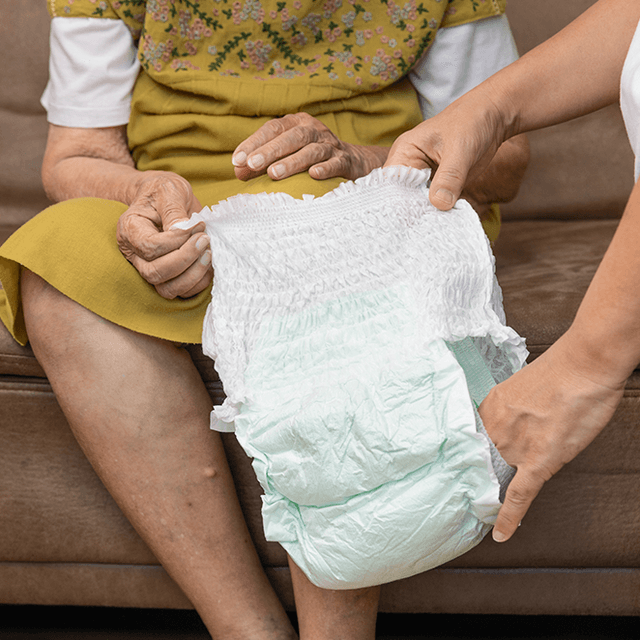
Standing leak guards are present in overnight diapers. These standing leak guards are made of soft elastic materials that remain vertical around the openings of the legs when the product is opened up. When the user is in the lying position, the guards remain vertical and act as barriers that contain any liquid that might leak because of the path of lowest resistance out of the sides.
This is easily tested prior to purchase. You can simply open the diaper flat on a surface, and with your finger, gently push down on one of the leg cuffs. If the leg cuff snaps back into a vertical position, standing guards are present. If it remains flat, it does not contain standing guards. This simple test will provide an immense amount of information about the overnight performance of the diaper versus the information provided on the packaging.
Breathable outer cover: protecting the skin's exposure throughout the night
Consider the difference between sleeping in a gentle, breathable cotton-piece versus sleeping in a piece that is completely sealed and plastic. One garment allows airflow and the other becomes a warm, sealed environment. That difference is especially important when the exposure lasts the entire night.
A modern, breathable cover has a micro-porous material that allows air to pass even after the product has absorbed its maximum fluid capacity to keep the skin cooler, lower humidity and reduces the likelihood of IAD.
Anti-sag construction
Not enough attention is paid to this failure mode. A saturated diaper weighs more than a dry one. Without sufficient structural support, the diaper will sag. When a diaper sags, gaps open at the legs. Liquid will escape from the gaps at the leg openings, no matter how well the core and guards are designed. All the engineering is wasted because the product is out of its designed shape.
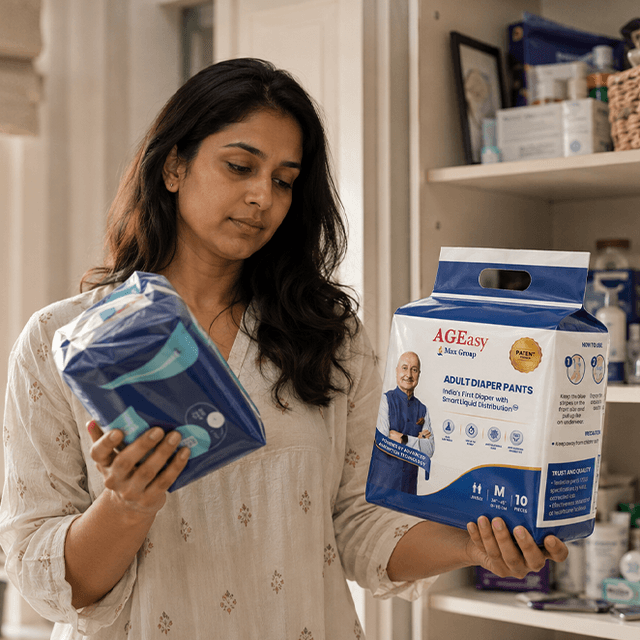
Premium overnight diapers incorporate specially engineered elastic waistbands and absorbent cores designed to retain shape when saturated. This is not a comfort or cosmetic feature. It is essential to keep the standing guards in their intended anatomical position and to keep the absorbent core aligned properly throughout the night, as the core's absorption capacity increases from hour 1 to hour 10. Without this feature, the best core in the world will get displaced out of position and will create gaps. Models like the AGEasy Smart Liquid Distribution Pant are designed with this anti-sagging architecture, prioritizing consistent fit and leak-guard stability throughout an entire night of wear.
| Feature | Daytime Diaper | Overnight Diaper |
|---|---|---|
| Wear duration | 4 to 8 hours | 10 to 16 hours |
| SAP core | Standard capacity | High-capacity, multi-chamber |
| Leak guards | Flat or semi-upright | Tall standing guards |
| Breathability | Basic outer cover | Micro-porous, enhanced airflow |
| Shape at saturation | Standard | Anti-sag construction |
| Wetness indicator | Sometimes | Recommended for overnight use |
Getting the Fit Right
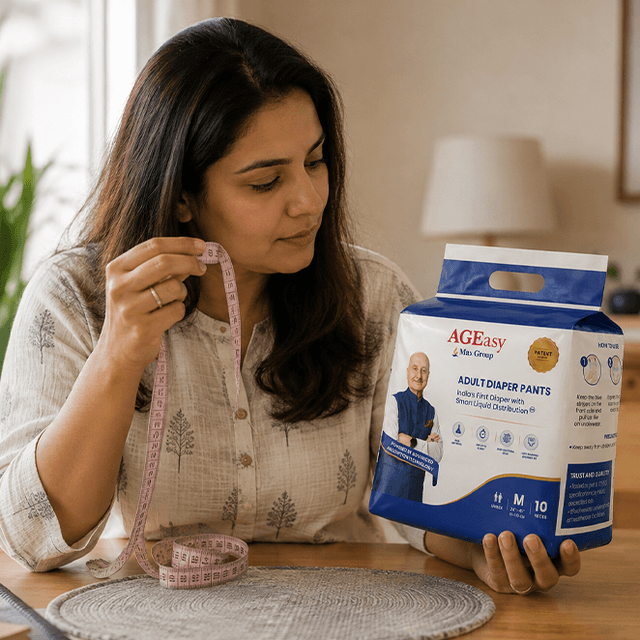
An overnight diaper with the best absorbency in India will still leak if it is not the right size. Families are most often let down by the overnight failures due to incorrect sizing. A brief that is too big will have gaps at the legs and waist where standing guards cannot form a seal, and a brief that is too small will prevent the guards from functioning to do the one thing that they are designed to do.
When it comes to pull-up pants, your most important measurement will be your hips, while waist measurement will be most important for tape-style briefs. Most companies provide sizing charts. When in doubt between two sizes, choose a size up. A little extra room is always better than tight fit, especially when the pants have functional anti-leak guards that do their job.
The Overnight Diaper Is Part of a System
Something families discover, usually in the first week of using an overnight product, is that even a well-chosen, correctly fitting diaper works better when it is not working alone.
This matters especially in the early weeks, when you are still calibrating which product suits your specific situation. And it matters even more for seniors with heavy incontinence, where any single product is doing real work and a backup layer is simply good practice.
The underpad: the backup layer
Families often learn during their first week of using an overnight product that even an optimally chosen and correctly sized diaper works better when it works in a team.
This is especially true in the first few weeks, when you are still figuring out which product works best for your scenario. This is particularly true for elderly people with severe incontinence, as any one product typically does real work while a backup system is simply good practice.
An underpad, also known as a bed protector, is placed under the senior on their mattress. Its purpose is not to make up for a diaper that fits poorly. Rather, even night protection is not uncommonly faced with high demands, and a backup layer beneath it will reduce what would be a full sheet change down to a simple underpad swap.
Consider a spare tire. You wish you never have to use it. However, the presence of the spare means that an emergency at 3am that would take 45 minutes to respond to, now only takes a 5 minute response time. No need to change a full set of sheets or clean the mattress. Just a new underpad and everybody goes back to sleep.
For seniors who are heavily incontinent, this is a standard practice, not an optional upgrade.
Barrier cream: the skin protection step most caregivers skip
Here is a step almost every caregiver adds, the question being whether they add it before or after the first signs of skin breakdown.
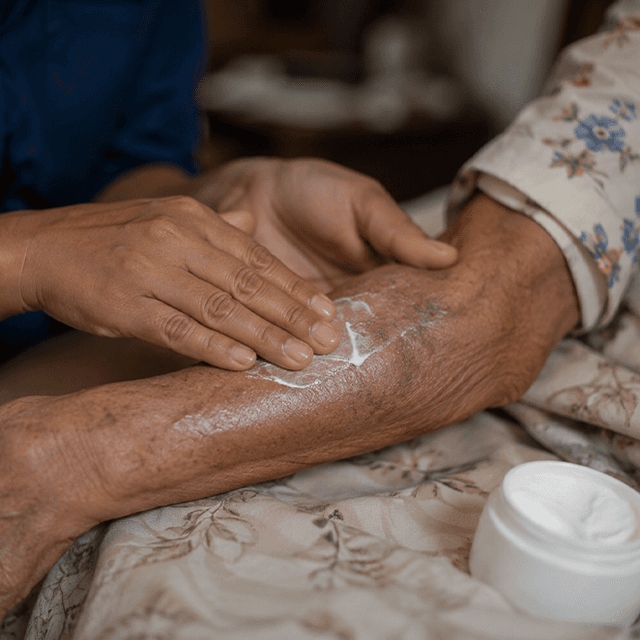
Overnight wear means extended skin exposure. Even a breathable, well-fitted overnight diaper creates some degree of moisture contact during 10 or more hours of wear. A zinc oxide or petrolatum-based barrier cream applied at the last evening change creates a protective film between the skin and that moisture. It stays in place through the night. It does not need to be removed before reapplication in the morning.
The caregivers who discover this product usually do so because a nurse or doctor recommends it after redness has already appeared. The better practice is to start it before redness develops, as a nightly routine rather than a response to a problem. Prevention is always cheaper than treatment, and especially when the skin involved is that of an elderly person with overnight incontinence.
The Connection Nobody Makes Until It Is Too Late
Most families think about overnight diapers as an incontinence solution. Which they are. But there is a second function that matters just as much, possibly more.
An overnight diaper that actually works eliminates the reason to get up.
Let that sit for a moment.
While seniors are used to getting up to use the toilet, every transfer remains a risk for that person to fall. Bed to bedside commode transfers are always a risk by nature of the transfer. A person is woken suddenly, disoriented, from a warm bed to a cold floor. They are at a risk in so many ways. Their balance is impaired. Their reaction time is slowed. The floor could even be wet from some leaky bladder.
StatPearls claims that over 25 percent of all home falls occur at night. Research from PMC states that the risk of hip fractures associated with nocturia is raised 1.8 times when compared to those that do not experience nocturnal voiding. These are not random figures; they exemplify the consequences of the repeated, nightly, and often transfers that occur when the overnight protection is not reliable.
When family members invest in a good overnight diaper, they are buying more than just comfort or convenience. They are also saving transfers and therefore saving countless potential falls. This costs something, and it is something that is very difficult to achieve again once lost. It may be a hip, a sense of safety, or a confidence in their mobility.
How to Choose: A Practical Framework
There is no one-size-fits-all answer for what the best overnight diaper is. It comes down to the individual person, their level of incontinence, and their situation during the night. This is a way to make a decision that is not lost in marketing descriptions.
Start with mobility
Can the seniors walk and do their nighttime routine by themselves? If so, pull-up pants will allow them that independence.
If they need help from a caregiver to change them, a tape style brief with resealable tabs will allow for an easier change without having to do a full change at 2 in the morning.
If the senior is bedridden, typically tape style briefs are the way to go. If that's the case, you will want to make sure there is a good height on the standing guards as well, especially for someone who is lying down the whole night.
Be honest with yourself about the level of incontinence
If the overnight incontinence is moderate (one or two episodes during the night), the majority of overnight products available in the Indian market should work well.
In cases of heavy overnight incontinence where there are continuous voids or there may be very large amounts of urine, you will need to look for products with high capacity absorbency specifically designed for overnight use and you will want to always have an underpad as a backup layer as opposed to an occasional one.
Check the label for what actually matters
- If you open the product and the standing leak guards do not spring upright, they are not standing guards.
- Look for SAP core that is labeled high capacity, multi-chamber, or is specifically designed for overnight use. If there are generic claims around absorbency without this language, they are likely to have a daytime-grade core.
- Breathable outer cover. Rather than a plastic backing, look for terms like micro-porous or breathable in the outer material description.
- Wetness indicator, which allows a caregiver to check the product's saturation level without waking the senior or removing the product.
- The product description mentions anti-sag construction. This is the feature that keeps everything else in position throughout the night.
Test before you buy a month's supply
Overnight performance varies more than daytime performance due to body shape, sleeping position, and individual urine output. Buy a small quantity first. Use it for a full week to evaluate the performance over the different nights before committing to a bulk order. This is not caution for caution's sake. It is the practical approach that experienced caregivers almost universally recommend.
A Final Observation
The real issue with overnight incontinence is not finding the right product. It is the assumption, sometimes unspoken, and sometimes running silently in the background, that this is just how things are now. That the 2 AM disruption is unavoidable. That you plan around it.
Many families carry that assumption for months or years before discovering it was wrong.
Sleep is not a privilege for the senior or for the caregiver. It is fundamental. It is the foundation for everything else: mood, memory, physical stability, the immune system, and the emotional reserves that make another day of caregiving possible.
The aim is not to have a perfect night.
It is to have a quiet one. And that is something to strive for.
SOURCES & EVIDENCE BASE
- PMC (2025): Prevalence of nocturia in adults aged 60 and older
- ScienceDirect: Frequency of nocturnal voiding in adults over 70
- US Pharmacist / PMC: Nocturnal polyuria prevalence by age and gender
- Urology Care Foundation: Nocturia prevalence in adults over 30
- StatPearls / NCBI: Nocturia as the most bothersome lower urinary tract symptom; nighttime falls prevalence
- Springer: Nocturia frequency and sleep disturbance severity
- PMC: Nocturia and hip fracture risk; nocturia and mortality in men
- National Statistical Office / AgeWell Care (2025): Dependency rates among elderly Indians
- Journal of Mid-life Health (Kochi community study): Urinary incontinence prevalence in women aged 60 and older in Kerala
This content is for informational purposes only and does not constitute medical advice. If you or a family member are experiencing urinary incontinence, consult a qualified healthcare professional for personalised assessment and guidance.
AGEasy.co.in | Helping families create safer, healthier, and more independent lives for ageing parents