

Adult Diaper Price Guide in India 2026: Costs & Brands
Article by: Aryan
Article Category: Adult Diapers & More
Aug 12, 2026


How Much Should You Actually Pay? (S to XXXL, Pant vs. Tape)
What is the true cost of Adult Diapers?
What people do is walk into the nearest medical shop and grab an adult diaper pack, or they just settle for the first item they see listed on Amazon and click on the buy button.
All of this is done for the sake of convenience and for the sake of the "elder". What they don't know is that the cost per piece is ₹60 at the nearest medical shop while the identical product with almost the same absorbency rating is ₹28 on IndiaMart.
Let's do the math, an average of 6 diaper changes a day, the monthly total would come to about ₹6,000 every single month!
This is the unfortunate state of our financial affairs which nobody bothered to do a cost analysis on. This following guide tries to solve that for you.
Let's examine the disparity in cost about pant-styles and tape-styles products, how to calculate your costs monthly, how buying bulk works, and where buying bulk saves you money and where it just ties up your cash for something that may not even work.
So what are you actually paying for? These 6 things:
- Absorbent Core Capacity: this describes how absorbent a product is and how quickly it locks moisture away from the skin.
- Wear Duration: A product designed for 8 hours is cheaper than one designed for 12 or 16 hours. This is because more hours require more absorbent material, which increases the costs.
- Skin Contact Materials: Softer and more cloth like top sheets and breathable panel layers cost more than plastic sheet back layers.
- Size: Different sizes of the same product contain different materials. For example, XL and XXL sizes cost 10–30% more than L sizes.
- Style: Pant styles while looking simple are actually a bit more complex. Implementing a leak-proof comfortable design into a pull-up waistband increases the cost by 10–20% when you compare it to tape design.
- Origin: Indian brands such as Friends, Lifree, Liberty, and Kare In are cheaper than imported brands such as Seni, Tena etc. because of differences in manufacturing costs and supply chains.
Why is there a ₹110 diaper when there is already a ₹28 diaper?
Before we dive deeper, let's address the elephant in the room.
You see a diaper for ₹28 and another for ₹90, does the one that costs more have better quality? Is the cheaper one a false economy? Is the disparity that big? Actually, none of what you think.
It's just like the water filter system. In the ₹800 one, and the ₹8000 one, at the end both give you clean water but the cheaper one will clean water for you maybe once a month while the more expensive one is designed to clean the water every day for a whole year and needs less maintenance. They have the same purpose but one is designed for a tougher situation.
Adult diapers work exactly like this.
Tape-style diapers are almost always cheaper than pant-style at the same absorbency level within the same brand. Most caregivers assume the opposite. They think of pant-style as the premium version and tape-style as the basic, hospital-grade option.
Pant-style diapers are actually the more expensive engineering challenge. It's built for people who can participate in their own toileting, pulling the garment up with minimal help. Making that work reliably, comfortably, and without leaks requires more elastic, more precise construction, and better materials. So it costs more.
What this means practically: if your parent is largely bedridden and needs full caregiver help for every change anyway, tape-style is often both the better clinical choice and the more economical one. The 10–20% price saving is just a happy side-effect of choosing the right product for the situation.
But we'll get into that properly in the pants vs. tape section. Let's look at the brands first.
What Each Brand Actually Costs (June 2026 Retail Prices)
The figure below contains price estimates based on actual listings in June 2026 on Amazon.in, Flipkart, IndiaMart, and brand sites. As a note, listings can vary due to promotions, pack sizes, and your location within India. Use these as long term cost estimates and approximate costs.
That said, these price ranges are likely to be accurate in most purchase scenarios.
| Brand | Style | Size | Pack Price (₹) | Per Piece (₹) | Absorbency |
|---|---|---|---|---|---|
| Friends | Tape (Economy) | M/L | ₹250–300 / 10pc | ₹25–30 | ~8 hrs |
| Friends | Pant (Classic) | M/L/XL | ₹300–400 / 10pc | ₹30–40 | 10–12 hrs |
| Friends | Premium / Overnight | XL/XXL | ₹400–600 / 10pc | ₹40–60 | Up to 16 hrs |
| Lifree | Pant | M | ₹320–380 / 10pc | ₹32–38 | Standard |
| Lifree | Extra Absorb Pant | XL | ₹400–480 / 10pc | ₹40–48 | Heavy |
| Lifree | Durable Absorb Tape | M | ₹280–340 / 10pc | ₹28–34 | Standard |
| Liberty | Pant | M/L | ₹300–400 / 10pc | ₹30–40 | Standard |
| Dignity | Premium Tape | M/L | ₹350–500 / 10pc | ₹35–50 | 10–12 hrs |
| Dignity | Premium Tape | XL/XXL | ₹500–700 / 10pc | ₹50–70 | 10–12 hrs |
| Kare In | Pant | M/L | ₹280–360 / 10pc | ₹28–36 | Standard |
| Seni / Super Seni | Tape (Imported) | L–Bariatric | ₹600–900 / 10pc | ₹60–90 | Heavy/Bariatric |
| Tena | Various (Imported) | M–XL | ₹700–1,100 / pack | ₹70–110 | Premium |
| AGEasy | Smart Liquid Dist.™ | S–XL | ₹399–439 / pack | ₹40–44 | Up to 12 hrs |
AGEasy Smart Liquid Distribution™ diapers are sold on AGEasy.co.in.
The 4 Price Bands: Which One Actually Makes Sense for You?
This is the accurate state of the market for adult diapers in India. There are actually four categories: Budget Band, Mid-Range Band, Premium Band, and Super Premium Band. Surprisingly, it matters most which band your chosen product comes from, not which specific product you choose.
Knowing why price bands exist and how they come to be will be more time saving and cost saving than your usual hunt for the best bargain.
| Segment | Price per Piece (₹) | Best For |
|---|---|---|
| Budget / Economy | ₹25–35 | Light incontinence, bulk buyers, budget-conscious families |
| Mid-Range / Standard | ₹35–55 | Moderate incontinence, everyday use for most seniors |
| Premium / Overnight | ₹55–80 | Heavy incontinence, overnight use, sensitive skin |
| Super Premium / Imported | ₹80–110+ | Bariatric needs, post-surgical, medical-grade requirements |
The Budget Band (₹25–35/piece): When It Makes Sense
First the Budget Tier. Be honest. There is a stigma surrounding these products, like opting for the ₹28 product means you are taking the cheap route in caring for your parents. Not the case.
If your parent requires 2 - 3 changes in a day, and does not have any significant skin issues in the case he is Budget Tiered for some self-managed hygiene, Budget Tiered works just fine.
The calculation changes with heavy incontinence and overnight. Unfortunately, Budget Tier absorbed the savings and created a skin issue or worse, leakage. You are then left to spend on barrier creams, linens, and rash treatments.
The Mid-Range Band (₹35–55/piece): Where Most Families Land
For those of you looking to identify where most of the families in India land in their product choice, you are looking at the Mid-Range Band. Brands in this band include AGEasy, Friends Classic and Premium, Lifree Extra Absorb, Dignity Premium, and Liberty Pant-style among others.
The vast majority of options on the market provide up to 12 hours of protection. A good portion of these options include a wetness indicator. Protection is good enough for daily tasks.
Most families use products in the mid-range category during the day with a change every 4-6 hours. For products at night, families typically use a high-capacity product. This combination is sufficient for moderate incontinence and prevents families from spending extra on products that are also needed for daytime use.
The Premium Band (₹55–80/piece): When to Step Up
The increase of price from mid-range to premium is usually due to the lack of features at the mid-range level. When a mid-range product is leaking too much, a skin rash comes along (this is caused by prolonged indirect contact with moisture and is more common than most people think.). If a product is used overnight and needs to stay in the place for 6–8 hours. Used during the post-surgical recovery period for added peace of mind.
If any of the above relate to you, you should invest in the premium band.
This is where the mental maths gets really tricky. Even though going from ₹40 to ₹65 feels like an enormous cost, one leak at 2 AM means a complete bed change along with a complete wash of the bed linens. Plus, you are causing your caregiver to exhaust all of their energy. Therefore, it really isn't saving you money.
Super Premium and Imported (₹80–110+/piece): Specific Use Cases
Seni and Tena are great products. They are both very well trusted products within clinical care in Europe. To be honest, if you are looking to care for someone in your home within the context of typical care in India, you really are better off without spending the money.
For bariatric care (heavy weights, large body sizes and heavy incontinence), only the highest premium products will suffice.
For everything else, you really can look to the Indian premium brands within the ₹40–80 range. The imported tier really is overkill and only for very specific use cases.
The Size Trap: Why XL Costs More Than You Think
Here's something that surprises almost every family when they finally do a comprehensive pricing analysis.
Everyone knows that the larger the pack, the more units you get. But not many know that the larger the body size, the more you pay per unit, even in the same pack of the same product.
And this is not the retailer's margin padding. It's a question of materials. An XL diaper uses 25–35% greater absorbent core, wider elastics, and more fabric than an M size of the same product. The cost difference is clearly in the manufacturing.
What to expect as the size goes up (in the same brand and variant):
- Size M/L: priced as the baseline, the lowest per-unit cost in most ranges
- Size XL: generally a 10–20% increase per unit than M/L
- Size XXL: generally a 20–30% increase per unit than M/L
- Size XXXL (bariatric): generally 40–60% more than M, where it is available
The lesson here is clear: look for unit pricing, not pack pricing. A ₹480 10-piece XL pack is not the same as a ₹380 10-piece M pack. They cater to different body types. It's like comparing a litre of fuel for a scooter versus a SUV.
But most importantly, never, ever, make size decisions based on price.
Any diaper leaks if it doesn't fit, regardless of how well designed it is or how many star reviews it has. Diapers that are too small, leak at the leg openings. Diapers that have too big gaps at the waist. Diaper fitting problems mean more changes and exposures and cost more in the end, so it is better to buy the properly sized diapers first.
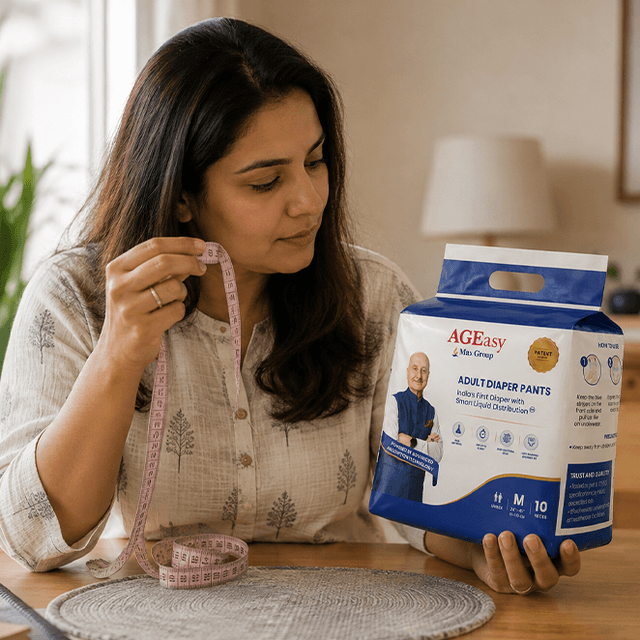
Simply measure the waist and hip, check the size chart, and buy. It takes under five minutes.
What You'll Actually Spend Each Month: Let's Work It Out
Now we come to what is probably going to be the most useful section of the entire guide.
What we aren't going to do is provide an arbitrary range of ₹3,000 to ₹15,000 for you with absolutely nothing in between to help you determine your spending. We'll provide you with the basis of what you will actually spend depending on the price tier you choose and your parent's actual usage.
The formula is straightforward enough:
Input your numbers and then see how they compare to the common trends below:
| Usage Pattern | Changes/Day | Price/Piece (₹) | Monthly Cost (₹) |
|---|---|---|---|
| Light / Budget | 3 | ~₹28 | ~₹2,520 |
| Moderate / Standard | 4 | ~₹40 | ~₹4,800 |
| Moderate / Mid-Range | 4 | ~₹55 | ~₹6,600 |
| Heavy / Premium | 6 | ~₹65 | ~₹11,700 |
| Mixed (4 day + 2 overnight) | 6 total | ₹40 day / ₹70 overnight | ~₹6,600–₹9,600 |
Here are some things that you should understand before you finalize your calculations:
- Of the three inputs, changes per day is the most variable and has the largest effect on calculations. For people with average mobility and some self-care in hygiene, 3–4 changes is normal for moderate incontinence. For highly dependent individuals with bowel incontinence and heavy urinary incontinence, expect the need for 6–8 changes.
- Caregivers of dependent individuals often adopt a mixed strategy. Throughout the day and with more moderate incontinence levels, the cost per unit is more appropriate with increased changes. During the night, premium diapers make sense with a higher cost per unit since no caregiver wants to deal with a night leak.
- The mixed day versus night strategy is often the most effective for cost and quality for heavy incontinence. Most caregivers appreciate that, although it's more expensive for the overnight strategy, the peace of mind and sleep is worth the cost.
The Hidden Costs That May Catch You Off Guard
Experienced purchasers will tell you the unfortunate truth that you will never read about in a product description. Buying diapers is just step one.
Full incontinence care requires three categories of products, all of which are necessary, and that you will need to purchase regularly:
| Care Item | Monthly Cost (₹) |
|---|---|
| Wet wipes / cleansing cloths | ₹300–800 |
| Barrier / rash cream (IAD prevention) | ₹200–500 |
| Underpads / bed protectors | ₹400–1,200 |
| Total care cost (accessories + diapers, heavy use) | ₹4,500–₹14,000+ |
None of these are luxury items. Barrier cream and wet wipes are necessary to protect against incontinence associated dermatitis, a painful skin condition that occurs after skin is in prolonged contact with moisture and waste. This condition is painful and can be very difficult to manage and treat.
Underpads are necessary for protecting the mattress and the sheet, and are very important for parents that are bedridden or if nighttime control is not yet fully reliable.
Budgeting and thinking about incontinence care as a whole instead of just diapers is important. For mild to moderate incontinence, you can expect to pay around ₹4,500 to ₹8,000 a month. For heavy incontinence, ₹12,000 to ₹14,000, for the best quality products and accessories, is a realistic cost.
Although this amount seems high for full incontinence care, it is best to know ahead of time the real costs instead of when you are three months in and stuck with a routine.
Where Bulk Buying Saves You Money (And One Buying Mistake To Avoid)
Bulk buying in all its forms, perhaps especially purchasing incontinence products at wholesale prices, has the biggest impact on spend for Indian families. Savings are not small; wholesale prices can reduce the cost of a product by 20 to 35% at the wholesale level. There is, however, a process to follow, and the biggest mistake care givers make is avoiding a step in the process.
Wholesale via IndiaMart: 20–35% Below Retail
Once you know a product will meet your needs, India's wholesale distributors will likely save the most money on your orders. The distributors for Friends, Dignity, Liberty, and other major brands, offer a 10 piece pack of Friends Economy, at prices ranging from ₹165 to 250, a savings of 20 to 35%, considering the usual retail cost of ₹250 to 300. Since there are so many retail outlets, this savings will be repeated every time you purchase.
Wholesale buying generally requires you to make a larger commitment than retail buying. This often means purchasing case quantities, which can be as many as 100 to 200 units. Indian cities which probably have the best wholesale service networks are Mumbai, Pune, Delhi, Chennai, Bengaluru, Hyderabad, and Kolkata, though it will likely take some work to build a customer and distributor relationship.
Wholesale buying is probably the best option if this will be a recurring purchase for the 3 to 6 month period, which is usually the case for incontinence products. For example, a 30% savings on a monthly order of diapers costing ₹6,000 means a savings of ₹1,800. This amounts to a savings of ₹21,600 for the year.
→ See AGEasy's bulk discount guide at ageasy.co.in/adult-diaper-bulk-discounts
Amazon Subscribe & Save: 5–10% With Zero Effort
Some families don't want to work with distributors or deal with bulk orders. Some families may just be testing out the product. Some families may have very little storage space. Some families may want the convenience of automatic orders.
Amazon Subscribe & Save accommodates all of that. They offer a 5–10% discount with free shipping on orders that are automatically sent at whatever frequency you decide. It won't be the same savings you'll find at a wholesale store, but it will take exactly one click to set up and zero effort to maintain. For families that highly value convenience and simplicity, that savings means a lot.
The right approach goes like this:
- After confirming the product and size suit your needs, avoid bulk buying. It is advisable to conduct a trial for at least 2-3 weeks.
- If you plan to use the product for more than 3 months, explore the option of getting wholesale rates on IndiaMart.
- When you want to save costs and avoid a large bulk purchase, use Amazon Subscribe & Save.
- Always check the per unit price as pack size varies. In some cases, a larger pack may not translate to a better per unit price.
Pant vs. Tape
So, which is better? Within the same brand and level of absorbency, tape style products are usually 10-20% less absorbent than pant style products. Most assume the opposite. Generally, pull-up style products are regarded with the most ease and dignity, and tape style are associated with clinical, bed-ridden patients. So, tape style must be the easiest and cheapest, right?
Not really. Pant style products require a full elastic waistband with stretch panels to hold their shape and seal. This can be used in a variety of different positions and after multiple uses. This construction costs more. The pull-up style products do indeed require a more sophisticated construction.
The price difference should be a factor, but it should not be the driving factor.
Pant-style is appropriate when:
- The individual is able to use the toilet with some assistance by walking to the toilet and pulling the pants up or down.
- It is important to the individual to have dignity and independence and the individual is opposed to a caregiver doing all of the work for them.
- The self-management of the individual is actively supported within the care environment in order to enhance the quality of life of the individual.
Tape-style is appropriate when:
- The individual is mostly bed-ridden or has the inability to move about much.
- The assistance of a caregiver is required for every single change and the individual has no participation.
- Fit is important and tape-style has a re-sealable feature that allows you to adjust the fit by making it tighter or looser, something that is not possible with pant-style.
- Post-surgical care or hospital care is involved.
To put it simply, for your parent's care and mobility, tape-style is appropriate. It's the right clinical decision and should be cost-effective. In the case that both tape-style and pant-style would legitimately work just as well, tape-style in the same level of absorbency would also be the right decision and the most cost-effective.
Don't let the price difference make the decision for you. Let the price support the decision.
Where to Actually Start: A 5-Step Decision Guide
If you're new to this and the options feel like too much to navigate all at once, here's the sequence that cuts through it.
Five steps. Follow them in order.
Step 1: Establish the usage pattern
How many changes are considered light, moderate, or heavy? (1-3, 4-5, 6 or more respectively). Be honest. With this one number, more than anything else in this guide, you can identify your tier.
Step 2: Determine which style can be safely matched to the user's capability
Are they capable of standing, moving to the bathroom, and pulling a garment up with some assistance? Then go with pant style. If they are mostly bedridden, need a lot of assistance, or a full-time caregiver to manage them, then go with tape style. This one is easy.
Step 3: Measure to find the best fit
Measure the waist and hip. Check the brand size chart and do not order a "just in case" larger size. A fit that is too loose results in leakage and is the same as wearing the wrong product.
Step 4: One pack is all you need to test before committing to a purchase
This is important. Make sure you check fit, leakage, and skin health. If you can meet all three, then you can purchase in bulk. This process helps reduce the cost of a product that you will not be able to use.
Step 5: Establish the cost of your monthly use, and you can determine which bulk buy option is the best for you
Do you want to buy from IndiaMart? Amazon Subscribe and Save? A direct brand subscription? Use the formula that's provided in this guide to figure it all out.
Cost comparison calculator, subscription plans, and discounts for bulk purchases will help you take this process one step further.
It's Not Just About Price
We hope to show you something that goes beyond cost comparisons and purchasing guides.
Most families spend too much on adult diapers. It's not that families don't care. It's not that families don't make correct choices. It's that families never had a way of thinking about this before they were placed in the position of having to make the first choice.
Just because a diaper costs ₹60 compared to a diaper that costs ₹35 does not mean that the ₹60 diaper is the better choice. Just because the ₹35 diaper costs less that does not mean that choice is the inadequate choice. The right choice is the product that fits properly at the level of the person's incontinence and the person's level of mobility and achieves a high level of reliability for the family for the whole night and is the price that the family can afford.
That price is much more important than the majority of people believe. Few people need to be taken care of for just a couple weeks. This usually is a long period of time and the purchases that the family made in those first few weeks of panic are the purchases the family will make for a long time.
It is worth the time that you take in that first week to try the product and really do the math. This is the decision you will have to live with for a long time. This will most likely be the product that you choose to live with for at least a year.
Most of the time you really can not see the positive effects of preventing something from happening. You will not see damage to someone's skin because you used a product to prevent it from happening. You will not remember the product that prevented the night from being disturbed. You really can not see the effects of preventing an infection that never happens because you are using the product that prevented it.
The caregiver gets to sleep the full night because the overnight product fulfilled its purpose. This product helps the caregiver show up the next day, and the day after that.
The right choice matters. Quietly, consistently, every single day.
The goal was never the cheapest option.
It's the right one, bought the smartest way.
Medical Disclaimer
This article is for informational purposes only and does not constitute medical advice. Product suitability, incontinence management, and care decisions should be made in consultation with a qualified healthcare professional. Price data is based on current retail listings as of June 2026 and is subject to change. AGEasy does not guarantee price accuracy across third-party platforms. Always verify current pricing directly with the retailer or brand before purchasing.