





India's Viral 'Granfluencers' Are Proving 75 Is Just a Number
Article by: Admin
Jun 16, 2026. 66 min read
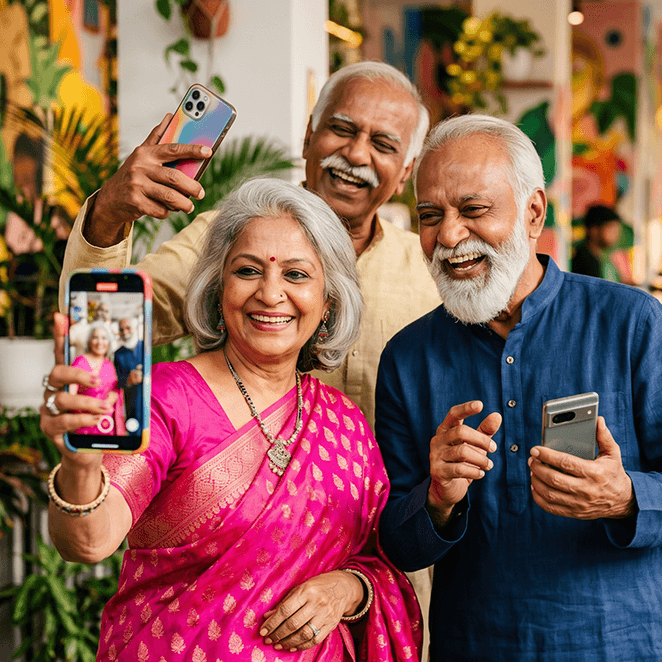
If you’re looking at social media these days, you’ll notice an unusual trend.
A woman in her late 60s dancing with more energy than people half her age. A grandfather launching a second career as a model. A 70-year-old grandmother is becoming a style icon to hundreds of thousands of followers.
For many decades now, aging in India followed the exact same script - slow down, step aside and let the younger generation take centre stage. But today’s older generation is quietly rewriting this script in public with millions of watching.
Social media is calling them “granfluencers” and they are reshaping how India and the World thinks about aging and growing older.
Take Ravi Bala Sharma, a 68 years old woman who’s dancing circles on the internet wearing a scarlet sari is a viral sensation from Moradabad and is now, better known as the ‘Dancing Dadi’ with nearly 761K followers on Instagram. Her posts are not for social media; the love and joy in her dancing is quite visible.
In Delhi, Dinesh Mohan transformed himself by losing over 40 kilos, and turned himself into a model and actor in his 60s. With a current following of over 540k followers on instagram, he’s showing us how committing fitness can change your life.
Granfluencers are breaking the notion that growing old is a step back, a subtraction, an act of giving up. This is a global phenomenon, and here is some evidence to back that up. The famous Baddie Winkle is 94 years old and has over 3 million Instagram followers. Iris Apfel signed a modeling contract at 97, and she has 2.6 million followers. 'Brunch with Babs' is a TikTok account with over 3 million followers, and she is 74 years old.
There is a large, untapped, older, and very wealthy market, and many large brands are recruiting older influencers for marketing purposes. All of these examples send the same message: The older, the bolder, and life goes on.
The Joyful Truth and the Honest One
This is especially true for the Dancing Dadi of this world. It is heartwarming to see your 68 year old virtual grandma dancing, and it makes you want to share it with your parents, your grandma, and everyone else that may be a little too old to have fun.
But here is the thing about all of them. No one reaches vitality haphazardly. Behind each viral video of a senior dancing, hiking, modeling, lifting weights, etc. is a body that someone is caring for. Maintaining muscles. Practicing balance. Supporting joints. Avoiding falls as much as possible and, when they do happen, planning how to recover.
We are beyond narrow in the scope of our conversations in this area. We do these creators a disservice when we watch them and assume that is just a rare privilege of the lucky few at 70. There is a wealth of research on aging and physical activity that sends a clear and strong message. For the long-term health of older adults, the best thing they can do is stay physically active. And falling, or the fear of falling, is among the most effective ways to keep them from being active.
Both of these realities have to be acknowledged. And they are far more relevant to one another than most people know.
Why Movement is Important and Why it Matters
Multiple studies and comprehensive clinical reviews show that for older adults the positive impact of physical activity is significant and varied. It reduces the risk of coronary heart disease and stroke. It reduces some types of cancer and type 2 diabetes. It helps prevent post-menopausal osteoporosis and reduces the risk of osteoporotic fractures. It helps sharpen cognitive ability and reduce anxiety. It is a buffer against the social isolation that research has shown is related to greater cognitive decline.
Regular physical activity reduces the chance of accidental falls for seniors. Yes, you read that correctly. Regular movement lowers the risk for falls, even if people are not careful or cautious. It builds the infrastructure needed (i.e., the muscles and the balance) for being able to sit down and stand back up without support and for walking at a good pace and for being able to balance.
The body is responsive to how it is used, and letting it know that it is used less will show less overall capability. These are not irrelevant metrics. Mobility means being able to live a life and do the activities you want to do without needing help.
Mobility means being able to age actively and still be able to walk to the park to see your grandchildren whenever they want you to. With about 140 million people over the age of 60 in India and projected to be around 320 million by 2050 (almost 25% of the population), there is huge motivation to get active aging going now in India instead of just hoping for it.
In order for People to see the effects of this, it should be explained in a way that keeps people interested and helps them want to get and stay active.
The Number That Changes Everything
Statistics show that 1 in 3 older adults aged 65 and above experiences fall every year. The falls don't happen in their community's healthcare facilities and the falls happen in their own communities, in their own homes, and throughout the average days that they live.
This isn't what the worst-case scenario looks like for them; it is the average case and of the adults that fall, roughly 50% fall again.
Some falls only result in a bruise or a funny story shared with family at the dinner table, while other cases result in the individual having a hip fracture, a prolonged stay at the hospital, and a slow, painful, and gradual end to the active lifestyle that the individual built and enjoyed for many years. As a result of this, the individual also experiences a loss of various things including confidence, independence, and the everyday routines that keep the individual linked to the family and friends that they cherish and love the most.
Research suggests that between 35% and 55% of older adults live with a fear of falling. What's surprising is that many of them have never actually experienced a fall. The fear results from witnessing someone else's fall, or having a close call and almost falling, or the fear of falling just comes over as an individual starts to age.
It's like a door that has been pushed shut by fear. Falling fear means less movement. With less movement, muscles that support balance erode. With poorer balance, falling becomes more likely. The pushed shut door becomes harder to open with each instance of falling fear.
Researchers refer to this as the fear-of-falling cycle. It affects millions of elderly people. These people could be doing so much more, according to clinical evaluations, but they choose not to. The fear is understandable, but it has negative health impacts, so it is self-harm.
Each Granfluencer video represents the same thing. The Dancing dadis and people like them are not remarkable just because they chose to dance, but because they refused to fall into the health-harming fear-of-falling cycle. The question we should be asking is, what can we do to make the same possible for all?
An Overlooked Solution
For decades, physiotherapists and rehabilitation specialists have relied on a simple tool to help older adults stay active and reduce their risk of falls.
It is not a medication.
It is not an expensive gadget.
It is not a trendy new exercise program.
It is a walking aid.
Walking sticks, walkers, and rollators have become so closely associated with old age that many people overlook their real purpose. Rather than being symbols of decline, they are tools that help people stay mobile, confident, and independent.
To combat the fear-of-falling cycle, and to keep elderly people more active, there is a product that has been prescribed by physiotherapists for decades. It is not a pharmaceutical. No one is required to purchase a device. It is not a new exercise regime. It is simply a walking aid.
Walking aids have become synonymous with old age. They include walking sticks, frames, and even rollators. Because walking aids have been so integrated into people's thinking of what it means to get old, they have become almost invisible. They are so familiar, they are actually misunderstood.
There is consistent evidence that using walking aids provides a safer gait by increasing the base support and walking aids also enhance stability, balance, and mobility, and lower the risk of falls for adults with limited mobility. Walking aids also enhance the functional independence of older adults. This means older adults can walk to different locations and engage in activities and everyday opportunities that would previously be unsafe, or uninhibited, but in a safe and less energy-draining way.
You can think of a rollator as a special walking aid that is made for older adults with chronic respiratory problems, like COPD, to improve the ability to walk, increase oxygen levels, and use less energy and cause less shortness of breath.
The World Health Organization's Global Cooperation on Assistive Technology sees walking aids as actually enhancing the ability to walk and promoting independence, rather than aids in coping with disability and expressing decline. This healthy and actually needed shift in thinking is a positive development.
Reaching for a walking aid stands for many families a symbolic and emotional act, where a demise has occurred, and says a lot about the condition of the person in question.
Physiotherapists interpret it differently, as aids to walking give the body the ability to do something that walking is really trying to achieve in a safe and sustainable way.
Walking sticks are not a sign of being unable to walk. They allow a person to walk further with more assurance, and with more safety.
The Granfluencer Spirit Is a Mobility Question
Think of what Granfluencers are showing off. Not youth. They are not celebrating youth by hiding their age or pretending to not be old.
They are celebrating the ability to “Choose Your Own Adventure”. The ability to move through the world of their own accord, and a part of this is the ability to do things that bring you joy. The Granfluencer Spirit and Mobility aids are celebrating the same thing. The Granfluencer Spirit is showcasing presence and participation. The Spirit of participation that is expressed through mobility aids is a celebration of presence.
A mobility aid allows a person to visit their grandchildren that live far away, and allows a person to walk to the park at 6 AM to do their daily walk with a group of friends. Mobility aids are especially important in community activities and events that people look forward to all year. The aids allow for more participation focused on social activities.
The mobility aid is not the focus. The focus is the celebration of participation.
Dinesh Mohan also definitely seems to be thriving after gaining 540,000 followers documenting his rehabilitation journey. Unlike most people who lose motivation, Dinesh relied on supporters to strengthen his physical health one step at a time. This included a walking aid, a new rollator, physiotherapy, etc. Ironically, these achieved the support of many to build the infrastructure for granfluencers.
Rather than defy the rules of aging; the granfluencers follow these rules to illustrate the positive outcomes of sufficient and competent support.
Choosing the Right Walking Aid: A Quick Guide
Choosing the right walking aid depends on the person’s unique mobility needs, gait, living situation, daily activities, and more. Physiotherapists can make the right recommendation. This is a first-level guide for families.
Walking sticks (single-point cane): These are the most common first-choice aid for people with minor balance difficulty or minor leg/side weakness. They are light and can be used in almost all locations. A commonly missed detail is that the stick should be held in the hand that is opposite to the weak side/leg.
Quad canes (four-point sticks): These canes have a wider base and provide more help than the previously described walking aid, and canes stand on their own. Easier stability can be used when standard walking aids don’t provide help.
Walking frames (standard walkers): These provide maximum stability, and are best used in situations with significant balance issues and short distance.
Rollators (wheeled walkers): Rollators are easier to use for people with upper body strength issues. These aids are designed to be pushed and cover a lot of distance. Many of them have seats designed for use on breaks, and aid production for walking significant distances with reduced symptoms of breathlessness.
One thing worth knowing across all of these: fit is crucial. Set at the wrong height, a walking stick changes the body's mechanics in a way that minimizes the stick's benefit and, worse, adds strain over time. So, height calibration, especially with the help of a qualified physiotherapist, is not a minor detail when it comes to walking sticks. It is, in fact, a huge part of the point.
A Note for Families
If you are reading this as the adult child or caregiver in someone's life, you already know that the conversation around walking aids is harder than it should be.
When thinking about walking aids, parents are known to be the most resistant. It is true that parents of most walking aid resisters know that they feel unsteady and that they are often using aids for walking. It is felt by families that suggesting the parent use a walking aid feels like giving up on the person's capability, like saying out loud that things have changed.
While it is true that the two above instincts come from love, the instincts do point in the wrong direction.
You should not think of the use of walking aids as the end of the walking life. It is the most important thing to keep a walking life active and going.
When Dinesh Mohan talks about the time he needed help to stand up, he does not refer to it as a low period of his life that he is thankful to have moved on from. He instead describes it as the honest beginning of everything that followed. The correct help at the correct time is, more commonly than not, the point of departure for the start of a new life.
If a parent's increasing unsteadiness, the recovery from a fall, or a parent's quiet no longer participating in their activities shows a decline; the time it takes to schedule an appointment for a walking aid evaluation with a physical therapist is truly priceless.
The Real Picture Behind the Reels
India's granfluencers are an incredible demonstration of the endless vitality of older individuals. The joy in those clips is evidence that they have learned to truly value life and begin living it. These videos are a form of living proof that 'age is just a number' is not a cliché.
It is important to note that videos show us the highlights. They do not show us how these individuals balance the rest of their day, nor the morning routine before the camera turns on. The balancing of the aid that was lightly touched upon the last time is what enabled the journey from the bedroom to the garden. The arrangement of the filming aid that was in the bedroom provides the infrastructure needed to practice active ageing. Without that the highlight will not be possible. The arrangements enable the filming aid to balance the invigorating journey that allows these individuals to demonstrate that joy.
This elderly population will constitute a massive, economically significant demographic. For all of these people and their families, the problem of how to age safely and actively will dominate their lives.
The goal was never to look younger.
The goal is to remain present. The goal is to remain engaged.
Mobility support that is carefully chosen, tailored, bespoke, and without the stigma that it has never deserved is one of the most practical ways that we can achieve that mobility for far more people.
The granfluencers are showing us what active aging is all about.
What we need to do now is ensure that active aging is a reality for all, and not just for those fortunate enough to be able to achieve it on their own.
Recommended Blogs
You May Also Like
 No products found
Article by:
Admin
Article Category:
General Wellness