





The 10-Minute Chair Yoga Routine Your Parent Can Start This Week
Article by: Admin
Jun 16, 2026. 13 min read
For many adults, the hardest part of yoga isn't stretching. It is getting down to the floor and getting back up.
As India prepares to
celebrate the 12th International Day of Yoga on June 21, 2026, the Ministry of
Ayush has chosen a telling theme: "Yoga for Healthy Ageing". The
message is clear. Yoga isn't just for the young, flexible, or physically fit. It's
a tool that can help people stay independent, mobile, and confident as they
grow older.
The good news? Your parents
don't need a yoga mat, special clothing, or an hour-long class to begin. A
simple 10-minute chair yoga routine can improve flexibility, balance,
circulation, and overall well-being without ever having to sit on the floor.
If you've been looking for a
safe, practical way to help your parents stay active, this routine is an easy
place to start.
In this article, we'll cover
1.
Why Ministry of Ayush is focusing on Yoga for Older Adults
2.
What Yoga
Samavesh Is, and Why It Was Created
3.
10-Minute Chair Yoga Routine for Seniors
Eager to find out? Let's dive
in.
Why Yoga for
Older Adults Is Becoming a Necessity
By the year 2050, the adult population of India over the
age of 60 is expected to reach 320 million people. This is not a slow and
steady increase. It is doubling.
Hence, the Ministry has
decided to tackle this problem head on. In their recent awareness drives, they
are making a crucial distinction between lifespan (the total number of years a
person lives) and health span (the years lived in good, disease-free health).
The goal is to close the gap between simply adding years to life and adding
life to those years.
What Yoga Is Samavesh, and Why It Was Created
The Ministry of ayush Yoga
Samavesh is the first program designed to include seniors, the disabled, and
the unserved.
The rationale is rather
simple. Even the so-called “gentle” yoga classes require an arbitrary level of
functional mobility that many seniors lack, be it from arthritic knees,
compromised balance, a fracture that didn’t heal quite right, or hip replacements
that change how someone sits. Many of these habits and injuries aggregate
within a single person.
Chair yoga does not use the
floor. All movements take place while seated or using a sturdy chair to support
them. This reduces their range of motion, but as a result the risk of falling
while practicing drops considerably. Yet the benefits are real and measurable.
A review of six randomized
controlled trials conducted in India, involving more than 300 adults aged 60
and above, found that yoga had a positive effect on balance and a moderate
effect on mobility. Many of the programs lasted around 12 weeks, including one
carried out in a Nagpur care home, showing that even gentle and adapted yoga
practices can help older adults maintain movement, stability, and independence
as they age.
The Fall Fear
Loop That Nobody Talks About
With the passing years, a subtle decline in agility often
occurs in older adults. And before they know it, a cycle starts to manifest
within.
An older adult falls, or
almost falls, and develops a fear of falling. With that fear, they begin to
move less. The less they move, the weaker their muscles become. With weaker
muscles comes poorer balance which increases the risk of falling. This ultimately
intensifies the fear.
Between 35% and 55% of older adults have a fear of
falling. The fear of falling often causes more limitations than the actual
physical decline. Chair yoga addresses the fear directly.
The best part?
All it takes is a 10-minute successful practice to change
the narrative in someone's mind. If the yoga sequence is repeated over several
weeks, it begins to change the story that an individual tells themselves about
the intentional restrictions they placed on their body.
The 10-Minute
Chair Yoga Routine for Seniors
This chair yoga routine is
designed for senior adults so that they can practice yoga safely and
consistently. If your parents have suffered from osteoporosis, glaucoma,
uncontrolled hypertension or have had a surgery, they must consult their doctor
before trying this.
1. Seated Mountain: Posture Reset (1 minute)
Sit upright with both feet flat and hip width apart. Place
your hands on your thighs. You can close your eyes or let them rest on
something in front of you.
Take three deep, slow
breaths. Each breath should be drawn in through the nose and exhaled through
the mouth.
The body often compensates
and slouches in its posture. This was a reminder to the body of what upright
actually feels like.
2. Neck and Shoulder Rolls (1 minute)
Gently drop your right ear toward your right shoulder.
Hold for five seconds, then come back to the center. Now drop your left ear to
your left shoulder. Hold, then return.
Next, roll your shoulders forward three times and then
three times backward.
No need to force any
movements. Avoid sudden jerks. The neck and shoulder area holds excess tension,
especially in older adults. This could be from years of leaning over phones,
staring at computer screens, or carrying small children.
3. Seated Cat-Cow: Spinal Flexion and Extension (1
minute)
Place hands on knees. Inhale:
arch your back, raise your chest, tilt your pelvis a bit forwards. This is the
"cow" position.Exhale: round your spine, pull your stomach in, and
let your head drop a bit. This is "cat".
Do 6 to 8 reps of slow movement between these two
positions.
Your spine has discs, filled
with fluid, between each pair of vertebrae. Because of these discs, your spine
works the same as sponges. When you perform certain movements, the sponges will
compress and release, thus taking in nutrients and pushing out waste products.
Inactive movements will “starve” your discs. This movement will help to feed
them.
4. Seated Spinal Twist (1 minute)
Sit up. Put the right hand on
the outside of the left knee. Then, place the left hand on the back of the
chair or the seat beside you.
To inhale is to lengthen the spine. Then exhale and gently
rotate to the left while looking over the left shoulder. For five breaths, try
to hold this position; once finished, return to the center and repeat on the
other side.
Try to not go beyond your
limits of comfort with this activity. The goal is not how far you've come but
on how much rotation you have to introduce to a spine that has barely rotated
anymore.
5. Seated Forward Fold (1 minute)
Make sure your feet are flat on the floor. Inhale and sit
up tall. Exhale while hinging forward at the hips, not the waist, allowing your
hands to slide down towards your shins or the floor.
You should be feeling a
stretch at the back of your legs and lower back, if you are feeling pain from
this movement then you should go as far as you feel comfortable.
Use an inhale to rise back
up, if you have held this position for 5 breaths.
This pose gently works the
hamstrings (muscles running down the back of the thigh). Tight hamstrings can
contribute to poor posture and lower back pain in older adults.
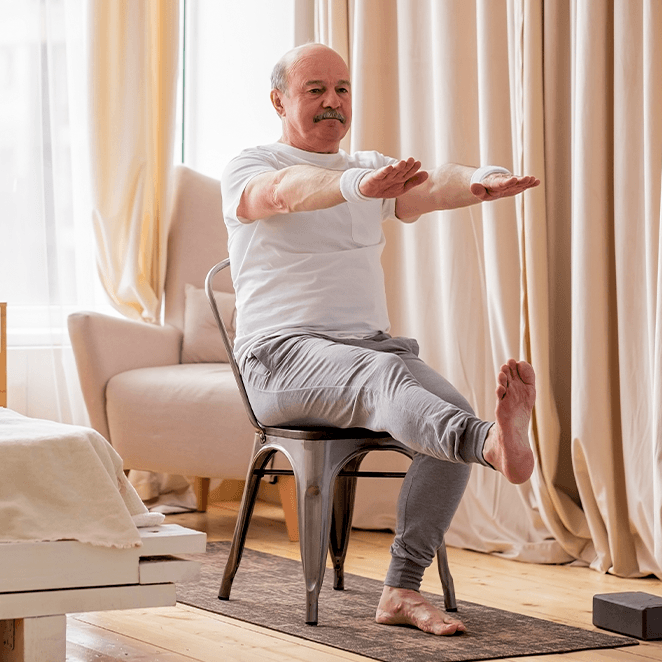
6. Seated Leg Extensions and Ankle Circles (2
minutes)
Sit up straight. Extend the right leg straight out and
hold it parallel to the floor for three seconds. Then lower it slowly. Do this
ten times, then switch to the left leg.
Next, lift both feet off the
floor and draw slow circles with the ankles, doing ten clockwise and ten
counter clockwise.
This may be the most functionally important exercise in
the entire sequence.
When standing up from a
chair, the quadriceps (located at the front of the thigh) are the muscles
primarily responsible for doing this and along with this the primary
stabilisers of the knee joint. Weakness here correlates directly with fall
risk. Chair yoga research done on older adults with osteoarthritis showed
exactly this type of leg work to improve functional mobility.
Lower leg ankle circles provide the body with a warning
system for unstable ground. This exercise helps improve circulation and
proprioception (awareness of the position and movement of the body).
7. Seated Side Stretch (1 minute)
Sit tall. Stretch the right
arm overhead and lean gently to the left, creating a stretch along the right
side of the torso. Hold this position for three breaths then return to the
centre and repeat on the left side.
Exercises that elicit a
response from the lateral stabilizers (muscles on either side of the torso) are
almost never included in routines offered to older adults. Research has
demonstrated that strengthening these muscles facilitates the performance of safe
and stable reaching, turning, and walking on uneven terrain.
8. Mobility of the Wrist and Hand (30 seconds)
Arms extended in front. Fist,
fingers, fist, fingers. 10 reps. Rotate each wrist 10 times in each
direction. This exercise may seem small, but its importance is not. Grip
strength is one of the most reliable predictors of good overall health among
older adults. This is especially true for any older adult who uses a walking
aid. Their wrists and hands become the load-bearing joints of their mobility
every day.
9. Guided Relaxation: Closing Practice (1 minute)
This is the last part - the
cool down phase. Rest your hands, palms up on your thighs. Close your eyes and
take 5 deep breaths. With each exhale, consciously relax a different part of
your body: your jaw, shoulders, hands, thighs, and feet. Finish by remaining
still for a moment, without any specific purpose or movement. Just be present.
This is not a formality. In
the practice of yoga, it is referred to as savasana, the transition from
stillness to movement allows the nervous system to process what has just taken
place. It is the difference between a workout and a practice.
Making Home
Practice Safer
The chair yoga sequence is
intended for home practice. However, the home environment is not always planned
for movement. Here's how you can make it safer.
1.
Use a stable chair on a non-slip surface.
2.
Place a non-slip mat under the chair to minimize the
movement of the chair during leg extensions or twists
3.
Practice closer to a wall, grab bar or sturdy furniture
positioned close enough to reach to ensure safety during exercises that require
leaning or stretching.
Chair yoga strengthens the
body’s overall balance. A safe home environment serves as an additional
protective layer. You can always look at AGEasy’s portfolio of
mobility aids and fall prevention products to ensure that your surroundings
are safer and encourage movement.
How to get
your parents to try this
How do you get someone who has never done yoga to do 10
Minutes in a kitchen chair?
Here are few things that work -
1.
Do it with them,
the first time. Not as an instructor. As a participant. Ten minutes alongside
someone is very different from watching someone do something.
2.
Frame it as an
experiment, not a commitment. “Let’s try this for 2 weeks” is a manageable ask.
“You should do yoga every day” is not.
3.
What they did is
of secondary importance. Focus on how they feel afterward. “How do your hips
feel now?” “Did you notice your breathing slow down?” Doing such conversations
helps build the internal motivation in senior adults to sustain the habit over
time.
As long as where they are
practicing is safe, they don't have to wait for the perfect chair, the perfect
space or the perfect time for the practice. It is the consistency of practice
that brings results later.
The goal is
not perfection
Chair yoga will not reverse
arthritis. It will not undo decades of sedentary habits in a matter of weeks,
and will not guarantee that no future falls will occur.
However, chair yoga does help
build balance, strength and confidence to make your body more resilient.
Measures have shown that chair yoga provides these benefits with Indian
clinical trials done specifically on this demographic.
In the Nagpur study, a
control group's mobility declined, whereas the yoga group's mobility improved.
This is not an inspirational talk. This is a report on clinical data.
The body is always changing in response to stimulus.
Building capacity is cumulative and requires use or else it will atrophy.
Want to age well? Take a 10-minute chair yoga session every day in a quiet environment. That's all it takes.
Recommended Blogs

You May Also Like
 No products found
Article by:
Admin
Article Category:
General Wellness