

Monsoon Is Here and India's Seniors Face 3 Real Dangers at Home Right Now
Article by: Admin
Jun 20, 2026. 12 min read

A Practical Safety Checklist for Families
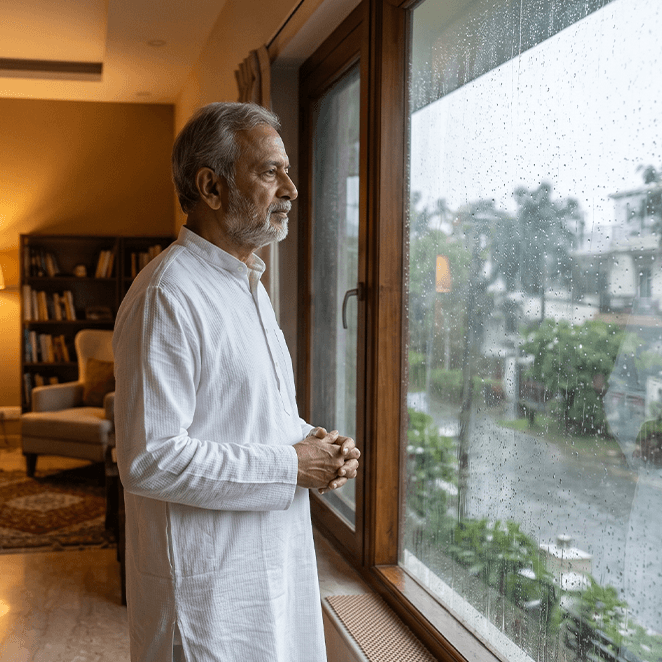
There is an intangible quality that changes in Indian homes with the arrival of the monsoon. For many of us, these changes have become so common that we no longer acknowledge them.
The first change is in the scent, and then the floors change too. That mosaic tile in the hallway that your father walked across countless times...now becomes more difficult to traverse. More dangerous somehow.
The damp patch in your bathroom wall that your mother always meant to fix? The monsoon changes that from a cosmetic issue to something that impacts the air she breathes.
Your parents, who are now stretching their legs with a midnight bathroom break in absolute darkness, must navigate the air damp with no electricity and no one else to keep it company.
It doesn't feel like a crisis. And that's what makes it more dangerous.
The Southwest Monsoon set in over Kerala on 4 June 2026, confirmed by the India Meteorological Department, and by 8 June, had already advanced to parts of Maharashtra, Karnataka, Andhra Pradesh and Telangana. Now, we are in the middle of the peak hazard window. June to July is when the patterns below manifest in Indian homes, and they are as real and consequential as ever.
We'll discuss these patterns, and the changes families can make to address them this week.
DANGER 1 - Slippery Floors: a hazard that does not wait for the rain to arrive
Here is something people get wrong about the monsoon falls.
They imagine an outdoor scene. One person, somewhere, stepping into a puddle. Another sliding on slick pavement. Rain is striking a footpath.
The unfortunate reality is that what the family of an older adult experiences most during monsoon season is slipping, and falling, though family members are convinced that their house is the safest place.
In the absence of rain, humidity alone can damage the flooring of a house. The rising moisture content of the air alters the friction coefficient on floor surfaces, in this case, tiles and polished marble, making them slippery. Add a wet doormat, rain water carried in on shoes, or a window left open, and what can otherwise be seen as a safe, normal floor, becomes a trap.
An older adult can easily be distracted by other things in the house and will not be aware of the hazard floor.
The Biology of Why Older Adults Fall on Surfaces Younger People Navigate Fine
The reason is that it explains the great disparities in the same floor and how it can affect different people.
The coordination of our balance consists of vision, hearing, and the sense of where you are in space through the joints and feet. The last one is called proprioception, and is a living and dynamic system.
These 3 systems become less precise with age. The signals slow down. The brain loses the ability to process and respond. In younger people, micro-corrections happen automatically to prevent stumbles and falls. With aging, those corrections arrive too late.
Imagine a car's stability control system. The hardware is still functional, but the software in the system has aged. The system's response to slip is too late, and a sudden slip in the car is an unmanageable challenge for the system.
In 2025, a study published in the journal Age and Ageing, using nationally representative data for older Indians, found that household dampness increased the risk of a fall for older Indians. It was a fall risk on its own, independent of poorly lit or unstable flooring. Researchers considered those risk factors, and dampness was still a risk of a fall. This is a significant finding.
An additional survey of the rural population of Pondicherry found that every household had fall hazard listed, poor lighting or flooring, or mats that were too loose and cluttered passageways. Those hazards are consistent between dry days. Monsoons make them worse.
Falls in older adults are rarely about one bad moment. They are about several small vulnerabilities, each tolerable on its own, arriving at the same time.
The repercussions of a fall are not limited to the physical. For a parent that lives fully independently, the injury is only part of the challenge. Most of the danger is in the wait. There is a huge difference between the clinical outcome of a hip fracture that is treated a few hours later and one that is discovered the next morning.
This is why the checklist at the end of this article is not optional during these months.
DANGER 2 - Mould and Respiratory Illness: The Problem You Cannot See Until It Has Already Started
A good representation of the challenges that arise in the monsoons is what you see - and smell - when you enter a room that has been shut for about 3 days of rain. You know that smell.
Heavy, stale, and the kind of smell that makes you want to open a window and let it out.
It is not just unpleasant. It is a kind of biological assessment of the air. The humidity is high enough for microbial growth. Growth is a challenge everywhere, but especially in most of the Indian kitchens and bathrooms, that process can occur in just 24 to 48 hours of rain starting.
Mould Only needs moisture, warmth, and a surface. The monsoons provide all 3, for weeks.
Consequences of Mould Spore Inhalation in Older Adults
By design, mould is difficult to contain; it propagates through air by releasing spores. Everyone is exposed to spores. For younger people with strong, fully functioning lungs, exposure is likely little more than a minor annoyance.
It is not the same for the older adult, especially one who is known to have asthma or chronic obstructive pulmonary disease.
Mould commonly saturates our indoor air in damp, closed environments comprise, among others, Aspergillus, Alternaria, Cladosporium, and Penicillium. They are known to cause breathing difficulties for most people, but for those with lung disease, it is no longer an annoyance, but a serious and worsening health risk, the longer the exposure.
A Damp and Mouldy Homes Study estimated that around 16% of European homes have mold-prompted indoor dampness problems. It will likely be worse in India, where monsoons incursion, combined with insufficient waterproofing of walls, coupled with kitchens and bathrooms devoid of appropriate exhaust systems, create an environment favoring indoor dampness. The research also shows that even within well-regulated housing systems, mould is more prevalent than people think.
In older adults, especially those with diabetes, an already vulnerable population, the effects of constant moisture are further aggravated by the increased risk of chronic skin irritation, persistent fungal skin infections, and gradual immune system suppression.
Here is what catches families off guard: the cough that starts in June often does not get connected to the mould that appeared in the bathroom corner in early July. The link is real. The timeline just requires someone to notice it.
It smells bad. Maybe make a grey-black smudge on the wall behind a bucket or a corner in the ceiling that is above the shower. It may trigger a persistent morning cough that family members, including yourself, assume is a seasonal cold. There are many signs of mould, but by the time a family member connects the persistent morning cough to the cough, it is too late.
The good news is that early mould is easy to detect. The challenge is identifying early signs of mold before a family has to cope with the persistent morning cough.
DANGER 3 - The Bathroom: Where Hazards are Piled
If you had to draw a map of your home, the bathroom would be shadowed with the most risk. This is not because the rest of your home is safe, but because the bathroom, at the same time, circulates most significantly the first 2 greatest risks we've discussed.
The floor is wet, there is poor ventilation, the walls trap moisture, and the room is small and uncomfortable. Older adults, on average, visit this room several times a night.
Wet bathroom floors, especially after a shower, are dangerous for seniors. Apollo Hospitals specifically names them as a monsoon home hazard. They are likely responsible for many of the summer emergency visits that doctors see on a yearly basis.
Consider the scenario. An older father wakes at 3, as many older men do, to make a bathroom trip. He walks across a slick bathroom floor. The air has held the shower water, and there are no bathroom grab bars. The light switch is located at the far side of the room, requiring him to completely enter before he can illuminate the room. As a bonus, if the power goes out, he has no light.
That scenario is completely normal, and taken as a whole, it presents a significant fall risk.
Why the Grab Bar Is the Most Important Thing on This Checklist
The National Health and Ageing Trends Study (NHATS) found that older adults (65+) had a significant risk of falling if their bathrooms did not contain certain safety features, such as grab bars, shower seats, and tubs that require stepping over without any assistance.
Grab bars are not about calling someone fragile. They are a response to the laws of physics. Reduced balance and no anchor point on a wet surface equals fall. A grab bar represents a great change in the equation. A fixed, load-bearing bar placed in the most vulnerable position on the body actually changes the risk profile when entering or exiting the wet shower or raising or lowering the body from the toilet.
Ventilation, drainage, and anti-slip flooring consider the air, and the grab bar covers the moment of greatest instability, and the surface. They work together. For the least investment and the most return, this checklist shows best in the bathroom.
The Monsoon Home Safety Checklist
What follows is a room-by-room walk-through. The goal is not to overwhelm you. It is to give you something concrete to do this week, before the season is fully underway and before a problem becomes a crisis.
Go through this with your parents if they are willing. Or do it on your own during a visit. The checklist takes less time than you think, and the items that matter most cost very little.
BATHROOM: Start Here |
✓ Grab bars must be placed next to the toilet and in the shower and bathing areas. |
✓ Anti-slip mats must be placed in the wet zones and in the areas adjacent to the wet zones. |
✓ Ensure that the tiles in the shower and bathing areas and the shower drain clear unobstructed. |
✓ Consider a shower seat if standing in the shower for the entire time is difficult. |
✓ The exhaust fan should be run after every shower or the window should be opened on dry days to help remove the humid air. |
✓ Inspect the corners and ceiling near the shower for early signs of mold. Remove early signs of mold with a cotton swab and vinegar. |
✓ The light switch should be placed just inside the doorway so a person does not have to fully enter the bathroom to turn the lights on. |
FLOORS AND PASSAGEWAYS: The Whole House |
✓ All loose rugs and mats that may be shifting underfoot should be removed. |
✓ Inspect the main pathways for uneven floor tiles or raised edges that may catch a foot. |
✓ Confirm that a clear and well-lit pathway is provided from the bedroom to the bathroom. |
✓ A non-slip doormat that remains flat when wet should be placed outside of the main entrance. |
✓ A towel placed at the entrance should soak up rainwater to keep the water from spreading. |
✓ Dryness can be checked by hand on the walls of the hallways and by the windows. |
WALLS AND VENTILATION: Get Ahead of Mould |
✓ Observe the dampness of the bathrooms, kitchens, or on walls that face the north. |
✓ Repair walls before they deteriorate severely before peak rainfall - the sooner the better |
✓ Clear out damp air by opening all the windows and doors |
✓ Find the moisture source after you remove the visible surface mold |
✓ Don't close kitchen and bathroom vents to keep out mosquitoes. It will trap humidity. |
✓ Consider investing in a small dehumidifier for a persistent damp room |
POWER CUTS AND NIGHT SAFETY |
✓ Keep a charged torch or night light you can recharge in the bedroom and near the bathroom door |
✓ Charge your phone and keep it in your bedside phone |
✓ Keep a visible copy of your emergency contacts |
✓ If your parent lives alone, check in daily during the monsoon |
✓ A motion-sensing night light in the corridor between bedroom and bathroom is a great and considerate investment |
MOBILITY AND DAILY MOVEMENT |
✓ Encourage gentle movement practices for indoor days |
✓ Build in short standing breaks to offset stiffness from sitting |
✓ Monsoon footwear during the season is critical; slippers with non-slip soles should be worn |
✓ If a walking stick or walker will be used, check the tips; smooth tips on a wet floor are a slip hazard |
The Truth About All This
The monsoon isn't the reason for the weaknesses in your parents' home.
The monsoon finds them.
The loose mat, poor ventilation, missing grab bar, possible power cuts are all already there. The monsoon raises the stakes for each and every issue.
That's why is the time to act now, not when there is a fall, not after there is a hospitalization, and not when the monsoon rains are fully established and the season is half over.
We know how these discussions are. There is always something better to do. The home has been safe for years. Your parents may think nothing needs to change. We are not minimizing these challenges.
What the research shows is that the changes to homes of older adults that improve safety, especially in the monsoon, are very low cost. A grab bar, an anti-slip mat, a touch that is bedside and charged, a daily phone call to check in. The changes that improve safety and are more costly, such as waterproofing a seeping wall or fixing an uneven floor, also cost less if done before a safety related incident.
Prevention is invisible. The monsoon that passes without a fall or a hospitalisation does not make any news. It just means someone in that family paid attention a few weeks before it mattered.
The science explains the risks and how they affect older people. The checklist describes the responses. All that's left to do is set aside a few hours this week to actually go through the house.
You May Also Like
 No products found
Article by:

Admin
Article Category:
Bathroom Safety