

Your Parent’s Walking Stick Is Quietly Failing Them And Nobody Warned You About This
Article by: Prateek
Article Category: Walking Sticks
Aug 10, 2026
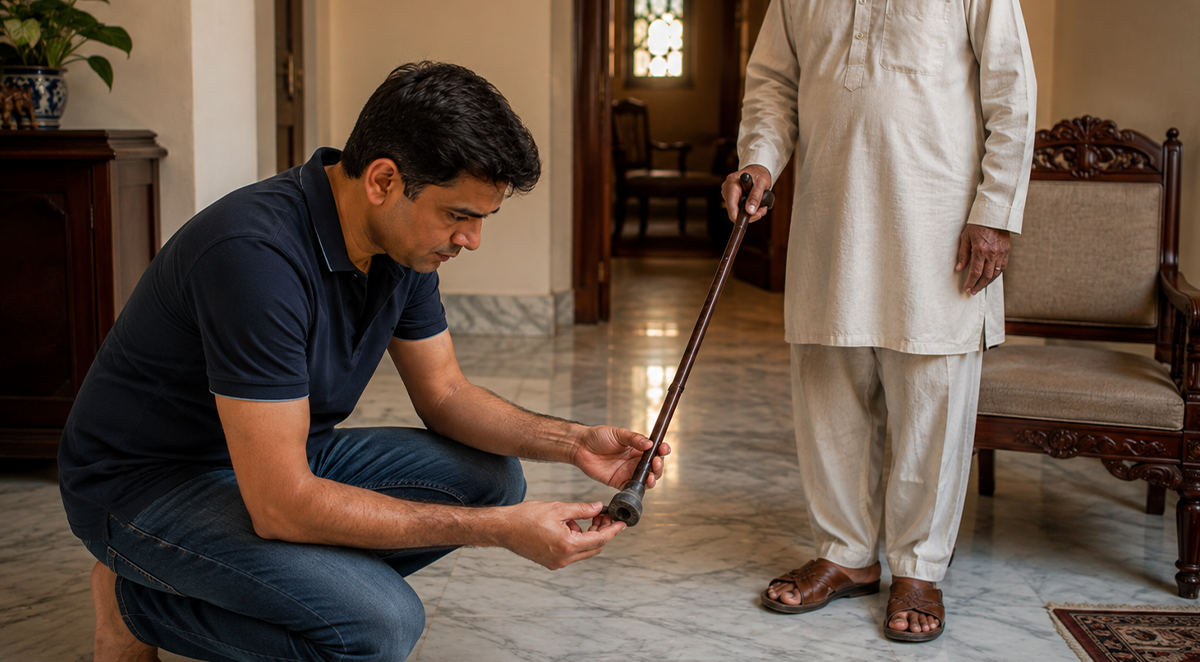
Most families have a hard time convincing their older family members to use a walking stick, but the real problem comes long after they agree and start to use one.
Purchasing a walking stick can come after a stressful and worrisome fall. It may come after the family member's physiotherapist has been convincing the family to buy one for a while. You may do some research and purchase a stick that you feel is appropriate, but afterwards you assume that it's doing its job right even after a long time of frequent use.
Often walking sticks are treated in a 'set and forget' manner. The consequences of neglecting this simple maintenance are probably a lot more dangerous than you assume.
Here is something you probably don't know.
Start Here: The Rubber Tip Is More Important Than You Realise
An old walking stick with a rubber tip on a slippery surface can be a lot more dangerous than walking with no stick.
Every time someone walks with a stick, they are transferring a considerable amount of their body weight down to the walking stick and to the surface/ground. The stick is doing its job as long as the rubber tip is 'sticking' to the ground. In the instance where the rubber tip is sliding, the stick is now, effectively, doing just the opposite. Instead of support, it is now sliding the stick forward, and the person who relies on it will fall.
Occupational and physical therapists see worn ferrules (the clinical term for the rubber tip on the stick) as a legitimate risk for falling, especially on smooth and wet surfaces indoors. And here's the reason this is important with respect to Indian homes: polished marble, glazed ceramic tile, smooth cement floors. Those are the most common surfaces in urban and semi-urban households, and they provide the least forgiving surfaces for a degraded walking stick rubber base.
The ferrule is not a design element. It is an element that provides friction. When it is functional, it works invisibly. When it wears down, that contact is broken, slowly, and without obvious warning.
Knowing When the Rubber Tip Needs Replacing
In most cases, wear of the ferrule is a slow process and difficult to notice. A stick is not like your phone screen, and you can't determine wear like you would on a flat tire. The rubber tip may look the same, but it is not providing the same performance.
The best way to tell is through observation. Look for the following:
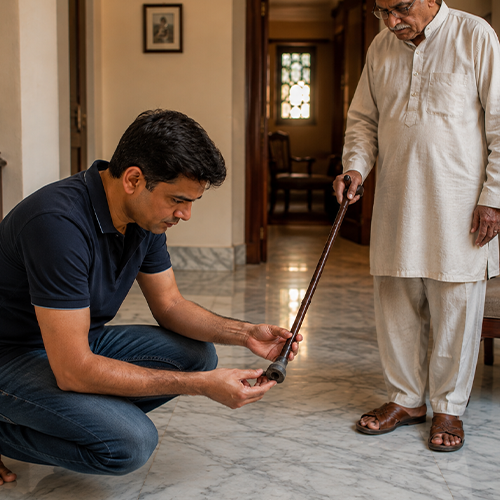
Look at the ferrule from the base. Looking at the tip, you will see the rubber ring has a texture that allows it to grip. With a well-used ferrule, you can see that the rubber is flat, shiny and smooth, and all the texture on the rubber has been polished away. Other signs of wear include rubber that is compressed in the center and may even appear to be sitting off-center or be rocking slightly.
Try the slide test. A stick with an unworn ferrule will resist your attempt to slide it across the kitchen (a smooth, polished floor). However, you may be surprised by how easily it is to slide a stick with a worn ferrule. This test takes five seconds and is far more informative than a distant look at the rubber.
Consider the duration of use. The average duration for a walking stick's use cannot be generalized since it is dependent on the user's daily routine, weight, and the kind of surface the stick strikes. For example, an indoor stick would wear out and eventually damage its protective tip faster than an outdoor stick due to excessive use for long periods (i.e. 8 hours a day). As a rule of thumb, check the stick's tip on a quarterly basis, and please do replace and report its condition when the rubber tip is noticeably worn down, as the damage has already been done to the stick.
Determine if the stick's tip remains secure. If a stick's tip is loose or freely rocks back and forth, this can become detrimental to the stability and integrity of the base of the walking stick. The base of the stick is engineered to accommodate ferrules within specific diameters, so they should fit snugly. A loose tip could actually break free of the stick which is usually the worst-case scenario.
On the bright side, replacement rubber tips for walking sticks are quite affordable and can be purchased in bulk. Anyone who uses their stick frequently should ideally buy ferrules along with their tips for added peace of mind. AGEasy provides ferrules for the standard diameter sticks, so it definitely gives good value for money.
The Handle: The Part Nobody's Talking About
Out of all the walking stick's comfort features, the handle is the most disregarded, and for good reason; it is often the cause of improper grip, which results in eliminating the handle's intended comfort purpose.
Walking sticks are typically designed with a crook handle, the curved hook shape. It is a mold that is designed to hold the stick like you would expect a stick to be held. The crook handle is not the most suitable option for a large number of elderly people, especially those with arthritis in their hands, reduced grip strength, or pain in their wrist joints. The crook handle is also the cheapest option available, which does not make it the right one.
Here is why the shape of a walking stick handle is so important.
When one grasps a crook handle walking stick, they will find that most of the pressure is concentrated on the palm that is in contact with the stick. This is perfectly acceptable for a person with strong and healthy hands. However, for a person with osteoarthritis, rheumatoid arthritis, or for an elderly person who has simply lost the ability to grip tightly, this concentrated pressure can lead to real and severe discomfort, and sometimes even pain.
Considerations for Walking Stick Handles
Orthopaedic or anatomical handles (sometimes known as Fischer handles) take on a different shape. They are wider and shaped to match the natural curve of the palm, helping to distribute weight across a larger area. For those with arthritis in their hands, this extra comfort can make a world of difference. Picture the difference between holding a heavy shopping bag by its flimsy plastic handles versus by a nice thick fabric one. Everything else is equal, but the experience is totally different.
When it comes to choosing a walking stick handle, there are several factors to weigh.
Grip Material. A grip made of hard plastic can become slippery when a user's palms are sweaty, or if they suffer from a hand tremor. Grips made of foam or rubber, on the other hand, provide a nice tactile feel without requiring a firm grip, which is a significant consideration for those with reduced finger strength.
Handle Angle. Some handles are designed to be offset or angled in relation to the stick. This design helps keep the user's wrists in a more neutral position to reduce the amount of torque and wrist strain that occurs with straight-through handles. Users with wrist pain or symptoms of carpal tunnel syndrome have found angled handles to be significantly more comfortable.
Temperature. In cold weather, metal handles can be unpleasant. If you plan on taking your stick outside in the winter, having an insulated handle can make a real difference.
Here's a question that merits an honest answer: if your parent has begun gripping their walking stick strangely, perhaps even too loosely or awkwardly with one hand, it may be less about their walking stick technique and more about the walking stick's handle.
Handle Height: Set Once, Forgotten Forever (Until Something Goes Wrong)
This is the kind of thing that gets done once, often done incorrectly, and then gets forgotten. And it is more important than most people realize.
When a walking stick is set to the right height, it feels good to use it, your whole body flows. When it is wrong, even by just a few centimeters, it silently defeats its own purpose for months, even years.
How to check the height correctly
Have the user stand in their usual shoes on a flat and even surface. Their arms should be relaxed and hanging by their sides, with their shoulders level. The handle of the stick should be at the level of the crease of their wrist, the line where the hand meets the inner forearm. When the user holds the stick at that height and puts weight on the stick, the elbow should be slightly bent, around 15 to 20 degrees.
That slight bend is crucial. It allows the arm to take load via muscles, and joints, instead of just hitting a locked elbow, and driving all the impact up into the shoulder.
When the stick is too tall, the shoulder on the stick side has to rise to compensate. This results in an asymmetric gait, and will lead to shoulder problems in the long run. After months of repeating this, the user may develop shoulder pain, but they will often be unaware of the cause. It never occurs to anyone to look in that direction.
When the stick is too short, the pain could be less apparent. The user will have to bend sideways at the waist or lean forward too much. This affects their posture and can lead to discomfort in the lower back and hips, again, in ways that don't easily trace back to the height of the stick.
Why do you need to check it again? Your required height might change with time. A hip or knee replacement will alter your posture. Over time, spinal compression will alter your posture. A substantial weight change will change your posture. Even changes in your shoes can affect the required height. People wearing flat slippers indoors and heels outside, will need two different height adjustments, or at least one set each per preferred shoes.
Most adjustable modern sticks can be reset in under a minute. Ideally check the height once or twice a year, or after any major change in the user's mobility or posture. It's a small effort that can save you from months of unexplained aches. You can set a reminder in your calendar.
Walking Sticks Not in Use Can Harm Too (People Find This Surprising)
Here's an interesting paradox.
A walking stick that rests against a wall could create a falling hazard.
The stick bought to prevent people from falling can create a falling hazard.
Sticks fall. It's not just an abstract worry. It's physics. A cylindrical object balanced on a flat surface (like the floor) against a vertical surface (like a wall) and disturbed dozens of times a day by normal household movement, vibration, the cat, someone walking by, it will fall.
There can be obstacles in a doorway. Someone could trip over a fallen stick, especially if they are walking at night and are less steady. If a person bends down to pick the stick up, without support when doing that, they are risking injury.
This is not about exaggerating possible injuries. These are all real events.
There is an easy remedy to this: a walking stick stand.
An ideal walking stick stand should have a weighted base or a stable clip to secure the stick in an upright position — eliminating all hazards, and keeping the stick accessible at all times.
These two are the biggest risk areas in most homes, the night bedroom and the bathroom. A stand right next to the bed means the user doesn't have to fumble in the dark for the stick. A stand or hook next to the bathroom door means the stick is there during and after what is usually the most risky movement of the day.
When selecting a walking stick stand, make sure the base is heavy enough to stay stable (not one that tips over when the stick is pulled too quickly), the slot is for the exact diameter of the stick being used (a loose fit defeats the purpose), and the position of the handle is such that the user does not have to bend over to reach it.
A few other habits that help
The stick should always be kept in the same location when it is not in use. For users with any memory loss or changes, having a predictable placement is enormously helpful. The stick is always at the front door, always by the bed, and always next to the chair. Inconsistent placements create searching. Searching creates risk.
Don't leave the stick in the bathroom. The rubber tip will sit in water, prolonging moisture which will cause the tip and the shaft to degrade, ferrule first, depending on the material used for the shaft. After using the stick outside in wet or rainy conditions, dry the tip before putting the stick away.
The Five-Minute Check That Actually Keeps People Safe
Every couple of months, you should plan 5 minutes to do the following.
Ferrule test. Grab the stick, flip it upside-down, and take a look at the bottom. Is the bottom still grippy or is it smooth? If it slides, then you need to replace it. Any new walking stick rubber can be replaced in under a minute.
Handle test. Ask the user of the walking stick whether the grip causes discomfort. Also look for damage on the grip material. If someone has arthritis, or discomfort in the hands or wrists, the standard walking stick grip is inadequate.
Height test. Ask the user of the walking stick to stand naturally. Check if the stick grip reaches the wrist when the arm is relaxed and the elbow is bent comfortably.
Also check how the stick is stored when not in use. If it is leaning against a wall or something similar, purchasing a stand is worthwhile.
When a Walking Stick Is No Longer the Right Tool
A new walking stick may even be needed if a user is becoming reluctant to move about independently. If balancing becomes an additional concern, this is a good sign a physiotherapist should be contacted to assess the situation. When there is concern about the user's stability on both sides, a wheeled walker is highly recommended, particularly if they require a support mechanism to lean against when standing.
If a physiotherapist has recommended the use of a wheeled walker, AGEasy's wheeled walker for elders would be an appropriate consideration. This is not a situation where walking sticks become useless. Rather, it is about understanding people's needs where their support mechanisms are being overlooked.
Why Safety Isn't Just Buying the Right Product, It's a Practice
The issue is clearly not that the family system does not care. The problem is that a walking stick does not present any indication of whether it is functioning appropriately or not in a very visible way.
The worn ferrule is just a ferrule. The wrong handle is just a handle. The stick against the wall looks like a stick ready to be used. The issues with a walking stick aren't visible until they are, and by that time, something significant is likely to have gone wrong.
For this reason, the only feasible strategy is to examine carefully at routine intervals before there are any signs of trouble. Family members who inspect the rubber tip every few weeks are not being particular or overly conservative. They are actually doing the one thing that the majority of people do not do: attending to the small details where small risks conceal themselves.
That sort of vigilance is required, more than just choosing the right product. It's the proactive checks which truly protect people.