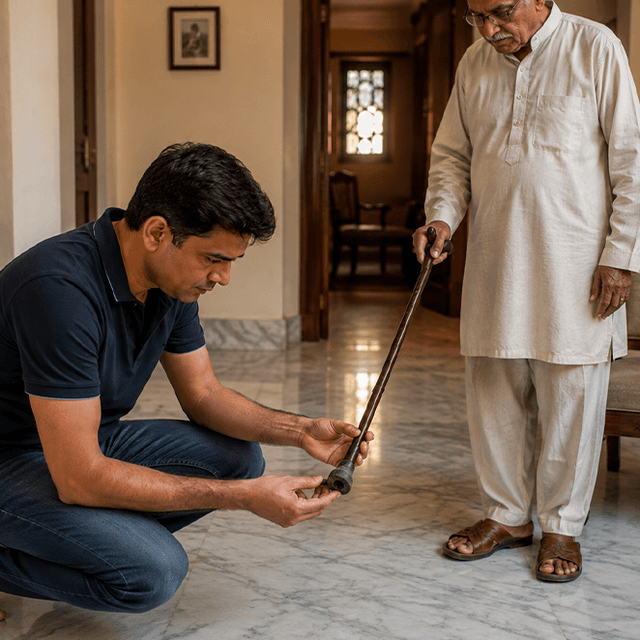


Finding the Right Support: A Comprehensive Guide on Walking Sticks for Indian Seniors (2026 Edition)
Article by: Addy
Article Category: Walking Sticks
Aug 6, 2026
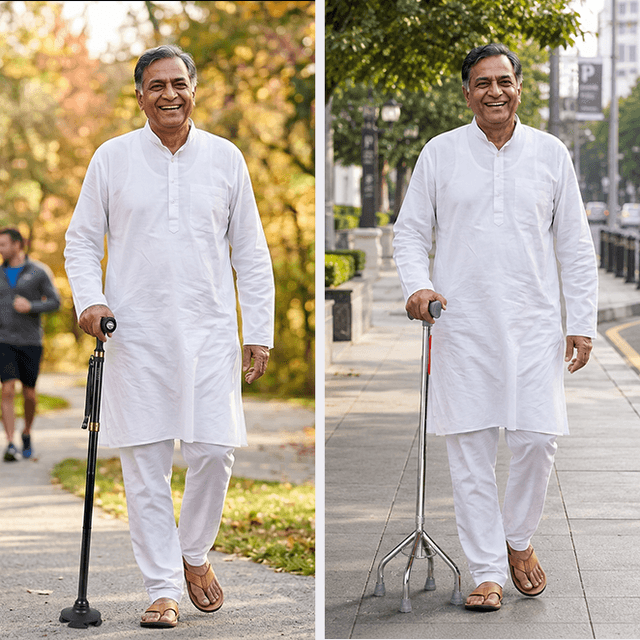
A walking stick doesn't mean your parents are getting old. It means they're choosing to stay independent.
Most families don't see it that way. They wait. They hope the unsteady walk is temporary. They tell themselves, "They're managing just fine."
Until one day, they aren't.
The biggest mistake isn't buying a walking stick too early. It's buying one too late.
You shouldn't wait for
- a painful fall,
- an emergency room visit,
- or a fractured hip
Look for the moments before that.
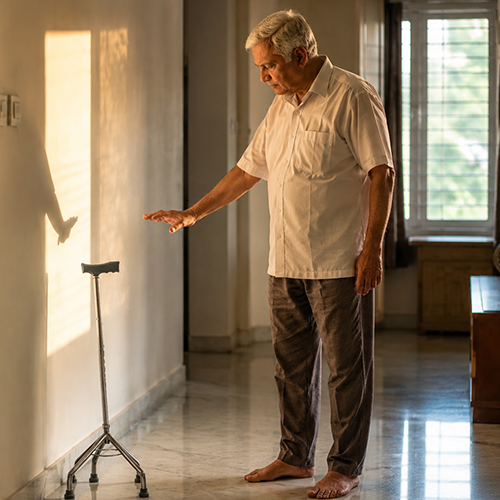
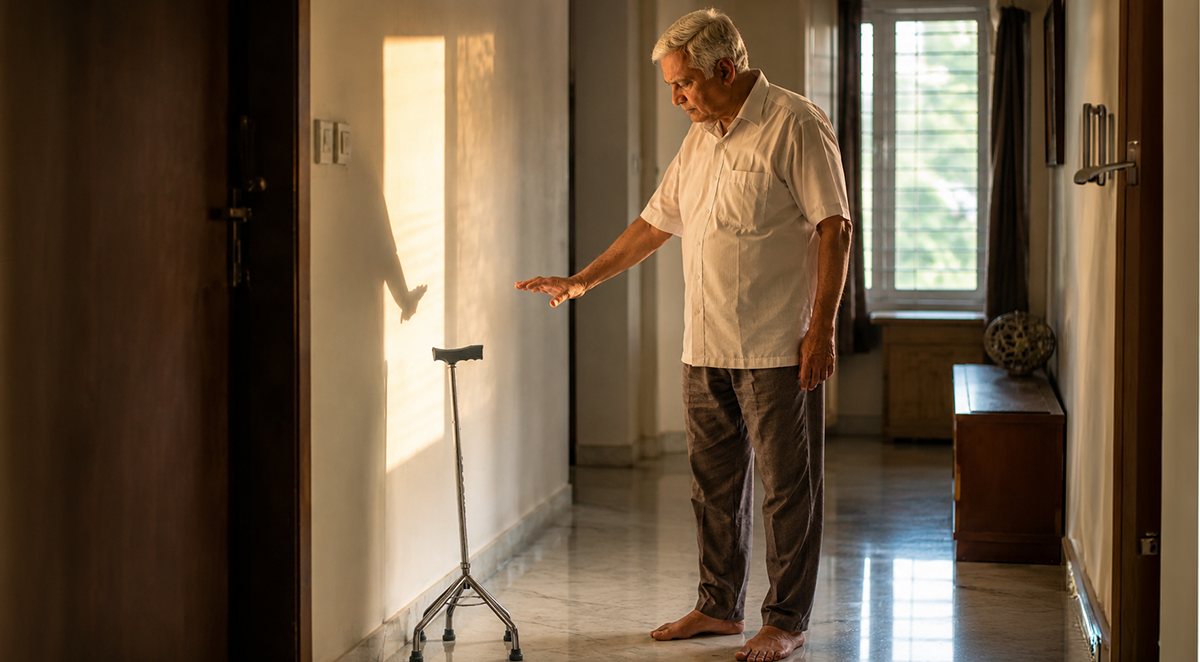
- The hand reaching for the wall while walking down the hallway.
- The extra few seconds it takes to stand up from a chair.
- The evening walk that quietly disappears from their routine.
- The hesitation before climbing a single step.
Those aren't signs of weakness. They're signs that your parents need a little more support - not a little less freedom.
And here's what most people get wrong. A walking stick is not just another medical product.
Choosing the wrong one can
- make walking feel more awkward.
- reduce confidence instead of building it.
- increase the risk of falls.
- end up unused in a corner of the house.
Choosing the right one can:
- bring back the confidence to walk independently.
- make morning walks enjoyable again.
- help them move safely around the house.
- give your family one less thing to worry about.
This guide will help you make that choice. Because the best walking stick isn't the most expensive one. It's the one that gives your parents the confidence to keep living life on their own terms.
So what type of walking stick should you buy? Let's dive in.
Reasons why having the wrong walking stick could be worse
Poorly sized walking sticks can cause more problems than they solve. They can cause users to develop awkward gaits, increase strain on the wrist and the shoulder, and worst of all, those who use them may develop a false sense of security on surfaces where the walking stick won't provide adequate traction.
A properly sized walking stick can be compared to a third leg. It helps to extend the body's support base, decreases the amount of stress and pressure on the joints that may be injured or simply weakened, and provides an additional point of contact to the ground that the user can rely on to help them with balance. When these factors are considered, most users can have a much more positive experience using the stick.
A poorly fitted stick can also disrupt the user's natural walking process and cause them to make awkward compensatory movements.
Defining what you need is an important part of this process, so let's get started.
Important Considerations Before Looking at Any Products
Before considering any products, there are three important questions that are essential to this process.
1. What is the primary reason your parents need assistance?
- Balance feels unsteady (dizziness, lightheadedness, inner ear problems)
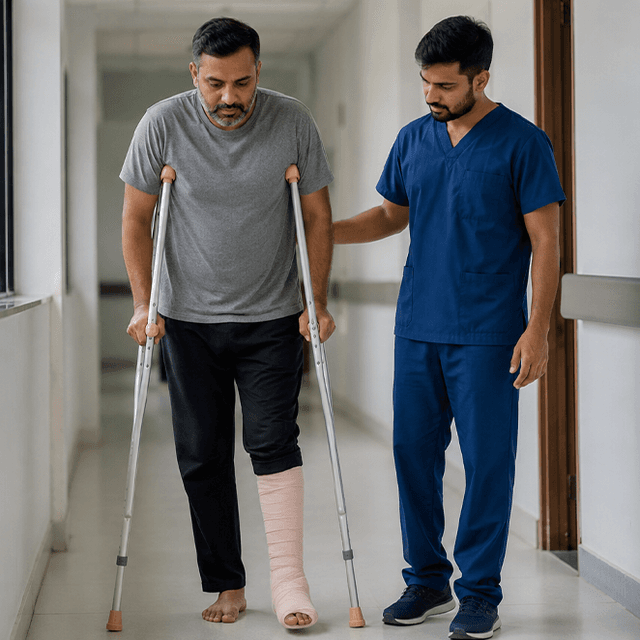
- One side is weaker (post-stroke, knee surgery, hip replacement)
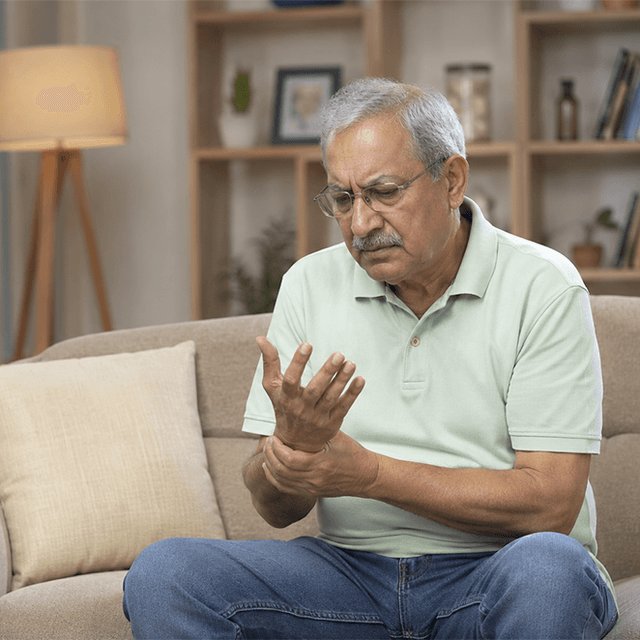
- Each step can be painful due to joint pain (arthritis, knee osteoarthritis)
- General weakness after an illness or a prolonged period of bed rest
- A recent fall that has created the fear of falling again, but there is no specific physical weakness
2. What kinds of surfaces do your parents walk on every day?
This is where most generic purchasing guides fail completely because Indian homes have a unique problem that most western guides miss completely.
The floors of most urban and semi-urban Indian households are polished marble and ceramic tiles, which are smooth when dry and truly treacherous when wet. Outdoor walking/mobility aids bring their own unique set of concerns and challenges. There are uneven and rough sidewalks, stone courtyards in temples, and the roads can become treacherously slippery during monsoons.
A stick which is perfectly acceptable in your friend's apartment in Pune may pose a significant safety hazard in your parents' Chennai home, especially if the residence is covered in marble floors.
3. How likely are they going to use the stick?
This is a question that requires brutal honesty. Walking aids are shunned by a lot of older adults. It's not because they're stubborn. It's because using a walking aid means having to come to terms with a lot of things. It's accepting that they're getting older and that their physical capabilities are limited. It means accepting the fact that they have to compensate for things that they've been able to do on their own.
Types of Walking Sticks
The Simplest Type of Cane
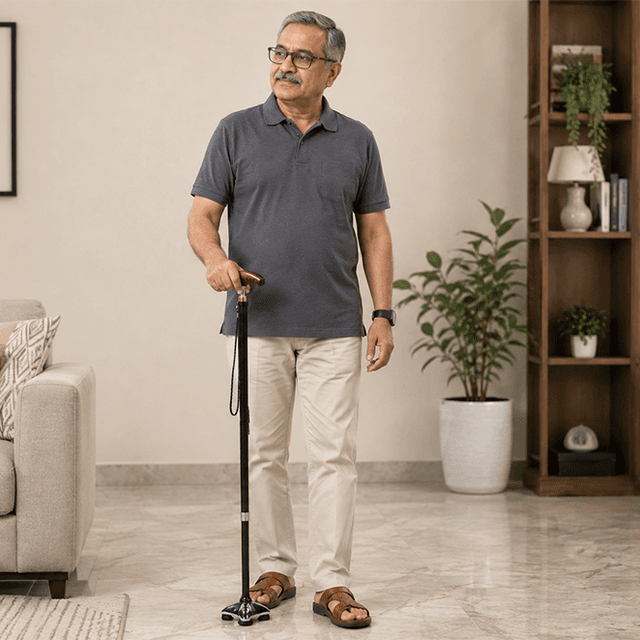
The simplest design. One shaft and one tip.
Single-point sticks are ideal for people who only need a little bit of support. These are best for someone who needs a little bit of support for things like steadying themselves on uneven surfaces, relieving pressure on a sore knee, or during periods of extended walking. Single-point walking sticks are light, and many of them can even fold up to fit in a bag or stow away in a chair.
Unfortunately, as with everything, there are some limitations. The limitation is exactly what it sounds like; a single tip of contact. A single tip walking cane requires a bit of vertical control to use it effectively.
Best suited for: Seniors who are relatively stable on their feet but would benefit from additional confidence support and those with mild joint discomfort. Also, active older adults require something lightweight and portable.
Tripod Walking Sticks
Three contact points instead of one.
Compared to a single-tip cane, a tripod design offers better lateral stability. The wider base means the stick does not need to be held perfectly upright to be effective. This means that the user does not have to keep the stick perfectly upright for it to be effective. It can cope with small changes in weight and angle. This is a critical design feature for users who may not have a steady grip or who walk with an unsteady or inconsistent gait.
In Indian markets of tripod and quadri-pod walking sticks, tripod sticks have more sales. They offer better utility as they're lighter and more compact than quadri-pod sticks but are more stable than a single-point cane.
Best suited for: Seniors who do not require maximum stability and only need support beyond a single-tip stick. They are also appropriate for individuals who have some balance problems, particularly on familiar domestic surfaces.
Quadripod (Four-Leg) Walking Sticks
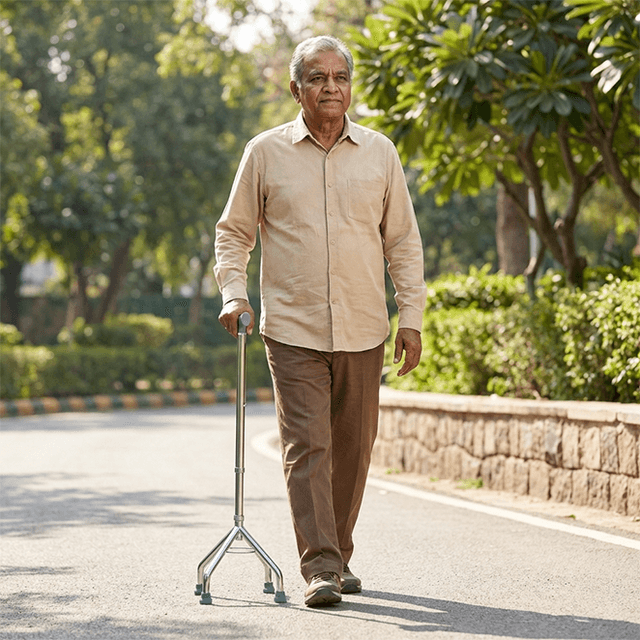
Four contact points. Widest base of support among standard walking cane designs. Quad sticks don't require you to hold them upright and steady like a single-tip cane. They can lean up against a wall and stand there. You can put it down momentarily while opening the door or adjust your clothes and never have to worry about it tipping over.
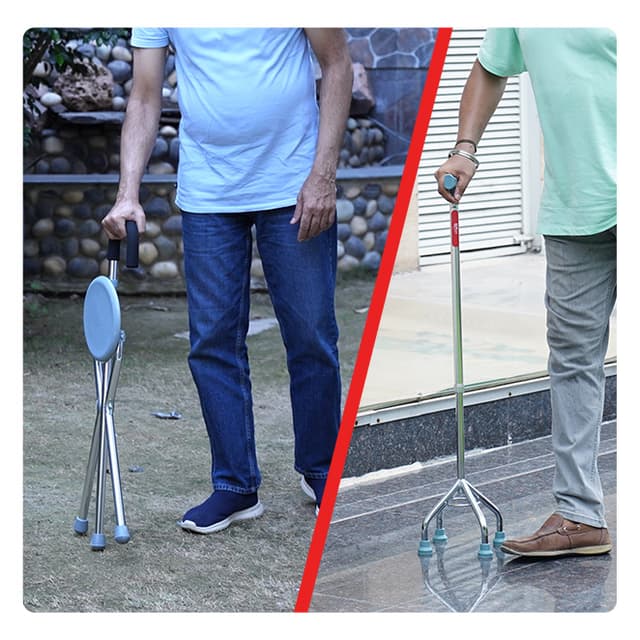
On slippery or wet surfaces, the four rubber tipped feet provide significantly better grip and stability than a single or triple contact point. The AGEasy Four Leg Walking Stick does all that and more. The quad base evenly spreads the weight on the circular support ring, and each of the four rubber feet are replaceable separately when they get worn out. Important since worn feet lose grip even when the stick itself might look fine.
Now the question is does the four-legged base size fit through Indian doorways? Most of the time, yes. It's definitely wider than a single tipped cane but still slim enough that it should clear the average doorway easily. In tight spaces, the four-legged walking frame may take some consideration but shouldn't be a huge problem in navigating around your home.
This is most appropriate for seniors who are recuperating from hip or knee surgeries, those who have had serious challenges with balance, and/or have fallen previously, or those who have home hazards that may be a slip issue. A physiotherapist may prescribe a quad cane as part of a post-operative rehab process, and that should certainly be heeded.
Specialized Options
Foldable Walking Sticks: When Portability Is Everything
Not every senior's main concern is home stability.
For elderly parents who still travel, a full-length walking stick that is not foldable can pose a problem. A foldable walking stick can collapse into three or four sections and easily fit into a handbag, travel bag, or car door pocket. The AGEasy Foldable Walking Stick (Black) is made from quality aluminum and therefore weighs about what you would expect it to weigh. The AGEasy also folds compactly and has height adjustability, so you do not have to sacrifice proper fit for convenience.
And this is something many families find out very quickly: if your parents are apprehensive about using a stick, a foldable one that can be stored discretely in a bag and taken out only when necessary is likely to be adopted to a much greater extent than non-foldable alternatives.
Where foldable sticks make the most sense:
- Travel and outdoor situations in strange environments.
- Seniors who are steady at home but require assistance outdoors in crowded or uneven terrain.
- Scenarios in which the stick is only needed at intervals, rather than on a continuous basis throughout the day.
The Walk-and-Rest Stick: A Category Most Families Are Unaware Of
A lot of seniors who are against the use of walking aids are not primarily concerned about the risk of falling. The concern is not about the walk itself. It is about being stuck in the middle of a walk, stranded between exhaustion and home with no resting place.
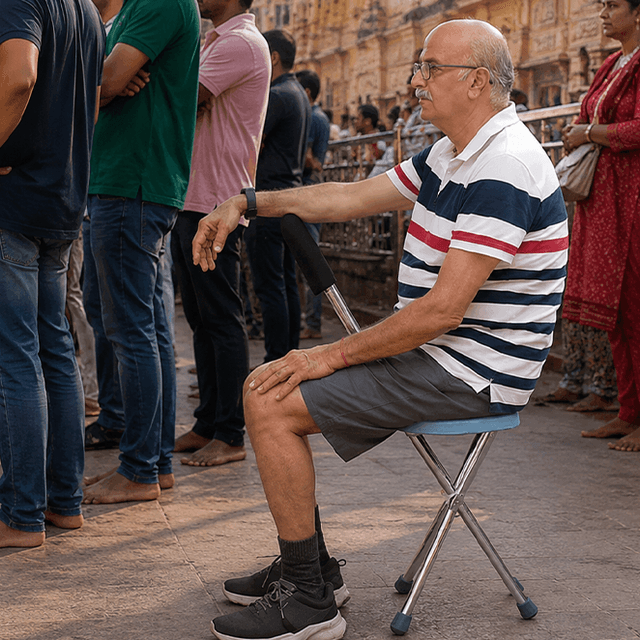
These specific walking sticks are made so that users can walk and rest without having to find an external rest feature like a bench or wall to lean against. The AGEasy Walk and Rest Walking Stick has been designed to allow people to walk and rest while walking by having an integrated seat that folds out when the user needs to rest. It has an adjustable height, with a maximum height set to 37 inches. There is a weight limit of 80 kg, so make sure to check that with your parents before purchasing, as this is less than the quad stick.
This type of walking stick might also help stimulate more movement for individuals who lack the psychological confidence to get up and move around.
What About Wooden Walking Sticks?
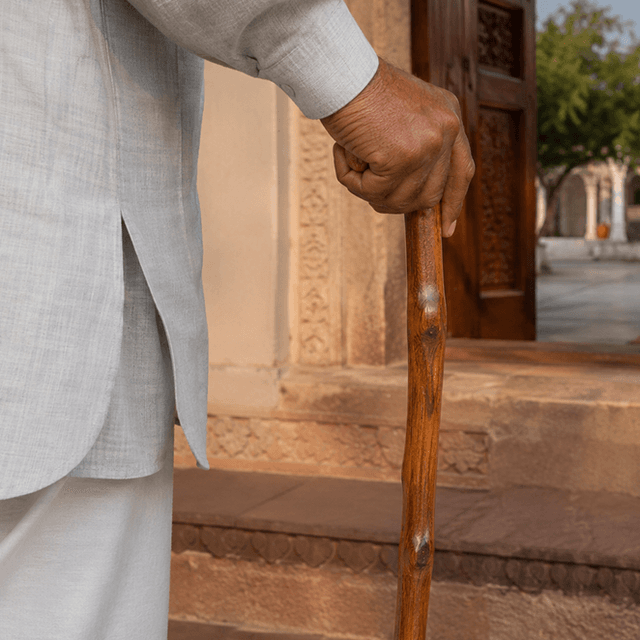
Older adults, particularly those in the late stages of life, often prefer traditional walking sticks made of wood. Many people view traditional walking sticks made of wood as more appealing than walking sticks made of aluminum and other materials.
Older adult males in Indian cultures prefer traditional stick walking sticks made with materials such as sheesham, bamboo, and other types of wood.
The truth about using traditional walking sticks made of wood is that:
- Traditional wooden walking sticks do not have height adjustment features. Once bought, the height of the stick is fixed.
- These are made of wood and are heavier than walking sticks made of aluminum.
- It can develop cracks, especially at the part of the stick that connects the main stick to the handle.
Overall, walking sticks made of wood do not allow for height adjustments and can pose other problems, such as cracking and potential increased weight. It is important to get the desired height correct to ensure optimal usage.
Important Features of Walking Sticks
In Indian medical supply stores, walking sticks often look the same, but some have different functions. Here is a quick list of the most important things to consider before you choose your next stick.
Quality of Grip and Type of Handle
The handle is the part of the stick that your parents will interact with the most. After a certain number of uses, you'll realize its importance.
T-bar shaped handles seem to be the most used in the Indian market. These handles distribute the weight evenly, as opposed to focusing it on the fingers. Which is very relevant for those who have hand arthritis or issues with grip.
Crook handles (which resemble a cane that has a curve at the top) are useful for ease of hanging the stick from a chair or counter; however, it isn't the best designed for optimal ergonomic sustained use for bearable weight. If your parent just needs basic stability support and not aesthetics, then either a T-bar or an ergonomic grip would work better.
What to look for: The grip should feel textured. A smooth hard plastic grip can get slippery when your hands are sweaty or damp which happens a lot, especially with humidity here in India. PVC or foam padding grips are softer and more comfortable for longer use. Also, they offer better relief than plastic grips from the vibrations traveling up through the floor and your wrists.
Height Adjustability
This is not optional. This is the single most important feature of any modern walking stick.
A stick that's the wrong height ruins everything. If it's too tall, you'll be forcing your arm up into an unnatural position and straining your shoulders while making the stick less capable of bearing more weight. If it's too short you'll have to stoop, putting extra pressure on your lower back while making you less balanced not more!
Set your stick to the right height. Standing upright in the shoes you wear indoors and keeping your arm hanging normally, the stick should be at the crease of your wrist. Most quality adjustable sticks use a push button mechanism to perform this adjustment: Press it, slide it to your desired marked position, then release until it clicks. This is a simple and precise mechanism.
The majority of adults fall within the 28 to 36 inch range. However, there is some individual variation, and the use of a non-adjustable stick is a genuine gamble. Spending a little extra to obtain adjustable height features will be worth your money.
Tip Design and Materials
The rubber ferrule located at the very bottom of the stick is the contact point with the floor, and it should be given more consideration.
For moderate everyday use on tile and marble flooring, a rubber tip that is solid and has a small dip at the bottom can provide some grip for the stick when the floor is dry. When the floors are wet, no rubber tip can be relied upon completely.
Here's a maintenance point: rubber should be checked regularly. Press your thumbnail onto the tip of the rubber. If the rubber is old, and it rests hard and does not provide some degree of flexibility, its traction has been quietly deteriorated. Therefore, the stick looks perfectly fine while providing only a small fraction of the grip expected. It is common to find worn out tips on sticks, and re-tipping can be done inexpensively. On sticks like the AGEasy quadripod, the tips are easily replaceable with standard size ones.
Weight of the Stick
Walking sticks are usually a part of an everyday routine. So, a stick that is heavier than the required weight will cause premature fatigue. This is even more true for senior citizens with some type of weakness in the shoulders or arms.
Aluminum is the ideal walking stick material because it is lighter than steel, is strong enough for everyday load bearing use, and is resistant to rust, unlike the damp, humid conditions found in Indian bathrooms and kitchens. Most good quality walking sticks made of aluminum weigh between 600 and 900 grams, depending on the design. A quad stick is bound to weigh more than a single tip design because of the wider base. However, in most cases, the increased stability is worth the weight trade off.
Load Capacity
Walking sticks are weight-bearing devices. This feature is often overlooked. The load capacity should always exceed the weight of the user by a significant margin. The AGEasy Four Leg Walking Stick has a load capacity of 136 KG, making it ideal for a wider selection of users. Load capacity is an important feature to consider as it can differ greatly between models.
Matching the Stick to the Situation
| Situation | Recommended Type | Key Feature to Prioritise |
|---|---|---|
| General unsteadiness, mild balance issues | Single-point or tripod | Ergonomic grip, correct height |
| Post-hip or knee surgery | Quadripod | Maximum base stability, load capacity |
| Arthritis in hands or wrists | Any type with cushioned T-bar grip | Handle material, grip texture |
| Slippery tile/marble floors at home | Quadripod | Four-point rubber tips, tip condition |
| Active outdoor use, travel | Foldable single-point | Portability, quick height adjustment |
| Fatigue or stamina concerns | Walk-and-rest design | Seat functionality, weight limit |
| Prefers traditional aesthetic | Wooden cane (fixed height) | Correct height, ferrule condition |
| Doctor/physio recommended quad cane | Quadripod | Compliance with clinical guidance |
Step-by-Step Guide to Getting the Right Height
This takes under five minutes. It really does make a difference. Make sure to do it right.
- The individual stands straight up in the shoes they wear indoors. Not barefoot, not in other shoes, just the ones they will use to walk.
- Arms are at their sides. Not raised, not stiff, just relaxed.
- Observe the position of the dominant wrist crease.
- For the adjustable stick, press the release button on the shaft, slide to the measurement you want, and press the button so it clicks into position.
- The individual holds the stick in a casual manner and does a normal walking motion. The elbow should be a tiny bit bent, about 15 to 20 degrees, when the stick is placed. If the arm is straight, the stick is too short. If the elbow is bent a lot, the stick is too long.
Finally, remember to check the height from time to time. Posture can change, especially the postural change due to aging, and a stick that was fitted properly a few months ago may need a revision.
Which Side to Hold the Walking Stick on?
Most people instinctively feel that they should grasp the stick on the side of the injury or the more painful leg. This is understandable. However, for what is termed "single-sided weakness," physiotherapists suggest a different approach: hold the stick in the hand opposite to the weaker or painful leg.
As the leg that is in pain moves forward, the weight shift will be countered by the stick, which will be planted and held opposite to the side of the pain. This will create a crossing or diagonal support system, which will allow the natural gait to be replicated. A more effective load shift will occur and the compensatory lean, which typically leads to lower back strain, will be minimized.
Such guidance generally applies to anyone with single leg weakness due to a stroke or surgery. For other situations, such as bilateral weakness and balance issues, the normal recommendation is for the dominant hand to be used. If there is any doubt on what to do, physicians should be consulted. They will be able to determine the weakness in the gait and provide more specific instructions to the individual. Rules and guidelines are limited.
Regarding Dignity
Accepting a walking aid isn't about being stubborn. It's about much heavier things. It's an acknowledgement that your body is changing. You're finally admitting to yourself and the world around you that you aren't able to do what you used to do without aid.
This mental burden is significant.
It isn't likely that a parent who isn't open to using mobility aid will appreciate the suggestion. In fact, it may only push the conversation further away from the topic. Instead, try making more positive, constructive comments: like "This will let you come to my wedding", "This will help you go to the temple again". In both of those cases, the mobility aids are viewed as freedom and opportunities, not inhibitions.
Someone with a walking stick is not old. Someone who holds the wall to cross a room is. This is the mentality we want to emulate.
Bottom line: Picking out the right mobility aid for your parents isn't just about picking out a tool. It's also about restoring their sense of independence and confidence.
Frequently Asked Questions
1. What distinguishes a tripod walking stick from a quadripod walking stick?
Both have a wider base of support than a single tip cane. A tripod has three contact points, and a quadripod has four support points. A quadripod is typically more stable and has the capability of standing unsupported on flat surfaces; this is helpful when someone needs to quickly free both hands. A quadripod is often the case when a physiotherapist has specifically stated that the patient needs to use a multi-point cane for rehabilitation or if the patient suffers from a serious balance deficit.
2. How can I tell if a walking stick is the right height?
The stick's handle should be level with the wrist crease when the arm is relaxed at the side, with shoes on, and the person is standing. When using the stick to walk, the elbow should be at a slight angle, which is about 15 to 20 degrees. A stick that is too tall will cause unnatural shoulder elevation, while one that is too short will cause slumping. Most decent walking sticks have the option for height adjustability, so this should be a quick fix.
3. When should I consider replacing the rubber tip?
Press a fingernail into the rubber tip; if the rubber feels hard and does not compress, the rubber has lost its elasticity and thus, much of its grip. Most users fail to realize that worn tips are a significant safety concern. They look fine, but worn rubber tips do not function properly. Quad sticks have four tips, so be sure to check all of them. Replacement tips are inexpensive and easily accessible; most quality walking sticks use standard sizes for tips.
4. What is the weight limit for walking sticks?
All walking sticks have load ratings which specify the maximum body weight that they are designed to support. Before buying any walking stick, make sure to compare the stick's load rating to the user's actual weight. Most quality aluminium quad sticks support up to 130 to 136 kg. The load ratings for walk-and-rest models are lower, around 80 kg, which should be verified before purchase. Support and structural integrity become unreliable when the rated load capacity is exceeded.
5. My dad refuses to use a walking stick. How should I approach this?
Although many resist the decision to use a stick, how to tackle this is about his identity and not about practicality. Pushing the issue directly usually has the opposite effect. It works better to steer the conversation towards what you'd like to be doing together such as family outings, temple visits, long walks, etc, rather than focusing on the mobility aid. Also, starting with a less formal stick (that he loves) can increase the chances that he'll use it. Sticks that people love are those that they find aesthetically pleasing, not clinical or medical-looking.
This article is intended for educational purposes and is not to be construed as providing medical or physiotherapy advice, or a substitute for such advice. If your parent has fallen, is in the post-operative phase of a surgical procedure, has a medical condition that affects his/her mobility or balance, please consult the parent's physician or physiotherapist prior to considering a mobility aid. Specifications and prices for products are current as of the date of publication and are subject to change.