

Types of Adult Diapers Explained: Pant Style, Tape Style, Pull-Ups, Pads and Bed Sheets: Which One Do You Need?
Article by: Aditya
Article Category: Adult Diapers & More
Aug 6, 2026


It's 2 AM, and your sheets are drenched (again). You chose your last product a mere hours ago after thoughtful consideration and even asked the pharmacist for some advice. You've been busy, and now you are changing the sheets in the dark for what feels like the millionth time.
Sheets are the least of your worries. The product you are experiencing problems with, doesn't have the issue with branding, you have the right brand, you just have the wrong type.
That's a big deal because the National Association for Continence (NAFC) reports that of the people experiencing incontinence, the majority are using the wrong type of product. Families usually go through 7 or more products without anyone explaining the fundamentals of this decision.
Several products, additional costs, skin rashes, all lead to the damage to the person you are trying to protect, all caused by frustration of moisture leaks.
The right answer is usually obvious once someone explains it properly. That's what this guide is for.
In this article, we breakdown what type of product you need, what are the most common wrong choices, the issues the wrong choice creates, and why you should never settle for the guess work of what you think you need. Finally, you will be eliminating your midnight pharmacy runs.
Before We Discuss Products: Why This Matters More Than You Think
The process of selecting an incontinence product is like the process of selecting a sponge. If your first choice leaks, just replace it.
The factor most people do not consider is the contact of moisture on the skin over time.
This contact of moisture is an inevitability with constant saturation of the product or poor fit of the product where the person ends up being positioned in a way where there is constant contact of the product with the skin. This can cause a lot of discomfort and will also aggravate a lot of other issues.
According to the peer-reviewed systematic literature, 35% to 47% of elderly patients with incontinence will develop incontinence-associated dermatitis (IAD). We want you to think about that for a moment. It's almost half of those patients. The skin will develop breakdown areas where trapped moisture contacts the skin. The development of IAD increases the chances of moisture-associated skin damage (MASD). Pressure ulcers become a concern for the elderly due to the pain they cause, the difficulty the pressure ulcers present for healing, and the stubbornness of the ulcers to heal. The incorrect product causes faster saturation.
When considering the appropriate type of incontinence product, both the clinical and the practical implications must be taken into account.
The body rarely gives a dramatic warning when skin breakdown begins. It starts as redness. Then irritation. Then something much harder to manage.
The 5 Types: What They Are and Who They're Actually For
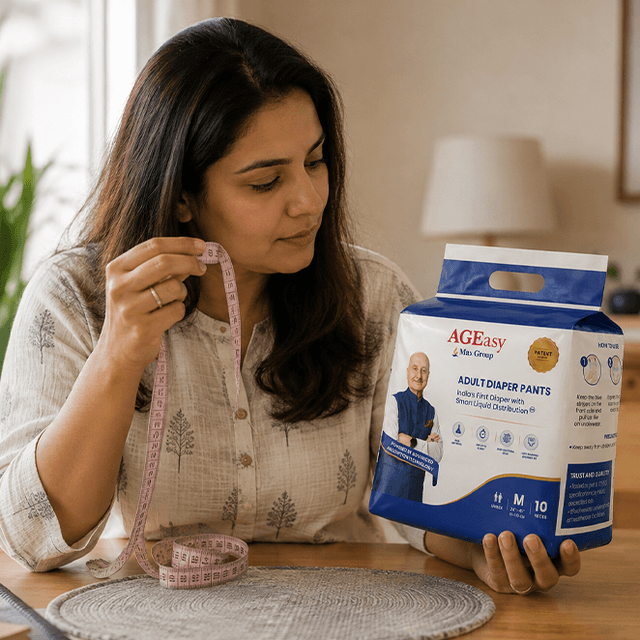
1. Pant-Style Pull-Up Diapers: For Active Seniors
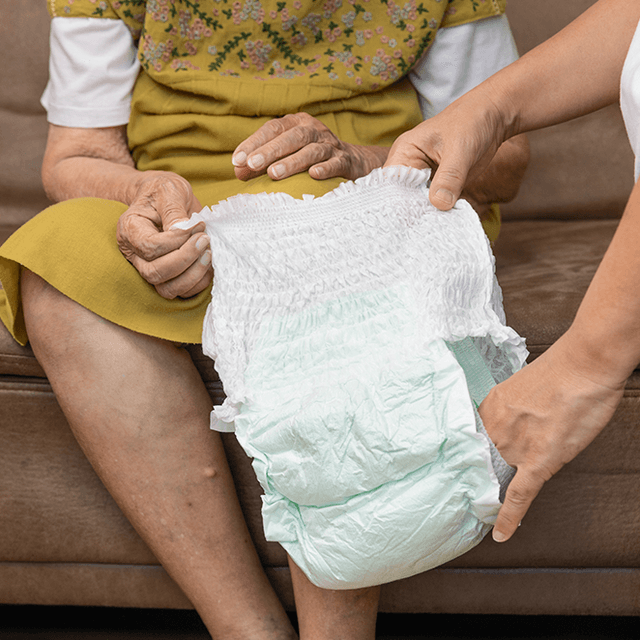
Picture a typical pair of underwear. Now, picture a pair of elastic underwear with a breathable outer shell and an absorbent core. That's a pull-up. And for seniors with mobility, it's brilliant.
Pull-ups are for seniors that can get to the restroom on their own, or with just a little help, as well as for those that want to maintain a level of dignity. With that in mind, pull-ups are for seniors with urge incontinence or even those that have a little bit of leakage during physical activities.
However, pull-ups are not to be worn when lying down. If a senior is bedridden and lies on their back, a pull-up can slide away from their back. It may create gaps on the sides with the superabsorbent core compressed at the center. Pull-up may leak on the bed, while the absorbent core stays compressed at the center.
Caregivers tend to blame the brand or themselves. They switch brands, and the problems continue. They keep doing this. The situation is almost never caused by the brand. There is always a configurational mismatch.
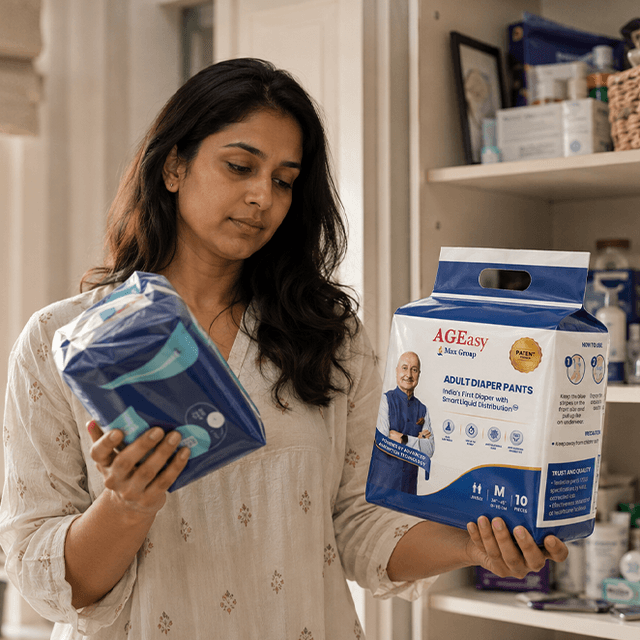
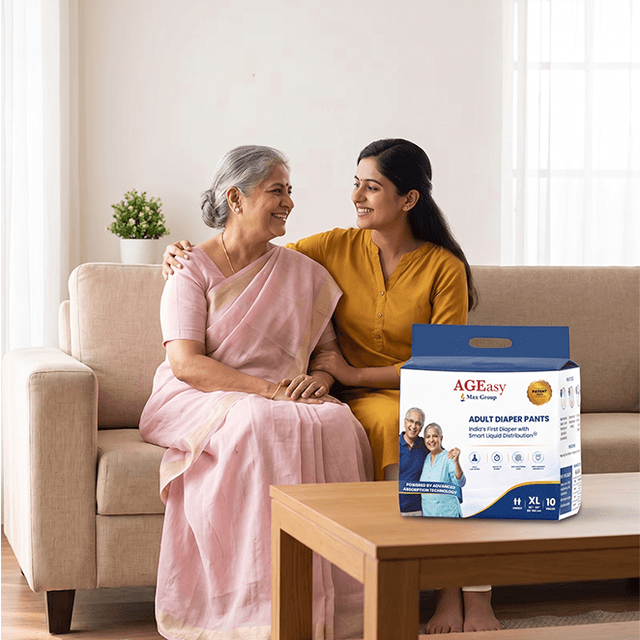
AGEasy offers 2 in this category -
- Regular Unisex Adult Diaper Pants Style,
- And another one with Smart Liquid Distribution technology.
Suitable for: Independent (active) seniors who can use a toilet with some assistance, and have light or moderate incontinence during the day.
Not suitable for: Seniors who are continuously bedridden, have heavy or dual incontinence, and cannot use it overnight without added protection.
2. Tape-Style / Tab Diapers: For bedridden adults and those needing assistance from a caregiver
These designs are what most people typically think of, when picturing adult diapers. The design consists of a brief, flat, with tabs (or closures), and is applied by a caregiver. This is by far the most important product type to distinguish.
While the pull-up is designed for the standing and walking population, tape-style diapers are designed completely for the horizontal population.
This style of diaper is placed flat under the individual and then the tabs are closed (or stuck) to the waist of the individual. Because this style is designed for a person who is lying down, there is no gap at the legs. While in the supine position, or lying on the side, the absorbent core is placed right at the position of leakage. Many of these diapers also have a wetness indicator strip, which informs caregivers of when a change is due, avoiding the unnecessary disturbance of a sleeping resident.
These diapers are specifically designed for the elderly who experience heavy incontinence. For those who experience both urinary and fecal incontinence, tape style diapers are the clinical standard. AGEasy offers Tape style Diapers that are suitable for this category.
Suitable for: Seniors who are bedbound, have had surgery, have a temporary disability, seniors who are fully incontinent, and situations where a full change is needed that must be done by a caregiver.
Not suitable for: Seniors who are fully active and mobile and who can use the toilet independently.
3. Pads, Liners, and Inserts: For Light Leakage Management
Incontinence pads and incontinence diapers should not be confused, and that distinction is important.
An incontinence pad is a mildly absorbent insert that is positioned within a pair of regular underwear or a pair of protective mesh pants to control light leakage. They are substantially cheaper and less bulky than a diaper. For people who suffer from very minor incontinence, they offer an opportunity to maintain a greater level of control in day-to-day activities. They offer more choices for daily activities when considering all available products.
The limitation is equally specific: a pad is leak tested and rated for light leakage only.
Incontinence pads cause skin issues for older adults by trapping moisture and causing dermatic problems. Older adults quickly saturate pads, causing localized irritation and dermatic issues to increase.
While they could help manage incontinence issues, their cost and non-medical appearance cause families to choose pads more frequently. Unfortunately, this causes more skin issues and increases the risk of infection. Pads, which are intended to help manage the skin issues caused by incontinence, are more harmful when used as a substitute for adult diapers.
Suitable for: For older adults that are active and only experience light incontinence from stress or urge incontinence. They can be used during the day when light incontinence demands discretion.
Not suitable for: For older adults that experience moderate to heavy incontinence, for use overnight, or for older adults that are bedbound.
4. Bed Sheets, Underpads, and Bed Protectors: A Second Layer, Not a Replacement
An underpad is a thin layer of material that is placed under a senior. It does not come into contact with skin in a meaningful way and protects the mattress without wicking moisture away.
Underpads provide multiple benefits when used correctly. In conjunction with diapers, they can help absorb and contain leaks that a saturated diaper can no longer hold. They provide protection for bedding and mattresses and help to expedite the clean up process for caregivers. They are especially beneficial and commonly used in palliative care and other long term care situations for those who are bed bound.
One important thing to note is that while the goal for families is to lessen the financial burden of care, for some, the transition to only using underpads, and no worn diapers at all, has actually backfired. While they hoped to avoid skin irritation and breakdown, they instead experienced unwanted and avoidable skin irritation/breakdown from prolonged contact with the underpad.
An underpad protects the mattress. Only a worn product protects the person.
Suitable for: Protection of mattresses, post surgical use, an under worn product use for bed bound seniors, and overnight use.
Not suitable for: Being the only option to replace a worn product.
5. Protective Absorbent Underwear: The Dignity Option
Protective absorbent underwear is like a hybrid between a pad and a pull-up. While still being functional, it looks a lot more like regular underwear than a pull-up. Protective absorbent underwear is made of softer materials, is more slim fitting, and is designed for when a Senior is being active, social, or just out in the community when regularness matters and this is the ideal solution.
Unlike regular pull-ups, these are designed for dignity and light to moderate leakage, not heavy incontinence. For seniors who have more than intermittent leakage, these are not the solution and a full pull-up or a tape style is recommended.
However, for the right person and in the right situation, this category addresses the invisible and psychological costs of incontinence such as social withdrawal, self isolation. These are documented costs and greatly affect a person's quality of life. With the proper products, people can be active participants in their own lives.
Suitable for: Dignity and discretion are a priority in social and active environments for Seniors who are mobile and have light to moderate leakage.
Not suitable for: Heavy incontinence, double incontinence, and for use by the bedridden.
The Decision: 2 Questions That Cut Through Everything
The whole decision process hinges on two questions, and in this order. If you correctly answer the first question, you will eliminate 5 options and narrow it down to 2 or 3.
Question 1: What is the senior's mobility? Can they get to the bathroom on their own? Can they assist themselves and walk on over with a little help? Or are they unable to do so at all?
Question 2: What is the severity of the incontinence? Is it a little or just a rare occurrence? Is it a moderate amount? Or, is it a complete saturation that is both urinary and bowel?
Use the 2 answers in the chart below to help you make the selection. The correct choice will be apparent.
| Senior's Profile | Right Product |
|---|---|
| Mobile, self-toileting, light leakage | Pad / liner or protective underwear |
| Mobile, self-toileting, moderate leakage | Pull-up / pant-style diaper |
| Mobile but needs some help, moderate to heavy | High-absorbency pull-up or tape style |
| Limited mobility, caregiver-assisted | Tape / tab style diaper |
| Bedridden, heavy or double incontinence | Tape / tab diaper plus underpad as backup layer |
| Overnight, any mobility level | High-absorbency tape or overnight pull-up plus underpad |
| Post-surgical / hospital discharge | Tape / tab style (easiest caregiver change) |
Whatever the product, use underpads as a second layer for overnight use. No product is designed for prolonged use, so a backup layer will maintain mattress integrity and protect the user's skin in the morning.
The Complete Picture: Product Selection Plus Skin Care
The primary preventative strategy for IAD deploys the following 3 components in conjunction:
- A product designed for an individual's specific level of mobility and incontinence whereby the product contains moisture and is positioned appropriately for the individual's needs.
- A prompt product change is made without waiting for the individual to complain of discomfort or for the product to reach the point of saturation. Discomfort is an indication of the prolonged and detrimental effect of moisture on the individual's skin.
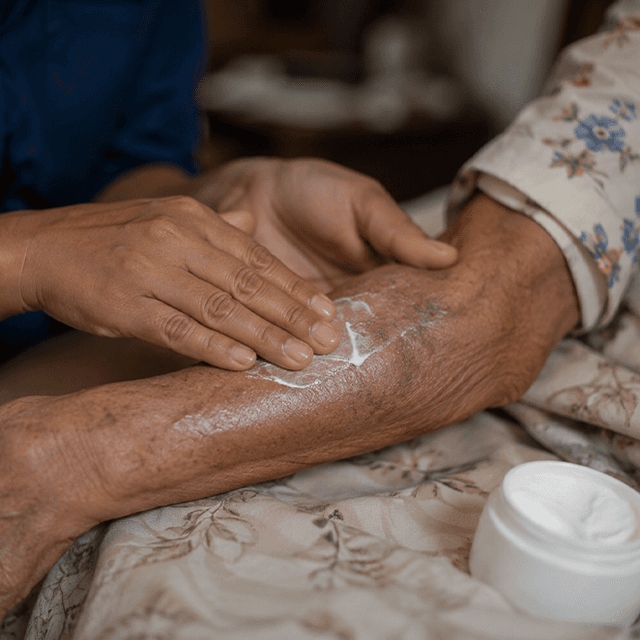
- A barrier cream is applied to the perineal and perianal areas to form a barrier between the skin and any moisture that may remain in the product after it is changed.
The 3 components work together. A barrier cream will not compensate for a product that requires a change every 2 hours. If all of the changes require that a bedridden individual be moved from a pull-up, then the likelihood of a timely change is very low. Furthermore, the most appropriate product is of little value if there are delays in changes due to caregiver exhaustion.
Within the 3 components, the most important product type can be selected first. This is the most important first step of the entire process.
A Note for Indian Families
In Indian families, even families that are managing incontinence together, find it extremely difficult to talk about the issue, and in some cases, it may never be discussed.
As in most cases, when no advice is available, people buy products that look least medical from the pharmacy, or assume what other families have bought from pharmacies for other purposes. This makes purchasing incontinence products very difficult.
This is the main reason for the 80% incorrect product statistic. It is not due to lack of information or will to do so, but the lack of space to have the conversation.
Naming the problem clearly is the first step toward solving it correctly. The fact that you're reading this is already that step.
The Real Question Is Simpler Than It Looks
When comparing the other pharmacy aisles, the Incontinence Aisle is frustrating. Competing products make conflicting claims, making it frustrating not to know what you're looking for.
At the very least, you have a more manageable problem than most caregivers who spend a couple of weeks shopping, trying to figure out what to buy. Other aisles may have a higher complexity, but when you learn to navigate the Incontinence Aisle, you'll soon find it is truly simple.
For each of the 5 mobility and severity types of products, the above Decision Matrix provides a lot of help. Of the 5 types, the one most clarifying, illuminating question is:
Can this person stand up, or do they spend most of their day lying down?
The answer to that one question eliminates 3 of the 5 types. The remaining 2 are differentiated by the severity of incontinence, and typically, that leaves one correct answer.
Around 80% of this population is using the wrong product. Broken sleep, burned-out caregivers, skin deterioration and complications, all of it is completely and 100% avoidable.
The most important decisions in caring for someone you love are not made in clinics or hospitals. They are made at home in the evening, from the pharmacy aisle at 7 PM, deciding what to buy. Now, you have everything necessary for the right decision.
Sources & References
- National Association For Continence (NAFC): nafc.org (80% wrong-products figure; 7+ product trials)
- Caregiver Action Network / National Family Caregiver Survey: 40% of caregivers assist with toileting
- MarketsandMarkets: Global Incontinence Care Products Market, 2025 ($13.99B to $20.85B, 7.1% CAGR)
- PMC Systematic Review: Incontinence-associated dermatitis prevalence in elderly incontinent patients (35 to 47%)