

"How to Choose the Right Adult Diaper Size (Adult Diaper Size Guide)"
Article by: Ayushi
Article Category: Adult Diapers & More
Aug 5, 2026


How to Get the Right Fit the First Time
Here's something most caregivers never hear.
When adult diapers leak (during the night, in the afternoon, on the walk back from the bathroom), most people think the same thing: the product isn't absorbing. Time to buy a better one. A thicker one. One that says it absorbs for 12 hours on the packaging.
And families continue to spend money. They try 3 brands, then 4. They switch every few months hoping to find something that works consistently.
What the research shows is quite the opposite.
Half the leaks in adult incontinence products are NOT because of poor absorbency. It leaks because the product is the wrong size.
And not just slightly. Wrong in ways that cause even high-quality products used correctly to fail every single time.
If you've been struggling with finding an adult diaper of right size for your loved ones, this article is for you. Understanding it changes everything about how you shop, how you size, and how you care for your loved one's skin.
This guide will cover all of it. It will show you how to measure, what each size band means for Indian brands, how a good fit should feel, how to recognize the signs of a wrong size before skin injuries happen, and why the instinct to size up when a product leaks is almost never the right thing to do.
Why Size Is the First Thing to Check, Not the Last
This is the first theory I will tackle that may seem counterintuitive.
When products leak, most assume the solution is to get a larger product. However, this logic doesn't take into consideration what is actually happening inside the product.
Let's begin by thinking of an adult diaper as a sealed chamber. To work properly, it needs to create a close, yet comfortable seal around the body. The gatekeepers to this properly sealed chamber are the leg openings and waistband.
When urine enters the product, it will trigger the absorption process. However, this will only happen if the liquid does not escape through the gaps created by the legs or is not forced out due to compression created by the waist.
Most products fail due to 2 common reasons. These issues are often on opposite ends of the spectrum.
When the Product Is Too Small: Compression Leaks
When a product is too small, the waistband and leg elastics are placed under constant tension and are pulled against the body. The material has been compressed. When the product receives liquid, instead of drawing it inward and locking it into the absorbent core, the compression pushes the material outward.
This results in wet clothing and a product that looks almost completely used on the inside. Although this may seem frustrating, what you are experiencing is nothing unusual. It is simply the laws of physics at work.
Some other signs of this type of leak include red pressure marks on the hips and inner thighs. Often, the person seems uncomfortable and is reluctant to move. The product will also require constant adjustment.
When the Product Is Too Large: Leg-Gap Leaks
Now consider the opposite scenario. If the product is too large, and the openings for the legs sag, instead of being sealed around the inner thigh, they create a gap. A gap wide enough for urine to escape during movement before the absorbent material has even begun to work.
Leg openings that are too loose create the biggest problem when it comes to leaks in adult diapers, and for families shopping for adult diapers, this is easy to overlook. The product may feel comfortable, and may even be mostly dry after a leak. Families assume they need a product with greater absorbency. What do they do? They buy a more expensive product that is the same size, and the leaks continue.
Now it may sound strange, but here is where it all begins to make sense.
When the leak is caused by leg openings being too loose, moving to a bigger size will make it worse. A bigger product will create even bigger gaps at the legs. In these circumstances, the instinct to size up is completely wrong. The answer is to size down, or change to a more fitted product for the same size, rather than size up.
The Sizing Paradox Worth Remembering
If leaks occur mainly during movement or walking, and not when the person is sitting or lying still, the cause is almost certainly a leg-opening fit problem, not inadequate absorbency.
Moving to a bigger size will increase leg-gap leaks.
The correct response is to size down, re-measure, or adjust the fit of the current product.
How to Measure Correctly (And the Mistake Almost Everyone Makes)
The most common measurement mistake is measuring the waist alone.
While it might seem obvious, when it comes to adult briefs and tab-style diapers, the definitive sizing measurement is the largest circumference between waist and hip. For many older adults, especially women, that is the hip, not the waist. Measuring only the waist results in a product that sits at the waist but gaps at the hips, which, as we have just discussed, is the exact condition that causes leaks.
So here's what you need to do (officially) to get it right:
What You Will Need
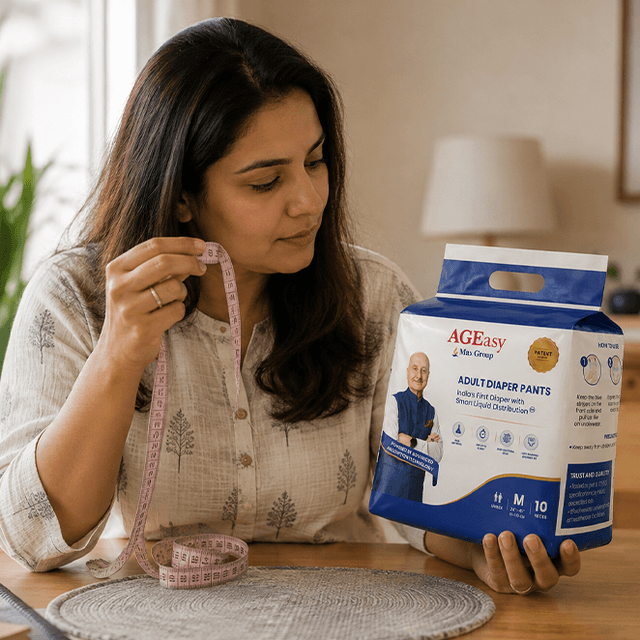
- Soft measuring tape (the type used in tailoring; not a builder's steel tape)
- Centre measurements as all major Indian incontinence brands use this standard
- A moment when the individual is standing upright, if there is no mobility, the measurements may be taken lying down. Add roughly 2 cm out of conservatism.
Step-by-Step Measurement Guide
Step 1. Measure the waist where it is natural, around the middle between the hip bone and the navel.
Step 2. Measure the hips at their maximum width, usually around 20 cm under the waist.
Step 3. For tab-style briefs: use the larger measurement of the two. That number is what you size against.
Step 4. For pull-up or pant-style products: use the larger measurement of waist and hip. The elasticated waistband has to stretch over the hips when it is worn, so the hip measurement takes precedence.
Step 5. Compare your measurements to the size chart of the specific brand, not a generalized S/M/L size chart. This part is more important than most people think. See brand note below.
What Should a Correct Fit Feel Like?
A well-fitted product should feel comfortable and snug. It shouldn't leave red marks on your skin when you take it off. It should not bunch at the legs, pinch when walking or sitting.
The finger test is something worth knowing. Run one finger lightly under the elastic around each leg opening. The elastic should meet your finger with gentle resistance. If it grips too strongly, you may not be able to comfortably fit a finger at all. If you can slide your finger freely without any resistance, then the leg seal is too loose.
Specifically For Tab Style Briefs: The adhesive tabs should stick at your abdomen, about halfway between your hip bone and navel. If the tabs just barely reach the middle of your abdomen, or if they overlap in the middle, the product is too small. Go up a size.
The Fit Check: Three Questions
1. Are there indentations or red marks on your skin when the product is removed? The product is too small.
2. Is the area around your thighs bunching and sagging? The product is too big.
3. Do you notice leaks only when you move, not when you're standing still? You need a smaller size or need to adjust the fit.
Adult Diaper Size Guide: S to XXXL for Indian Caregivers
To put it simply, there is no global or national standard when it comes to adult diaper sizing. For example, a Medium from one brand can fit like a Large from another. Even pull-ups and tabs from the same brand, with the same labeled size, often fit differently.
The below table shows the general sizing structure for the Indian incontinence-care market, with brands like Nobel Hygiene (Friends), Dryfeel, Kare In, Tena, and Confidence. Always check the specific product's size chart to confirm a measurement before purchasing.
| Size | Waist/Hip (approx.) | Typical User Profile | Indian Brand Availability Note |
|---|---|---|---|
| S | 56–80 cm | Smaller frame, lighter body weight, post-surgical recovery | Friends, Dryfeel, Tena, Confidence. Verify brand chart. |
| M | 70–100 cm | Average adult frame, most commonly purchased size | Friends, Dryfeel, Kare In, Tena, Confidence. Verify brand chart. |
| L | 85–120 cm | Larger frame, higher body weight, bariatric start range | Friends, Dryfeel, Kare In, Tena, Confidence. Verify brand chart. |
| XL | 100–135 cm | Bariatric range, higher mobility needs, wider hip profile | Friends, Dryfeel, Kare In, Tena. Verify brand chart. |
| XXL | 115–150 cm | Bariatric, limited mobility, bed-level care | Friends, Dryfeel. Verify brand chart. Not all brands offer. |
| XXXL | 130–170 cm | Bariatric / bedbound, full caregiver-assisted changes | Friends. Verify brand chart. Limited availability. |
Note: Waist and hip measurements listed above are only approximations. They change depending on the type of product and the specific brand and product line. Always take measurements and check the brand's size guide before buying.
Why the Same Size Label Means Different Things Across Brands
This is the part that trips even the most seasoned caregivers up. And to be frank, it should be confusing. But here we are.
When it comes to clothing, inconsistent sizing is annoying. When it comes to adult incontinence products, the size variation is more pronounced and the risks of getting it wrong are far greater than a shirt that doesn't fit.
There are three factors driving the inconsistency.
Product Type Changes Everything
For pull-up and pant-style products, the waistband is completely elastic and must slide over the hips in order to be worn. The waistband stretches over the hips and then contracts at the waist and thus, pull-ups are sized primarily against hip circumference.
In contrast, a tab-style brief is put on flat and then wrapped around the body and secured with adhesive tabs. The tabs allow for some adjustability which makes this style of brief a little more generous across a range of measurements. However, the elastic that surrounds each leg opening still needs to be considered.
Same measurement. Same size label. Different product types. Different fit. This is not a complaint on brand quality. This is how these two designs work.
Stretch and Material Composition
Elastic compositions differ amongst brands within the leg cuffs and waistbands. Items that state they are flexible or stretch-fit will fit a broader range of measurements within that size. Items that are more structured with fixed cuffs will be more restrictive at the edges of the given size band.
If a person sits close to the upper limit of a size band, they will likely achieve a better seal compared to those who sit at the middle or bottom limit of a size band. This is because there is more room for the product to move and adjust to the body without spanning the compression area.
How to Avoid the Frustrations of Brand Changes
- Always begin with the individual's current measurements. Do not consider their previous purchase as a guide. Bodies are subject to change due to illness, surgery, or fluctuations in weight.
- Examine each product line carefully, because even within the same brand there is variation.
- When a measurement is borderline between two size bands, think about the product type. When it comes to pull-up products, opt for the larger size. In the case of tab-style briefs, the tabs facilitate adjustability, so the smaller size is likely to work better.
- When changing brands for the first time, it's a fresh start. Measure again and check the fit of the product as if starting from the beginning.
Fit Is More Than a Comfort Issue — It Is a Skin Safety Problem
This is the section that changes the conversation.
When discussing adult diaper sizing, leakage concerns, laundry, and the anxiety of managing accidents overnight come to mind, and those concerns are valid. However, there are clinical reasons pertaining to correct fit that are equally important to understand, and caregivers should have access to this information.
Older adult skin differs from younger skin. Older skin is thinner, drier, and less elastic. Since older skin takes longer to heal, it's more vulnerable to moisture, friction, and pressure injuries. Poorly fitting incontinence products, and products that are changed too infrequently, make managing incontinence more difficult, and injured skin is the result.
What Prolonged Moisture Does to Skin: Incontinence-Associated Dermatitis
Prolonged contact with urine or feces causes what is called incontinence-associated dermatitis (IAD). Skin exposed to IAD becomes inflamed, and the genital area, buttocks, inner thighs, and lower back can suffer from erosions and redness that is accompanied by disturbance of the skin's surface (maceration).
The best way to understand skin IAD is to imagine skin is like a brick wall. The outer layer of skin (the stratum corneum) is a brick and the other layers are the mortar. Moisture dissolves the mortar and the brick protective barrier is lost. The underlying layers can then become infected and sustain further breakdown, even with minor pressure or friction.
A systematic review looking at IAD prevalence found that 35-48 within every 100 incontinent elderly patients will develop IAD. In acute hospital care settings, about 20% of incontinent patients show signs of IAD. These outcomes are common, and largely preventable.
The Connection To Pressure Injuries (Bed Sores)
IAD on its own is a significant concern. However, the research offers further risks that caregivers of bedbound or mobility-impaired family members need to be aware of.
Skin that has been weakened by moisture is far more likely to develop a pressure injury. A meta-analysis of 58 studies found the odds of developing a pressure ulcer nearly doubled with urinary incontinence. That is to say, in otherwise similar conditions, incontinent patients are roughly twice as likely to sustain a pressure injury compared to continent patients. The pooled odds ratio was 1.92.
Patients with double incontinence (both urinary and faecal) are nearly five times more likely to develop a pressure injury.
That is a significant risk increase, meaning that something as manageable as adequate fit and timely changes, is directly related to one of the most serious preventable complications in elder care.
The Skin-Safety Chain: How Wrong Fit Raises Risk
Wrong fit increases risk due to:
- Increased frequency of leaks
- Prolonged skin moisture
- Increased risk of IAD (skin breakdown)
IAD coupled with pressure injuries = bed sores.
Correct fit and timely changes are the most important primary preventive actions.
These problems are all part of the same continuum.
Two Well-Intentioned Habits That Raise Skin Risk
Two caregiving shortcuts, while well-intentioned, deserve honest mention here as both stem from a caring place and both often backfire.
Double-layering products. Some caregivers place two products over a brief, be it two briefs or a brief over a pad, hoping to extend protection overnight or during long intervals between changes. This does not add absorbency. Rather, it traps warm, moist air against the skin for extended periods, raising the temperature around the skin and creating an environment that promotes bacterial growth. This increases the risk of urinary tract infections, incontinence-associated dermatitis (IAD), and pressure injuries. If overnight protection is needed, the correct answer is a product designed specifically for overnight use, in the appropriate size.
Sizing up to reduce tightness. When a product is leaving behind red marks, the inclination is to buy the next size up. This is sometimes warranted and the product is indeed too small. However, a larger size with loose leg openings will not only fail to address the skin issue, it will add frequent leaks to the equation. The better first step is the fit check described above: use the finger test and check the tab placement. In most cases, proper fit adjustment resolves most of these situations without needing a size change at all.
Our detailed guide to preventing bed sores is a comprehensive guide to reducing the risk of pressure injuries for family members who are bedbound or have limited mobility.
Overnight Leaks: Understanding the Importance of Sizing
When it comes to the best care for an individual managing incontinence, nighttime management is the most challenging. When nighttime management fails, it can lead to sleepless nights for caregivers, and require exhausting 2 a.m. sheet changes.
Several things happen that are out of the control of both the user and caregivers during sleep that can negatively affect the performance of the product. The body is in a horizontal position which alters how urine collects in the product and is absorbed by the product. Due to the lack of movement during sleep, there is a greater chance for a cohort to experience leaks and voids as opposed to movement active management.
Inadequate nighttime products can potentially lead to leaks that have little to do with the absorbent capacity of the product. The most common leaks occur due to side sleeping position which can create added weight and pressure to the leg seals on that side. If products are too loose on one side, the leg seals can break.
Tab-style briefs can be tightened to achieve a better fit and seal on the side that the user sleeps on. In contrast, pull-ups are not adjustable and need to fit perfectly.
Even sizing down slightly, within the comfort range, reduces overnight leaks more effectively than changing to a more absorbent product. For example, if the hip measures 96 cm, both M and L are within range. However, M may cause fewer leaks than L which may be preferred for daytime comfort.
For guidance on selecting products specifically for nighttime use, see our guide to overnight adult diapers.
How To Know You Have The Wrong Size: Signs To Watch
Unlike other issues, sizing problems do not have a flashy announcement. They tend to develop gradually. An occasional leak here or there. Redness appears and is brushed off as something else. The product seeming mostly fine until it isn't.
The signs below are the warning signs to catch before they become a pattern.
Signs the Product Is Too Small
- Red marks on hips, inner thighs, or lower abdomen after use.
- Discomfort, tightness, or chafing.
- Tabs fastened at or beyond the center of the abdomen.
- Inside of the product is dry or only slightly wet, so leaks have occurred.
- Movement was restricted, or there was a reluctance to walk, stand, or sit.
Signs the Product is Too Big
- Leaks occur mostly in a standing position, not in a sitting or lying position, and only with movement, which indicates the product is too large.
- If the product noticeably sags or gathers at the groin or inner thigh area.
- Leg elastics that sit flat against the skin and not slide or gap.
- After a leak, a significant portion of the product remains unused inside.
- If the person can pull the product away from their body without having to unfasten the tabs.
Signs that the Fit Needs Adjusting
- The product leaks at night, and the tabs have not been repositioned.
- Leaks occur on one side only. The tab or elastic on that side may be positioned too low.
- A gain or loss in weight. New measurements should be obtained.
- A different brand or type of product within a familiar brand. New measurements should be taken.
Tab-Style Briefs vs Pull-Up Pants: What is Best for Your Situation?
This is a very common question, and the answer is, "It depends." Specifically, it depends on: the level of mobility of the person in question, who is doing the changes, and how much adjustment is needed for the fit. There is no absolute better option here. However, each option has specific scenarios where it works better.
When Tab-Style Briefs Work Better
- The user has limited mobility, and cannot stand easily for product changes.
- Specific adjustments to fit are necessary, for example, in managing asymmetric body shapes, or specific patterns of leakage.
- The most fit changes are done by the caregiver.
- Overnight management, where ensuring fit precision is more important than ease of use.
When Pull-Up Pants Work Better
- The user has enough mobility to stand and manage their own product changes.
- The user appreciates the discretion and familiarity of underwear-like products.
- Daytime use in social or active situations where ease of use is a priority.
- Measurements are situated at the centre of a size range rather than at the overlap between two sizes.
One practical consideration when measuring for pull-ups is that the product must be able to slide over the hips. If you have a wide margin between hip and waist measurements with the hip being the larger, only use the hip measurement for sizing. This is also true if you are at the edge of a size range. Start with the larger size and evaluate the leg and waist seals after the first use.
The Real Problem Is Not the Product
Families who are migrating from brand to brand, spending more money on laundry and watching skin issues develop problems that are not product-related. They are related to a sizing issue that was never diagnosed correctly.
The existing body of work states that half of all leaks that occur with adult incontinence products are due to fit issues. Complications of the skin that develop into pressure injuries can often be avoided. The body's warnings (such as red marks, leaks when moving, material that sags, and skin that breaks down in certain places) are easy to read once you know how.
Finding a better product is not the real problem.
The real issue is understanding that fit is the foundation everything else relies on.
Take time to measure. Consult the sizing chart for that specific brand. Use the finger test and tab positioning to determine fit. Most importantly, when the measurements span two sizes, comfort, mobility, and the typical leak pattern of the individual should dictate the decision, not the number on the chart.
The most critical decisions about care do not happen in clinics.
They happen quietly at home with a family member who is observing closely.
Sources and Evidence Base
This article draws on the following published sources:
- Beeckman, D. et al. (2014). Relationship between incontinence-associated dermatitis and pressure ulcers in patients with urinary/fecal incontinence: A systematic review. Research in Nursing and Health.
- Incontinence-associated dermatitis prevalence systematic review protocol (2024). PMC / National Library of Medicine.
- IAD prevalence in incontinent elderly hospital patients (Brazilian cohort study, n=138). Published via DOAJ.
- Skin breakdown mechanisms in incontinence-associated dermatitis (2025 review). PubMed.
- Fit and leakage in adult incontinence products. Because Market / incontinence-care industry documentation.
- Double-diapering risks and leg-opening gap leaks. Tranquility Products product care guidance.
- Fit guidance, finger test, and tab placement best practices. NorthShore Care Supply; Parentgiving; Aeroflow Urology.
- India adult diaper market size data: IMARC Group (India Elderly Care Market, supplementary reference; verify before publication). India incontinence prevalence: LASI Wave 1 data; Kochi community prevalence study (women 60+).
- Brand sizing reference: Nobel Hygiene (Friends), Dryfeel, Kare In, Tena, Confidence. Individual brand size charts (verify against current published charts at time of use).