





Yoga for Healthy Ageing Is the IDY 2026 Theme: What That Actually Means for Seniors' Balance and Fall Risk
Article by: Admin
Jun 12, 2026. 49 min read
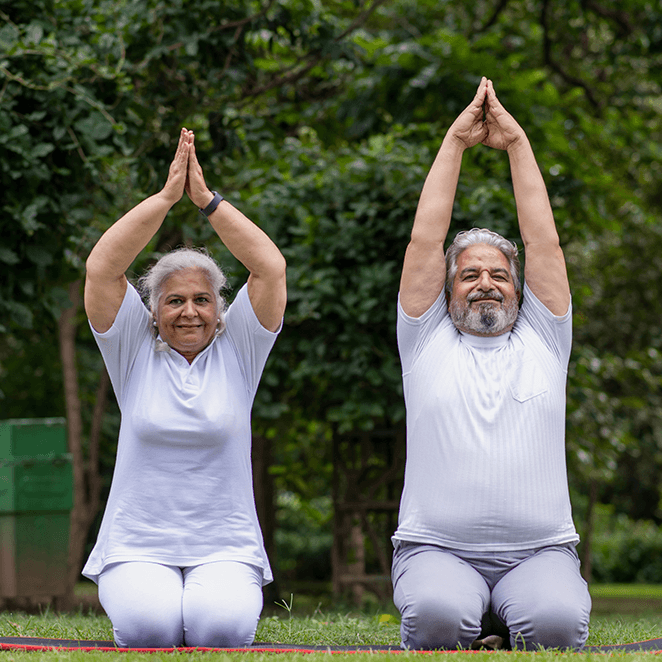
Have you ever noticed your parents getting out of a chair?
Not the obvious things that come with age, but the small details. Hands reaching for the armrests, subtle pause before standing, or a little touch of the wall for support before standing.
Most of us see these moments and simply label them as they are getting old.
What we rarely realize is that these tiny movements can reveal something much bigger. Long before a serious fall occurs, the body often sends quiet signals that balance, posture, and stability are beginning to change. The process is so gradual that families hardly notice it happening.
It is called postural erosion - the slow weakening of the body's ability to sense its position, maintain balance, and respond quickly enough to prevent a fall. It doesn't happen overnight. It unfolds silently over years, until one day what seemed like a minor habit suddenly looks like a warning sign.
And that's exactly why this year's theme for the 12th International Day of Yoga on June 21, 2026 is “Yoga for Healthy Ageing”. This deserves far more attention than a slogan on a banner. Behind those 4 words lies a growing body of evidence showing that something as simple as regular yoga practice may help older adults preserve balance, improve posture, reduce fall risk, and maintain independence for longer.
The science behind it is more practical and actionable than most people think. Let's take a closer look.
Why This Year's Theme Actually Matters
The International Day of Yoga is celebrated annually on June 21, 2026. The event was initiated by India at the United Nations in 2014 and now has 177 supporter nations. This is the 12th annual celebration.
The Ministry of Ayush presented the "Yoga for Healthy Ageing" theme on May 13, 2026, at the Yoga Mahotsav 2026 in Khajuraho, and began a 25-day countdown to the date. The main event will be hosted this year in Kolkata, West Bengal. Union Ayush Minister Prataprao Jadhav, centered the entire event around a single thought, which is worth pondering.
“It is not lifespan, it is healthspan.”
Healthspan, here, refers to the years lived in a healthy state. That distinction hits differently when you're a family thinking about your parents.
For many families, the biggest concern when thinking of their parent's old age is whether they will be able to age gracefully - active and healthy. Will Dad be able to walk to the corner store on his own? Will Mum be able to wander freely through the house?
The global population of individuals above the age of 60 is expected to double by the year 2050, and India is right at the center of this change. This situation is specifically addressing this year's yoga theme, with genuine evidence to support it.
The goal is not simply a longer life.
The goal is more years in which a person can move freely, think clearly,
and live without depending entirely on others.
What the Research Actually Shows (And What It Doesn't)
So, let's do this the right way.
What the science firmly, consistently supports: the practice of yoga improves balance and physical mobility among the older adults.
Researchers analyzed 6 randomized controlled trials and found that yoga was associated with a statistically significant improvement in balance, and a medium effect, which is described in terms of a real-world change, in physical mobility, in their sample of 307 individuals aged 60 and above. These changes represent, in a real-world sense, a change from an unsteady and a cautious approach to a steady and confident approach. These findings were published in Age and Aging.
Another randomized controlled trial that was conducted in a care home in Nagpur, India, for 12 weeks, found that the yoga group made significant improvements in balance and functional mobility, and the control group actually detoriated over the same time period. The absence of yoga practice was a deteriorating condition. The systems that are responsible for maintaining a body in an upright position require continual practice and movement, and the absence of practice and movement creates a space for deterioration.
A further study reported that a sample of 128 elderly individuals with osteoarthritis practiced yoga 3 times a week for 12 weeks, and the risk of falling among the practice group, compared to the control group, improved by nearly 6 points as measured by the Berg Balance Scale, which is a clinically significant improvement. There was also an improvement in the Timed-Up-and-Go score, and there was a decrease in the reported incidence of falls.
Yoga combines balance, core and upper-body strength, and breathing regulation within a single practice. Most forms of exercise don’t address breathing, let alone the fear of falling. We will discuss the fear of falling, as it is an important piece of the puzzle.
The Fear of Falling
The ‘fear of falling’ is a rather cruel loop which gets far too little attention.
Between 35 and 55 percent of adults over 65 are afraid of falling. That is in fact a large portion of the older adult population, and is an understandable fear. Not only are falls one of the leading causes of serious injuries in older age, but the loss of falling one’s independence also occurs. Additionally, it is reported that in a given year, one in three adults over 65 will fall.
When older adults become fearful of falling, the opposite of the intention occurs. Walking becomes shorter and less frequent, stairs are avoided, and more time is spent indoors. Even less conscious habits of walking become altered, as older adults begin gripping onto support like walls and furniture. Eventually, being less active weakens the systems that support and strengthen balance and movement. The less frequent movement leads to an increased likelihood of falling, which in turn makes the fear of falling grow stronger, and movement reduce more.
Ultimately, this creates a closed cycle which gradually decreases one’s mobility.
Studies show the fear of falling in older adults decreases with regular yoga practice. While strengthening the body plays a large role, much of the benefit comes from the yoga participant’s understanding of their body. In doing yoga, participants learn to trust their body enough to walk to the letterbox, and trust their body to maintain balance on the way there.
This confident attitude can really be the deciding factor in an older adult still actively living their life and an older adult who has conformed to a still life, even if no one has really noticed the change in the older yoga practicing adult.
But Let's Be Honest About What Yoga Doesn't Prove
There is substantial research supporting the idea that yoga improves balance, increases mobility, and decreases the fear of falling. The research becomes a bit murky about yoga and the direct prevention of falls.
What I cited from the Oxford meta-analysis noted that more research should be conducted before a balanced summary can be made. A large study—the SAGE trial, published in The Lancet Healthy Longevity, 2025— assessed Iyengar yoga among people aged 60 and older. Yoga helped balance and mobility, and the study found no clear evidence of a decrease in fall rate compared to an active control group.
This is by no means a criticism of yoga, and this should not be an excuse to disengage with yoga.
Yoga, of course, strengthens balance and core. And, along with yoga, strengthens reaction time, body awareness, and decreases fear of movement. Yoga, of course, provides the groundwork to decrease falls; however, there are many other factors. Falls can be caused by many things, such as poor lighting, wet floors, dangerous rugs, ill-fitting shoes, and medication.
Yoga can maintain what is happening on the inside. Safe environments and aid, of course, provide what is happening on the outside. They are the same issue and provide what is needed on different levels.
Yoga builds the foundations of fall resistance.
Home safety and mobility support protect against the falls that still happen.
These are not alternatives. They are partners.
How Much Yoga, and What Kind? (The Practical Bit)
The next question that families pose is completely reasonable: is this actually realistic? For someone who hasn't exercised for years, for someone that has joint pain, and for someone that lives in a flat where there is no yoga studio?
The answer is: this is more realistic than most people think.
The clinical studies that showed real and measurable progress for older people incorporated as little as 2-3 sessions per week, for 8-12 weeks. Other studies showed positive progress for people who did 10 minutes of yoga at home. The important factor isn't the intensity. It's the regularity.
Chair yoga and wall yoga
The benefits of balance-building yoga are encouraged in older adults by offering seated variations, or using chairs or walls as support for standing postures. With this variation, the risk of losing balance is removed. This is not a beginner's shortcut or a ‘lesser’ form of yoga. It is, quite literally, what the evidence supports. The proprioceptive training is there. The practice is there. The training is there. The confidence is there. It builds.
Breath Work
The regulated breath work of yoga is incorporated in the Common Yoga Protocol, and traditional yoga. For older adults, the benefits of guided breath work include decreased anxiety, and improved sleep quality, and for the fear-inactivity cycle, a calm interruption of the cycle is supported. Guided breath work can be offered without a single yoga asana.
Slow and Steady
For older adults, particularly those with osteoporosis or eye conditions such as glaucoma, yoga asanas that include deep forward bends or that are inverted should be approached with special consideration. This does not mean to avoid yoga, but to have the practice be slowly and steadily offered with the use of props. The practice is meant for frequent attendance, not for achieving a specific asana along the way.
Before You Start: The Sensible Word
If your parent hasn't exercised regularly in a while, or has a history of falls, or has osteoarthritis, osteoporosis and hypertension, or is on polypharmacy, please have a quick conversation with their doctor before starting. This is good sense, like checking the road before crossing.
A yoga instructor that builds a customized program for an older adult that includes adaptations to postures and use of props is a great resource. The Ministry of Ayush has made yoga access even easier through the new Yoga Sangam Portal and Yoga Park Portal, which was developed around IDY 2026.
The Common Yoga Protocol was created for the beginner, which is the target of the IDY events around the globe. This also happens to be a great starting place for the older adult who is new to yoga.
What Your Family Can Do This June
International Day of Yoga is going to be celebrated on 21 June 2026. However, the festivities shall begin from 14 June 2026 when a national Guinness World Record yoga attempt is scheduled. These are not just events on the calendar; they provide conversation opportunities.
Combine yoga and a safety evaluation of the home. Yoga motivates from within. Grab bars, better lighting, non-slip mats, and adequate walking support are all external motivators and are very important.
Think in terms of weeks, not sessions. The studies with the most meaningful and significant results lasted 8 to 12 weeks. The benefits of yoga are cumulative; one class does not prove or disprove anything, but a consistent month of yoga may speak volumes.
The Bigger Picture
India submitted a resolution for an International Day of Yoga to the United Nations more than a decade ago. 11 years later, one of the most quietly pressing challenges for families in this country is captured in the theme for 2026. This challenge is how to keep our loved ones moving, independent and fearless, through the advancing years.
For a long time, the intuitively understood concepts of yoga have been divorced from scientific thought. The practice of yoga helps strengthen both the physical sense of your balance and your mobility. But there is no measurable change in the sense of balance, and the quiet confidence a person carries about their body is something yoga helps to strengthen.
In older people, injuries caused by falling and the fear of falling, create disabilities and the opposite of independence – a life that is largely lived in fear of falling. These are very big challenges to face. Yoga is one of the many tools which is safe, gentle and easily accessible.
The theme of Yoga for Healthy Ageing is a scientifically backed invitation to the families who read this. But, as the saying goes “the hardest part is the first step”. The science gives us the "why" and the rest is up to us.
Recommended Blogs
You May Also Like
 No products found
Article by:
Admin
Article Category:
General Wellness